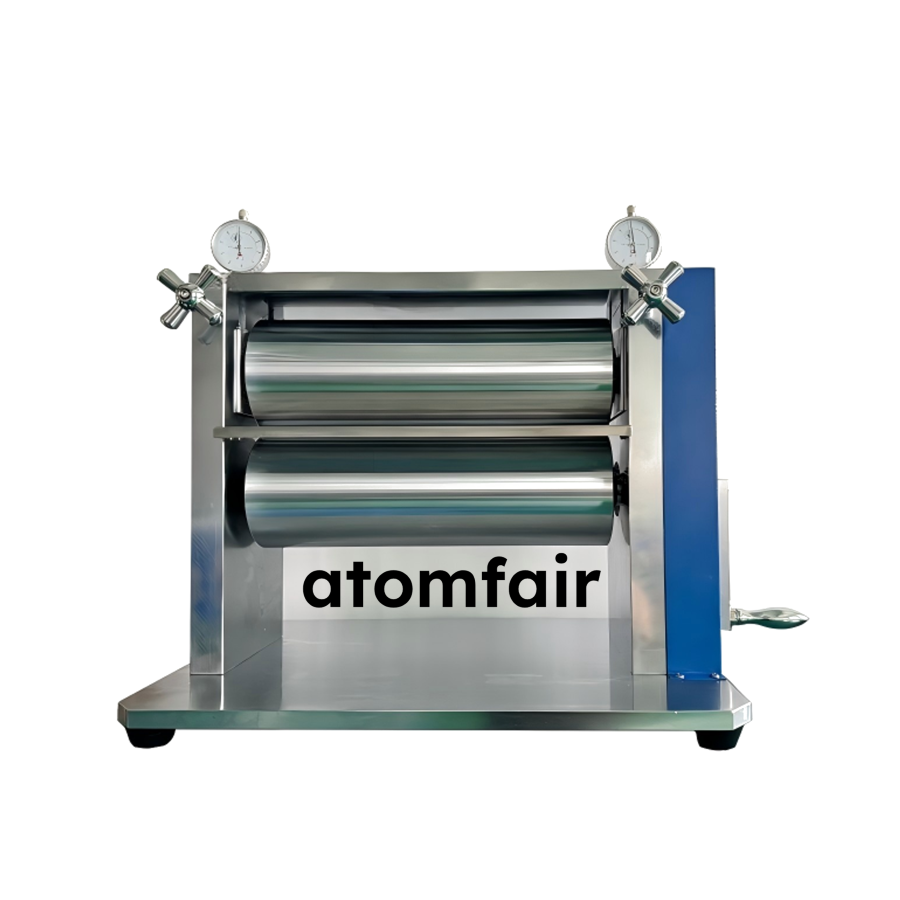
ATOMFAIR® ATOMFAIR-MTR7083 MANUAL TWIN ROLL MILLRESEARCH GRADE MATERIAL
|
|||||||||||||||||||||||||||||||||
|
|||||||||||||||||||||||||||||||||
|
TAILORED SOLUTIONS FOR RESEARCH
Contact our engineering team for technical support or official quotations.
EMAIL: inquiry@atomfair.com
|
|||||||||||||||||||||||||||||||||
|
Manufacturer: Atomfair LLC
Brand: ATOMFAIR®
|
This twin roll mill is designed for precise rolling of battery electrodes and soft metal foils. Maintaining roll surface integrity and alignment is critical to achieving consistent thickness and avoiding material defects.
- Material Hardness Limit: Do not roll materials with hardness exceeding HRC62 to prevent damaging the chrome-plated roll surface.
- Operational Stability: Operate the mill on a rigid, vibration-free surface to preserve roll cylindricity and ensure uniform pressure distribution.
- Roll Surface Cleanliness: Keep roll surfaces free of debris and residual material to avoid scratching the finish and compromising rolling accuracy.
This manual twin roll mill uses vertical roll placement and an inclined block for precise gap adjustment. Follow the steps below to safely and effectively roll battery electrode plates or similar thin materials.
- Inspect Rolls
Inspect the roll surfaces for any debris, residue, or damage before starting each rolling session. - Adjust Roll Gap
Adjust the rolling gap using the inclined block to the desired thickness within the 0–2 mm range. - Feed Material
Insert the material strip vertically between the rolls at the feed side, ensuring alignment with the roll width. - Activate Rolling
Turn the handwheel clockwise to engage the gear drive and draw the material through the roll nip. - Verify Thickness
Verify the rolled thickness with a micrometer and repeat the process if further reduction is needed. - Clean Rolls
Clean the roll surfaces with a soft, lint-free cloth after each use to maintain surface finish and precision.
What is the trade-off between roll hardness and surface finish for the Atomfair-MTR7083 manual twin roll mill?
Higher roll hardness (>HRC62) improves wear resistance and maintains roll profile over extended use, but the roll finish specification of Ra ≤0.4 μm ensures consistent pressing quality. This balance allows the mill to achieve high rolling accuracy with cylindricity ≤±2 μm while resisting deformation during manual operation.
Can the Atomfair-MTR7083 twin roll mill be used for rolling non-lithium battery materials such as precious metals or ceramics?
Yes, the mill is explicitly designed for manual rolling of small quantities of precious metal materials (e.g., gold, silver) and non-ferrous materials (e.g., copper, aluminum) in laboratories. It is especially ideal for thinning and densifying lithium battery plates, but its adjustable rolling thickness (0–2 mm) and width (0–100 mm) make it suitable for other strip materials as well.
What are the physical installation requirements for operating the Atomfair-MTR7083 manual twin roll mill in a laboratory?
The mill requires a stable workbench capable of supporting its weight (45 kg) and accommodating its overall dimensions of L385 mm × W245 mm × H355 mm. Its vertical roll placement and manual operation eliminate the need for electrical or hydraulic infrastructure, but feeding strip materials requires clear vertical space above the rolls.
The Atomfair-MTR7083 Manual Twin Roll Mill delivers high-hardness chrome rolls (HRC62) and ≤±2μm cylindricity for precise lab-scale densification and thinning of lithium battery plates, though manual operation demands skilled consistency and the 100mm rolling width restricts larger electrode strips.
Positive
- High-hardness chrome rolls with rust resistance: Roll surface hardness exceeds HRC62 with hard chrome plating, providing durability and corrosion resistance for repeated use with battery materials.
- High rolling accuracy for uniform thickness: Roll cylindricity ≤±2μm ensures consistent gap and thickness control critical for electrode densification and thinning in lithium battery processing.
Trade-offs
- Manual operation requires skilled consistency: Manual feed and gap adjustment rely on operator technique, introducing variability in rolling force and thickness repeatability compared to motorized systems.
- Limited rolling width for larger samples: Maximum rolling width of 100mm constrains the size of electrode strips or foils that can be processed, requiring narrow sample preparation.
Every advanced material, component, equipment, and instrument in our catalog is backed by rigorous testing. We maintain strict internal quality management frameworks and align with CE conformity metrics to deliver transparent, reproducible performance data via our public open-science repository.
To request raw batch performance data, submit formal vendor registration paperwork, or execute a fast-turnaround R&D manufacturing loop, contact us at inquiry@atomfair.com.
Item is dispatched under the Atomfair Shipping & Delivery Framework (Free worldwide shipping on orders over $59 USD excl. heavy equipment). Return is governed by the Atomfair Return & Refund Policy (7-day technical return window).