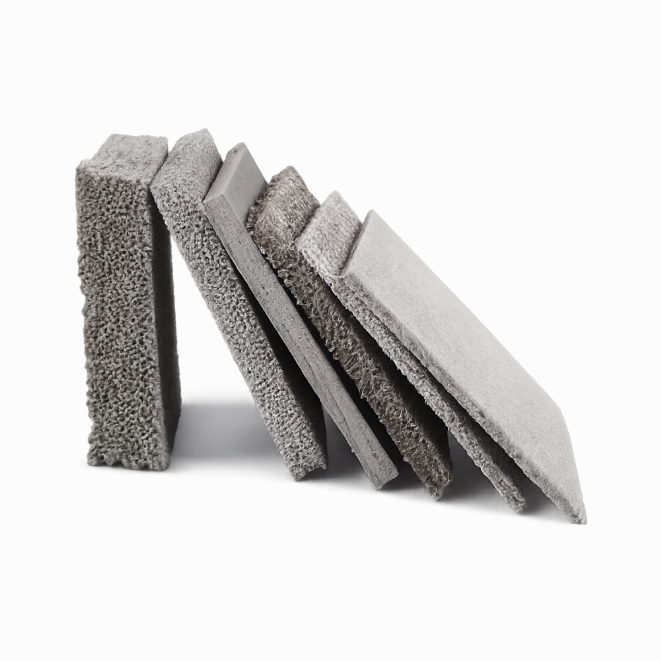
Specialty Metal Foams
Specialty metal foams are functional porous metal materials with interconnected three-dimensional structures. They combine the electrical conductivity, thermal conductivity, temperature resistance, and mechanical support of metals with the high surface area, permeability, lightweight structure, and loading capability of porous materials.
This category covers specialty metal foams and porous metal materials such as cobalt foam, iron foam, stainless steel foam, refractory metal foam, corrosion-resistant metal foam, modified metal foam, alloy foam, and customizable porous metal substrates. These materials are commonly selected for research, filtration, catalysis, electrochemistry, thermal management, acoustic control, and functional structural applications.
Customers can choose products by metal system, pore structure, sheet or plate format, thickness, size, surface condition, and intended operating environment.
Show More
Select by Metal System
| Material Type | Main Characteristics | Typical Application Directions |
|---|---|---|
| Cobalt Foam | High surface area, good conductivity, suitable for catalytic and electrochemical systems. | Electrode substrates, fuel cells, water electrolysis, catalyst supports, functional composite materials. |
| Iron Foam | Stable structure and good processability for functional structures and porous media. | Filtration media, battery research, damping materials, lightweight structures, magnetic functional materials. |
| Stainless Steel Foam | Corrosion resistance, practical strength, and compatibility with demanding media. | Gas and liquid filtration, flow distribution, chemical filtration, environmental purification, durable porous components. |
| Refractory Metal Foam | Suitable for high-temperature, vacuum, special atmosphere, or harsh operating conditions. | High-temperature supports, thermal field materials, catalyst carriers, vacuum equipment materials, advanced manufacturing research. |
| Corrosion-Resistant Metal Foam | Designed for porous metal use in acid, alkali, salt spray, or electrochemical environments. | Electrochemical reactors, corrosive media filtration, chemical experiments, special-condition porous components. |
| Coated or Composite Metal Foam | Surface coating, oxidation, plating, or composite modification can support specific functions. | Catalysis, conductivity enhancement, surface activation, oxidation resistance, interface modification research. |
Select by Pore Structure and Form
Specialty metal foams can be selected by pore size, PPI, porosity, open-cell ratio, thickness, density, and external dimensions. Coarser pore structures are often preferred for fast gas or liquid flow, low flow resistance, thermal transfer, and fluid distribution. Finer pore structures are typically used for filtration, active material loading, larger contact area, or more uniform reaction interfaces.
Common product forms include foam sheets, foam plates, discs, blocks, strips, custom-cut parts, and porous metal components. Thin sheets are convenient for cutting, stacking, pressing, and laboratory assembly, while thicker plates or blocks are suitable for structural support, flow channels, sound absorption, damping, and durable filtration components.
Main Application Areas
In electrochemical and energy research, specialty metal foams can be used as electrode current collectors, catalyst supports, reaction-interface enhancement materials, or porous conductive frameworks for batteries, supercapacitors, fuel cells, water electrolysis, metal-air batteries, and electrocatalysis studies.
In filtration and fluid treatment, porous metal materials can support gas filtration, liquid filtration, particle retention, flow distribution, gas-liquid dispersion, and cleanable filtration assemblies. Important selection factors include filtration precision, flow rate, pressure conditions, media compatibility, and whether the material needs to be cleaned or reused.
In thermal management, acoustic control, and functional structures, metal foams can provide heat-transfer enhancement, thermal support, sound absorption, vibration damping, electromagnetic shielding, lightweight structure, and composite-material reinforcement. Performance depends on the metal system, pore structure, thickness, installation method, and working environment.
Key Selection Factors
When choosing specialty metal foam, customers should first define the application purpose, then match the material and structure. For electrode or catalyst use, conductivity, surface area, surface condition, chemical stability, and coating compatibility are important. For filtration, pore size, filtration precision, flow rate, pressure resistance, temperature resistance, and cleanability should be considered. For structural or thermal use, thickness, density, strength, thermal conductivity, assembly method, and long-term stability are key factors.
For custom specifications, it is helpful to provide the required metal type, purity, pore size or PPI, porosity, thickness, dimensions, shape, working temperature, contact medium, operating pressure, and target application. For research projects, product selection can also be matched to test fixture size, flow-channel design, electrode area, or sample assembly method.
FAQ
Who uses specialty metal foams?
They are used by customers working in batteries, fuel cells, electrocatalysis, filtration, chemical processing, thermal management, acoustic materials, functional composites, and advanced manufacturing.
How should I choose the right metal foam material?
Start with the working environment and the required function. Electrochemical use often requires conductivity and corrosion resistance; filtration use focuses on pore size, flow rate, and pressure conditions; high-temperature use requires suitable thermal stability; structural use depends on thickness, strength, and processability.
What is the difference between PPI, pore size, and porosity?
PPI means pores per inch and describes how fine or coarse the foam structure is. Pore size refers to the actual opening size, while porosity describes the volume percentage of voids inside the material. These parameters should be considered together.
Can metal foam be cut or processed?
Many metal foam sheets and plates can be cut, stamped, bent, welded, or machined depending on the metal type, thickness, and pore structure. For precision dimensions or custom shapes, drawings are recommended.
Can metal foam be used for filtration?
Yes. Coarse-pore foam can be used for flow distribution, pre-filtration, or support layers, while finer porous metal structures are more suitable for particle retention and precision filtration. Media compatibility, temperature, pressure, and cleaning method should also be confirmed.
Can metal foam be used as an electrode substrate?
Yes. Open-cell metal foam provides a large effective surface area and connected pore channels, making it suitable for active-material loading, electrolyte contact, and three-dimensional electrode structures. Final selection depends on electrolyte compatibility, working potential, coating process, and target reaction system.
Should I choose a thin sheet or a thick plate?
Thin sheets are suitable for experimental electrodes, layered assemblies, cutting, and small sample tests. Thick plates are better for filtration support, flow channels, structural parts, heat-transfer components, and applications requiring stronger mechanical stability.
Can pore size, dimensions, or surface treatment be customized?
Specialty metal foams can often be customized by pore size, PPI, thickness, dimensions, shape, purity, surface condition, and packaging method. Providing the target application and key operating parameters helps match the right material more efficiently.
Showing the single result