
In-Situ & Operando Battery Test Cells
In-Situ & Operando Battery Test Cells are specialized research cells designed to monitor electrodes, electrolytes, interfaces, structural changes, and failure mechanisms while a battery is assembled, charged, discharged, or undergoing an electrochemical reaction.
Compared with standard electrochemical test cells, in-situ and operando cells may include optical windows, X-ray transmission paths, pressure-control systems, temperature-control features, gas ports, fluid channels, or microscope-compatible structures. These interfaces allow researchers to connect Raman, FTIR, UV-Vis, XRD, X-ray imaging, microscopy, gas-analysis, and other characterization systems.
This category is intended for lithium-ion, sodium-ion, solid-state, lithium-metal, lithium-sulfur, zinc-air, flow-battery, aqueous, and other advanced electrochemical energy-storage research. Select the appropriate cell according to the characterization method, electrode configuration, sample format, pressure, temperature, atmosphere, electrolyte, and instrument interface required for your experiment.
Show More: Selecting the Right In-Situ & Operando Battery Test Cell
Understanding In-Situ and Operando Testing
In-situ testing keeps the sample inside an assembled battery or controlled test environment while measurements are performed. This reduces the influence of disassembly, sample transfer, and reassembly.
Operando testing refers to characterization performed while the battery is actively operating, such as during charging, discharging, cycling, gas evolution, pressure change, or another electrochemical process. A standard battery cell is not automatically an operando cell. The cell must provide the required optical, X-ray, gas, pressure, temperature, fluid, or microscope interface for the selected measurement method.
Choose by Characterization Method
| Characterization Method | Recommended Cell Features | Typical Research Focus |
|---|---|---|
| Raman Spectroscopy | Optical window, suitable working distance, stable optical path | Phase transitions, chemical bonding, electrode and interface reactions |
| FTIR / UV-Vis | Spectroscopy-compatible window and controlled optical path | Electrolyte species, reaction products, redox behavior |
| XRD / X-ray Scattering | X-ray transmission path, low-background construction, correct geometry | Crystal structure, lattice changes, phase transitions, strain |
| X-ray Imaging / CT | X-ray-transparent structure and imaging-compatible mounting | Dendrites, pores, cracks, swelling, internal structure |
| Optical Microscopy | Transparent window, microscope clearance, stable focus distance | Dendrite growth, deposition, stripping, bubbles, surface morphology |
| Gas Analysis | Gas-tight chamber, inlet/outlet ports, pressure-rated connections | Gas generation, gas consumption, pressure variation, air reactions |
| Pressure / Temperature | Pressure adjustment, temperature control, sensor interface | Solid-state contact, swelling, impedance, thermal response |
Cell Configurations and Research Uses
| Cell Configuration | Suitable Applications | Important Specifications |
|---|---|---|
| Two-Electrode Cells | Routine cycling, material screening, electrolyte evaluation, full-cell testing | Electrode area, current path, electrolyte volume, sealing |
| Three-Electrode Cells | Half-cell studies, reference-potential measurements, interface analysis | Working, counter and reference electrode position |
| Optical-Window Cells | Raman, FTIR, UV-Vis and microscopy | Window material, optical axis, working distance, sealing |
| X-ray-Compatible Cells | XRD, X-ray imaging, CT and synchrotron research | Transmission, background, beam path, mounting geometry |
| Pressure-Controlled Cells | Solid-state, lithium-metal and electrode-swelling studies | Pressure range, adjustment, stability, insulation |
| Gas / Flow-Through Cells | Air batteries, gas reactions, liquid circulation and flow batteries | Port size, flow path, leak tightness, pressure rating |
| Pouch / Prismatic Fixtures | Larger-format cells, swelling studies and practical battery evaluation | Cell dimensions, clamping pressure, tabs, thermal interface |
Battery Chemistry and Application Coverage
| Battery System | Relevant Cell Functions | Main Selection Concern |
|---|---|---|
| Lithium-Ion | Raman, XRD, X-ray, three-electrode and temperature-controlled testing | Electrode geometry and instrument compatibility |
| Sodium-Ion | Two-electrode, three-electrode and optical-window testing | Electrolyte and wetted-material compatibility |
| Lithium-Metal | Dendrite observation, pressure control, gas monitoring | Pressure, sealing and optical access |
| Solid-State | Pressure-controlled, insulated and three-electrode cells | Stack pressure and solid-electrolyte dimensions |
| Lithium-Sulfur | Optical observation, gas monitoring and electrolyte studies | Chemical compatibility and gas management |
| Air / Zinc-Air | Air-interface, gas-flow and transparent cells | Gas flow, humidity and electrode exposure |
| Flow Batteries | Flow-through, circulation and optical observation | Flow path, sealing and active area |
| Aqueous and Emerging Systems | Transparent, corrosion-compatible, customized and multi-interface cells | Wetted materials, atmosphere and operating conditions |
Environmental and Control Options
| Control Requirement | Features to Confirm | Common Applications |
|---|---|---|
| Temperature Control | Operating range, sensor location, heating/cooling interface, seal temperature rating | Thermal response, kinetics, impedance and phase-transition studies |
| Pressure Control | Pressure range, adjustment method, monitoring, stability and insulation | Solid-state, lithium-metal and swelling research |
| Gas Handling | Gas ports, flow rate, leak tightness, pressure rating and analyzer connection | Air batteries, gas evolution and gas-consumption studies |
| Fluid Circulation | Inlet/outlet arrangement, tubing size, flow path and active area | Flow batteries, electrolyte circulation and mass transport |
| Controlled Atmosphere | Glovebox handling, inert gas compatibility, sealing and transfer conditions | Moisture-sensitive, air-sensitive and reactive battery chemistries |
Specifications to Confirm Before Ordering
| Specification | Buyer Checklist |
|---|---|
| Sample Format | Electrode diameter, pellet size, separator size, pouch dimensions or active area |
| Electrode Structure | Two-electrode, three-electrode, reference-electrode or air-electrode arrangement |
| Instrument Compatibility | Raman, FTIR, UV-Vis, XRD, microscope, potentiostat, gas analyzer or external stage |
| Wetted Materials | Cell body, window, seals, insulators and electrolyte compatibility |
| Operating Conditions | Temperature, pressure, flow rate, atmosphere, humidity and operating limits |
| Maintenance | Replaceable windows, seals, gaskets, fittings, tubing and cleaning requirements |
Quick Selection Guide
| Research Requirement | Recommended Direction |
|---|---|
| Observe chemical or structural changes during cycling | Raman, FTIR, UV-Vis or XRD-compatible cell |
| Measure working-electrode potential | Three-electrode cell with suitable reference-electrode positioning |
| Test solid electrolyte or solid-state batteries | Pressure-controlled cell with electrical insulation |
| Observe lithium dendrites or electrode morphology | Optical-window, microscope-compatible or X-ray imaging cell |
| Measure gas generation or pressure changes | Gas-tight cell with pressure-rated ports or sensor interface |
| Study air or flow-battery reactions | Air-interface or flow-through cell with controlled fluid paths |
Frequently Asked Questions
How do I choose the correct in-situ battery test cell?
Start with the characterization method and instrument interface. Then confirm the electrode structure, sample dimensions, electrolyte compatibility, sealing, pressure, temperature, atmosphere and required ports or windows.
Can a standard battery test cell be used for operando characterization?
Only if it provides the required interface for the selected method. Raman, XRD, microscopy, gas analysis, pressure and temperature measurements require different cell designs.
Should I choose a two-electrode or three-electrode cell?
Choose a two-electrode cell for routine cycling, material screening and overall battery evaluation. Choose a three-electrode cell when working-electrode potential or reference-electrode measurements are required.
Can an XRD cell also be used for Raman testing?
Not necessarily. XRD and Raman cells require different transmission paths, background control and instrument geometries. Confirm compatibility with the exact instrument before ordering.
Why do solid-state batteries require pressure-controlled cells?
Stable pressure helps maintain contact between the solid electrolyte and electrodes. The required pressure depends on the electrolyte type, electrode design, sample dimensions and test conditions.
Are the instruments included with the test cell?
Normally, the product includes the specified cell hardware and accessories only. Raman, XRD, microscopy, potentiostat, gas-analysis, temperature-control and pressure-control systems are generally separate unless stated otherwise.
Can these cells be assembled inside a glovebox?
Many research cells are suitable for glovebox assembly. Confirm the cell dimensions, sealing method, fittings, handling space and transfer requirements for air-sensitive or moisture-sensitive chemistries.
Can special windows, ports, dimensions or electrode configurations be customized?
Some configurations may be customized. Provide the test method, instrument model, sample dimensions, electrode configuration, electrolyte, temperature, pressure, atmosphere and required interfaces when requesting a custom solution.
Technical Support
For special optical paths, X-ray geometries, electrode sizes, gas interfaces, pressure systems, temperature control, fluid channels or multi-technique configurations, confirm the complete test conditions before purchase. The correct cell should be matched to the entire research workflow, not only to the battery chemistry.
Showing all 7 results
-
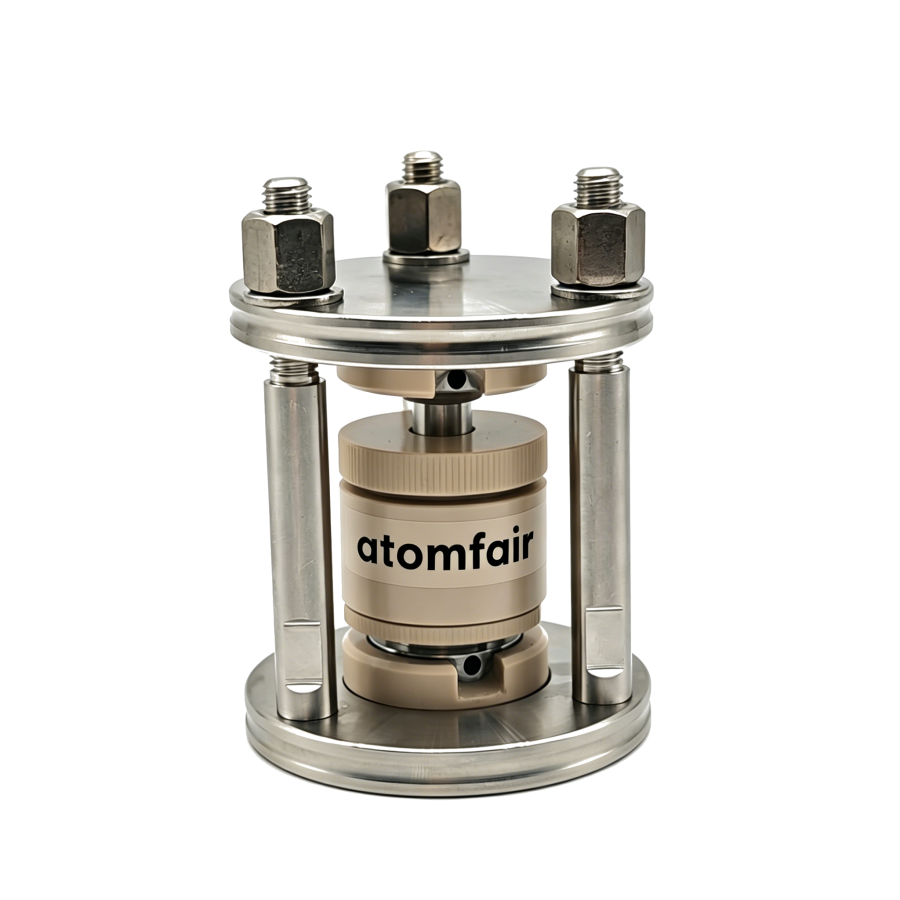
In-Situ Raman Cell & PEEK Mold Kit Ø70×94mm ATOMFAIR®
$800.00 -

Pure Titanium Swagelok 2-Electrode Cell 10–20mm ATOMFAIR®
Price range: $129.95 through $149.95 -

Swagelok High-Purity Mo Three-Electrode Cell ATOMFAIR®
Price range: $159.95 through $199.95 -

Swagelok Pure Titanium 3-Electrode Cell 10–20mm ATOMFAIR®
Price range: $129.95 through $149.95 -

Swagelok Three-Electrode Testing Cell TC4/304SS 10–20mm
Price range: $100.00 through $125.00 -

Swagelok Two-Electrode Cell 10–20mm High-Purity Mo ATOMFAIR®
Price range: $139.95 through $159.95 -

Swagelok Two-Electrode Testing Cell 10–20mm ATOMFAIR®
Price range: $129.95 through $149.95