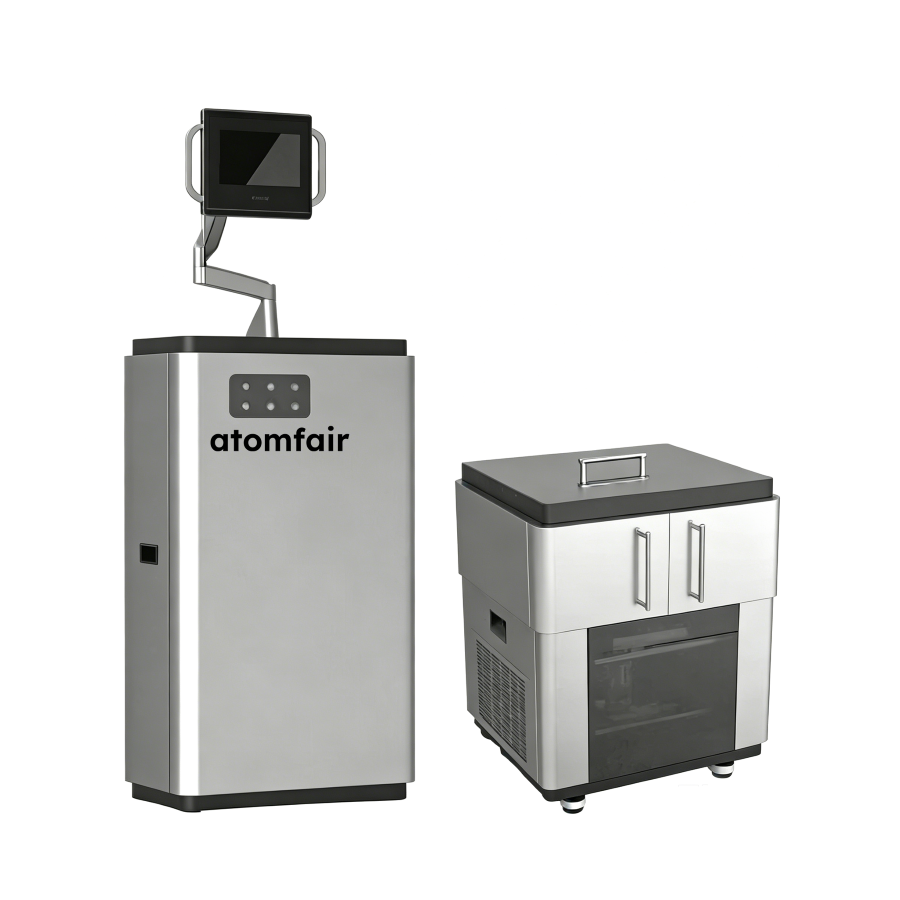
ATOMFAIR® AF-FE300ML FIBRILLATION SYSTEMRESEARCH GRADE MATERIAL
|
|||||||||||||||||||||||||||||||||||||
|
|||||||||||||||||||||||||||||||||||||
Operate the equipment on a stable, vibration-dampened surface with adequate clearance around cooling vents to prevent overheating. Connect only to a properly grounded electrical outlet rated for the 1.5 kW continuous power draw.
- Electrical Grounding: Ensure the power cord is connected to a grounded outlet matching the equipment's 1.5 kW rating to avoid electrical hazards.
- Thermal Management: Maintain at least 10 cm clearance around all ventilation openings to allow sufficient airflow during extended operation.
- Containment Integrity: Keep the stirring tank lid securely fastened while the rotor is in motion to prevent material ejection or splashing.
- Environmental Conditions: Place the unit in a dry, well-ventilated area away from flammable solvents, corrosive vapors, and excessive dust.
- Mechanical Stability: Position the device on a level, non-slip surface to minimize vibration and ensure stable operation during high-speed fibrillation.
This procedure outlines the safe initialization and operation of the 300 mL stirred tank fibrillation system. Follow these steps to process fibrous materials under controlled temperature and speed conditions.
Required Equipment: Atomfair AF-FE300mL Fibrillation System
- Inspect the Stirring Tank
Inspect the stirring tank interior to confirm it is clean, dry, and free of debris before loading the sample material. - Load the Sample
Transfer 70 to 210 mL of the material to be fibrillated into the tank, staying within the recommended feeding range. - Set Temperature Parameters
Set the desired process temperature on the digital controller and wait for the system to reach the setpoint within ±10°C. - Secure the Lid and Start
Close and latch the tank lid securely, then enable the stirring drive via the main power switch to begin fibrillation. - Monitor the Process
Monitor the temperature and run time throughout the cycle, adjusting parameters only after pausing the rotor if necessary. - Stop and Cool Down
Stop the stirring motor and allow the tank contents to cool to a safe handling temperature before opening the lid. - Retrieve the Product
Transfer the fibrillated material from the tank into a suitable storage container using a clean spatula or scoop.
Does the ±10°C temperature control precision of the AF-FE300mL limit its use for fibrillation of temperature-critical advanced materials?
The AF-FE300mL offers temperature control within ±10°C, which provides stable process conditions for many materials. For advanced materials requiring tighter thermal regulation, such as certain battery electrode slurries or heat-sensitive polymers, this precision may introduce variability in fibrillation efficiency and reproducibility. Researchers should validate their specific material's sensitivity against the system's stated ±10°C window to determine suitability.
What are the constraints of the 70–210 mL recommended feeding range for the AF-FE300mL?
The recommended feeding range of 70–210 mL (approximately 23–70% of the 300 mL tank capacity) ensures proper material coverage and efficient fibrillation dynamics. Operating below 70 mL may lead to insufficient contact with the rotor-stator, reducing fibrillation effectiveness, while exceeding 210 mL risks overflow or diminished linear speed performance. Adhering to this range is required to maintain the maximum linear speed of 55 m/s for consistent results.
What electrical and cooling infrastructure is needed to operate the 1.5 kW AF-FE300mL in a standard laboratory?
The AF-FE300L requires a 1.5 kW electrical supply and has an integrated 800 W cooling capacity to manage heat during operation. No external cooling water or chiller is specified as mandatory, but adequate ventilation around the 315×335×575 mm benchtop footprint is recommended to support the cooling system. Standard lab power outlets (e.g., 220 V, 10–15 A depending on regional standards) are typically sufficient to meet the 1.5 kW power demand.
The AF-FE300mL offers a compact, integrated solution for lab-scale fibrillation with a 300 mL tank and 55 m/s maximum linear speed. However, its ±10°C temperature precision and restricted feeding range impose constraints for high-accuracy thermal processes and full-volume utilization.
Positive
- Compact Design for Rapid Experimentation: The 300 mL tank enables quick setup and small-batch trials, ideal for iterative R&D and process optimization without requiring large material volumes.
- High Functional Integration: Integrates stirring, fibrillation, and temperature control in a single modular unit, simplifying workflows and reducing the need for separate instruments.
Trade-offs
- Wide Temperature Control Tolerance: The ±10°C precision may be insufficient for processes requiring tight thermal regulation, potentially affecting reproducibility in sensitive fibrillations.
- Limited Effective Working Volume: Recommended feeding range of 70–210 mL means only 23-70% of the 300 mL tank volume is usable, reducing batch capacity per run.
Every advanced material, component, equipment, and instrument in our catalog is backed by rigorous testing. We maintain strict internal quality management frameworks and align with CE conformity metrics to deliver transparent, reproducible performance data via our public open-science repository.
To request raw batch performance data, submit formal vendor registration paperwork, or execute a fast-turnaround R&D manufacturing loop, contact us at inquiry@atomfair.com.
Item is dispatched under the Atomfair Shipping & Delivery Framework (Free worldwide shipping on orders over $59 USD excl. heavy equipment). Return is governed by the Atomfair Return & Refund Policy (7-day technical return window).