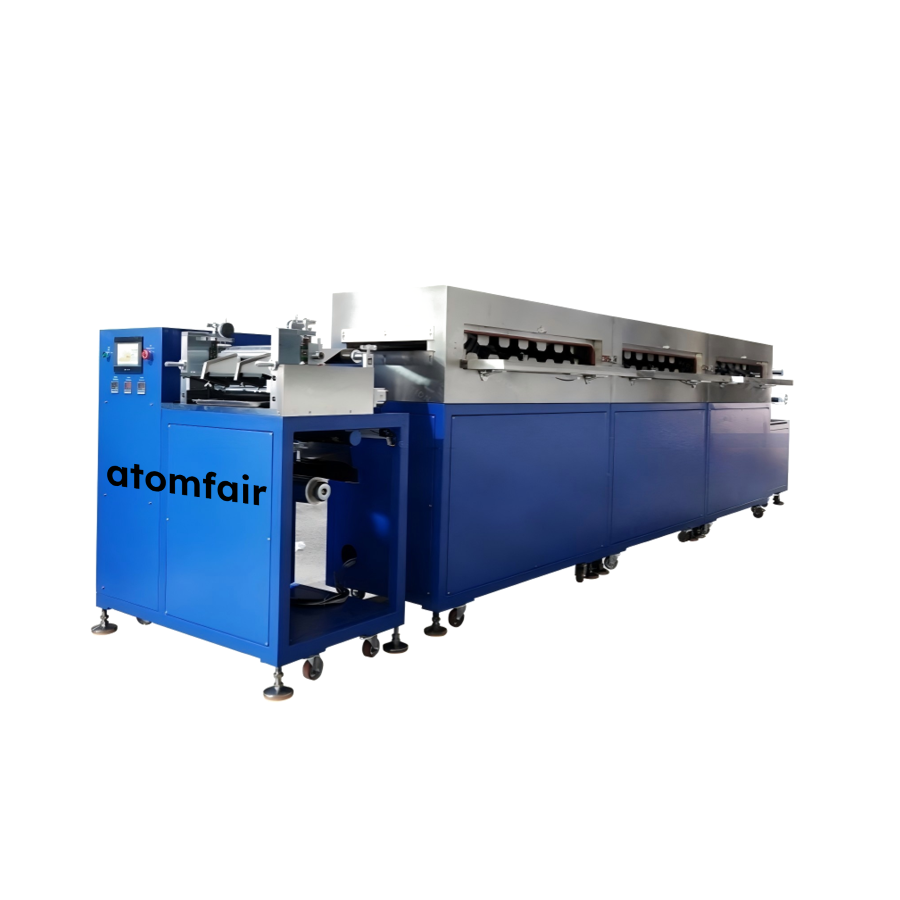
ATOMFAIR® ATOMFAIR-TCM-792 LAB COATING MACHINERESEARCH GRADE MATERIAL
|
|||||||||||||||||||||||||||||||||||||||||||||
|
|||||||||||||||||||||||||||||||||||||||||||||
This machine requires precise electrical, pneumatic, and environmental conditions to operate safely and maintain coating accuracy. Users must follow all specified parameters to prevent mechanical damage or personal injury.
- Electrical Supply: Connect to AC 220V, 50Hz supply with protective earth and circuit breaker rated for 25 A minimum.
- Compressed Air: Supply clean, dry compressed air at 0.5-0.7 MPa with dew point ≤ -20°C and particle filtration ≤ 5 μm.
- Drying Temperature: Set oven temperature between ambient and 120°C; do not exceed to avoid thermal degradation of substrates or slurry.
- Environmental Storage: Store and operate in a clean, dry environment with temperature 10-30°C and humidity < 80% to prevent corrosion and maintain precision.
- Solvent Safety: When using solvent-based slurries, ensure the workspace is ventilated and free of ignition sources; use the optional solvent recovery unit if available.
Follow these steps to safely initialize, operate, and shut down the coating machine. Proper procedure ensures consistent coating quality and prevents equipment damage or operator injury.
Required Equipment: Substrate roll, Coating slurry, Compressed air supply, Touch screen control panel
- Pre-Use Inspection
Inspect all rollers, blades, and conveyer for cleanliness and damage before each use. - Connect Pneumatic Supply
Connect compressed air and verify the gauge reading is within 0.5-0.7 MPa. - Set Drying Temperature
Set drying oven temperature to the required value between 20°C and 120°C and allow 15 minutes to stabilize. - Thread Substrate Web
Thread the substrate web through the unwind, coating station, and rewind rollers, adjusting tension to 10-30 N. - Apply Coating Slurry
Fill the coating slurry reservoir and adjust the comma blade gap to achieve the desired wet thickness (40-200 μm). - Start Coating Process
Start the web transport at ≥4.5 m/min and monitor coating uniformity on the touch screen, making fine adjustments. - Shutdown and Cleanup
After completing the run, stop the machine, release tension, disconnect power and compressed air, and clean all coated surfaces with appropriate solvent.
How does the transition between continuous and intermittent coating modes affect coating uniformity and edge accuracy on the Atomfair-TCM-792?
The three-roll transfer design maintains a coating accuracy of ±3 μm across the web (edge ±5 μm) in both continuous and intermittent modes, as the comma blade and precision adjustment are independent of mode switching. However, intermittent coating may require recalibration of tension control (max 60 N) and drying temperature (RT–120°C) to compensate for start/stop dynamics and ensure consistent thickness in the 40–200 μm range.
Can the Atomfair-TCM-792 coat slurries with high viscosity or solid content typical for lithium-ion battery anodes and cathodes?
Yes, the three-roll transfer design provides a wide coating window that accommodates slurries with varying rheology, but coating thickness is stated to depend on slurry properties. For high-viscosity or high-solids slurries, manual free adjustment of the roll gap and coating speed (minimum 4.5 m/min mechanical) is required, and the compressed air supply (0.5–0.7 MPa) must be stable for the pneumatic tension and deviation correction systems.
What are the compressed air and electrical infrastructure requirements for installing the Atomfair-TCM-792 in a battery R&D lab?
The machine requires a compressed air supply of 0.5–0.7 MPa for tension control and pneumatic components, and an AC 220V/50Hz electrical connection with a maximum power draw of 5 kW. With dimensions of 7000×1200×1800 mm and a 2-ton weight, the installation footprint must support the floor load; additionally, ventilation for hot air drying (up to 120°C) and optional solvent recovery integration should be planned for safe operation with organic solvents.
This lab coating machine offers ±3 μm coating accuracy and switchable continuous/intermittent modes, making it well-suited for lithium-ion battery electrode R&D and pilot lines. Operators must account for a limited coating thickness window (40–200 μm) and compressed air infrastructure at 0.5–0.7 MPa.
Positive
- High Coating Accuracy: Achieves ±3 μm thickness uniformity across the coating area (edge ±5 μm), enabling reproducible electrode fabrication for R&D and pilot production.
- Dual Coating Modes: Supports both continuous and intermittent coating in a single unit, eliminating the need for separate machines and increasing process flexibility for patterned coatings.
Trade-offs
- Limited Coating Thickness Range: Coating thickness is restricted to 40–200 μm and is slurry-dependent, which may exclude formulations requiring very thin or thick electrode layers.
- Compressed Air Requirement: Operates at 0.5–0.7 MPa compressed air, necessitating a dedicated pneumatic supply line in the lab or pilot facility.
Every advanced material, component, equipment, and instrument in our catalog is backed by rigorous testing. We maintain strict internal quality management frameworks and align with CE conformity metrics to deliver transparent, reproducible performance data via our public open-science repository.
To request raw batch performance data, submit formal vendor registration paperwork, or execute a fast-turnaround R&D manufacturing loop, contact us at inquiry@atomfair.com.
Item is dispatched under the Atomfair Shipping & Delivery Framework (Free worldwide shipping on orders over $59 USD excl. heavy equipment). Return is governed by the Atomfair Return & Refund Policy (7-day technical return window).