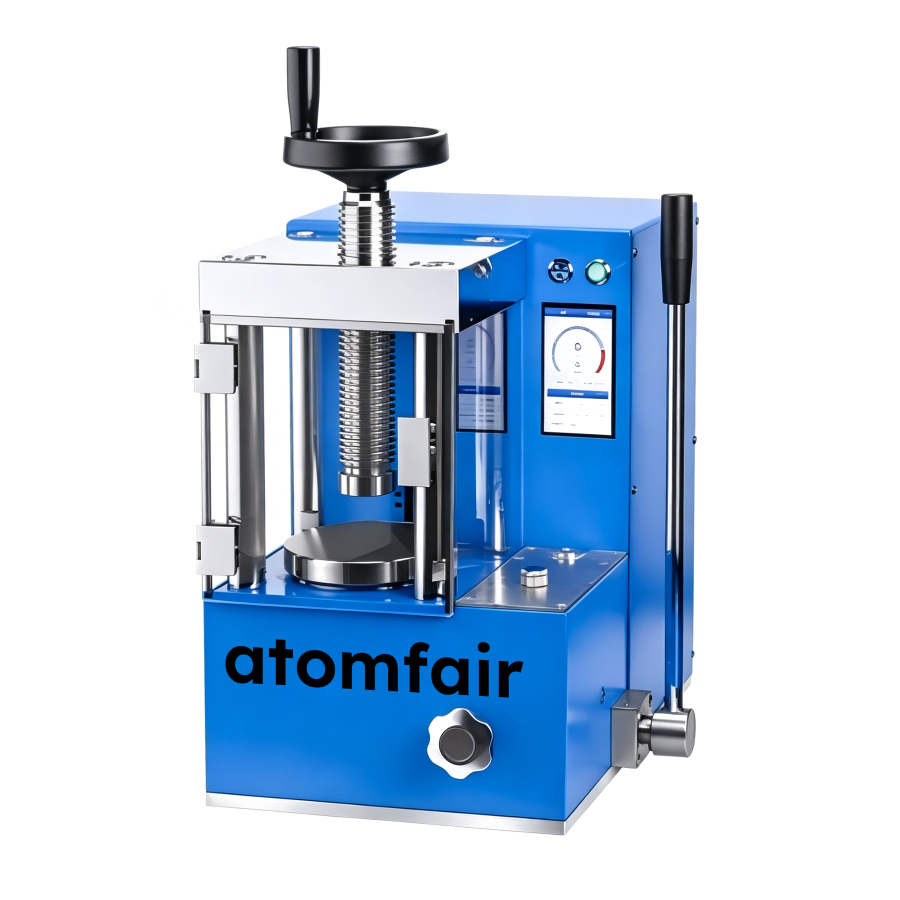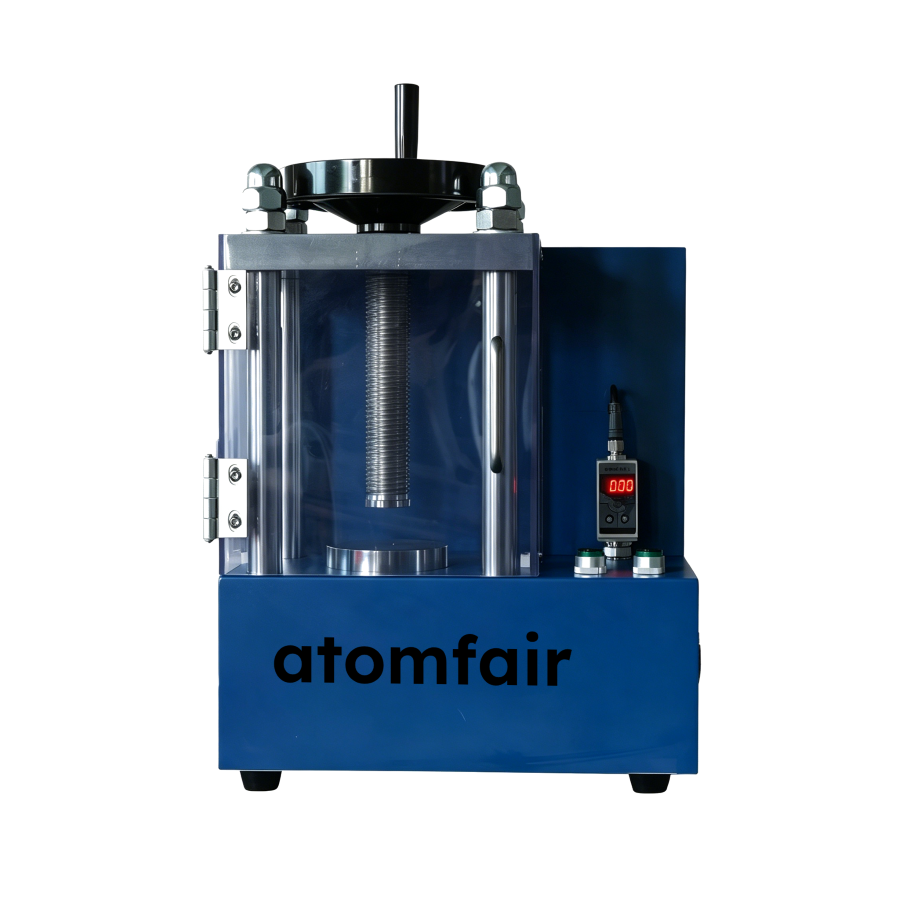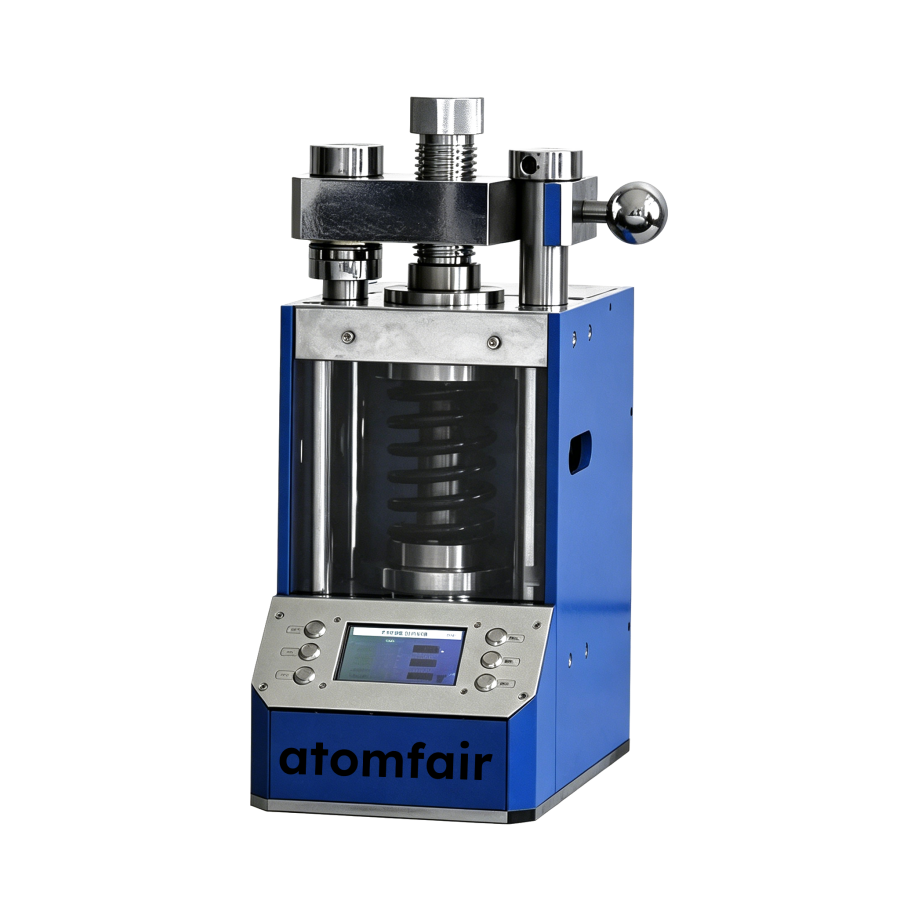
ATOMFAIR AFP-632 AUTOMATIC FLUORESCENCE PELLET PRESS (0-40 TON)MID-RANGE INDUSTRIAL ANALYSIS EQUIPMENT
|
|||||||||||||||||||||||||||
|
|||||||||||||||||||||||||||
|
TAILORED SOLUTIONS FOR RESEARCH
Contact our engineering team for technical support or customized equipment quotations.
EMAIL: INQUIRY@ATOMFAIR.COM
|
|||||||||||||||||||||||||||
|
Manufacturer: Atomfair LLC
Brand: ATOMFAIR
|
This automatic pellet press requires a stable, level work surface and a clean, dry environment to prevent electrical hazards and preserve mechanical alignment. The system's automatic venting cycle releases pressurized gas; operators must ensure the vent outlet is unobstructed and the area is well-ventilated.
- Surface and Environment: Operate the press on a rigid, vibration-free surface to maintain load accuracy and structural integrity during high-force cycles.
- Die Compatibility: Use only the specified 40 mm boric acid die mold to ensure proper force distribution and prevent die or ram damage.
- Pressure and Venting: Do not exceed the 40-ton maximum pressure rating, and verify the automatic venting pathway is clear before each compression cycle.
This procedure describes the safe operation of the AFP-632 press for preparing XRF sample pellets using the standard 40 mm boric acid die. Follow the automated compression sequence to produce consistent, flake-free analytical disks.
Required Equipment: Φ40 mm boric acid die mold module
- Prepare Die and Sample
Fill the die cavity with the sample powder and boric acid backing, then level the powder bed with a spatula to ensure uniform compression. - Position Die on Platen
Place the die assembly centrally on the lower ram of the press, ensuring it is seated evenly within the guide rings. - Set Dwell and Pressure Parameters
Using the digital LCD interface, enter the target pressure (within 0-40 tons) and the dwell duration (0-999.59 seconds) for the compression cycle. - Initiate Compression Sequence
Press the start button to begin the automated cycle, which will perform slow press intensification to the set pressure. - Monitor Stabilization and Venting
Wait through the continuous stabilization phase until the system automatically vents pressure, indicated by a distinct release sound and display prompt. - Remove Finished Pellet
After venting is complete, open the press, lift the die, and carefully extract the consolidated pellet using a gloved hand or ejector tool.
How does selecting a longer dwell time within the 0-999.59 second range affect pellet integrity for brittle ceramic samples?
Longer dwell time extends continuous stabilization under target pressure, enhancing cohesion and reducing flaking in brittle ceramic samples as the automated sequence optimizes disk cohesion metrics. However, it directly reduces sample throughput, presenting a trade-off between integrity and processing speed. The press's slow press intensification and stabilization profile ensures uniform compaction throughout the extended dwell.
What alternative die dimensions are available for the AFP-632 if the standard 40mm boric acid die is not suitable for my sample geometry?
The AFP-632 ships with a Φ40mm boric acid die, but alternative tooling options including customized powder metallurgy molds and other standard die dimensions are available. Users can explore the complete catalog or contact engineering for assistance with alternative hydraulic loads or mold configurations.
What workbench specifications are required to safely support the AFP-632 during continuous high-frequency operation?
The press has a net mass of 150 kg and a compact footprint of 280 mm × 460 mm × 550 mm. The operational compliance notice requires verifying that the target workbench configuration can securely handle the 150 kg machinery payload to prevent instability during the automated cycling sequence.
The AFP-632 automatic press delivers 40-ton capacity with automated cycling and adjustable dwell for reproducible XRF sample pellets, but requires a reinforced bench for its 150 kg frame and is optimized for medium-hardness materials, limiting use with extremely hard or abrasive samples.
Positive
- 40-ton capacity for diverse materials: The 0-40 ton pressure range enables processing of standard powders, medium-hardness minerals, and technical ceramics, broadening lab application scope.
- Automated cycling with adjustable dwell: Programmable compression sequence with 0-999.59 second dwell ensures consistent sample disk cohesion and reproducibility.
Trade-offs
- Heavy 150 kg frame requires stable bench: The 150 kg mass demands a reinforced analytical workbench that can securely support the payload during operation.
- Limited to medium-hardness materials: The press is designed for medium-hardness minerals and technical ceramics; extremely hard or abrasive samples may exceed its capability.
Every advanced material, component, equipment, and instrument in our catalog is backed by rigorous testing. We maintain strict internal quality management frameworks and align with CE conformity metrics to deliver transparent, reproducible performance data via our public open-science repository.
To request raw batch performance data, submit formal vendor registration paperwork, or execute a fast-turnaround R&D manufacturing loop, contact us at inquiry@atomfair.com.
Item is dispatched under the Atomfair Shipping & Delivery Framework (Free worldwide shipping on orders over $59 USD excl. heavy equipment). Return is governed by the Atomfair Return & Refund Policy (7-day technical return window).