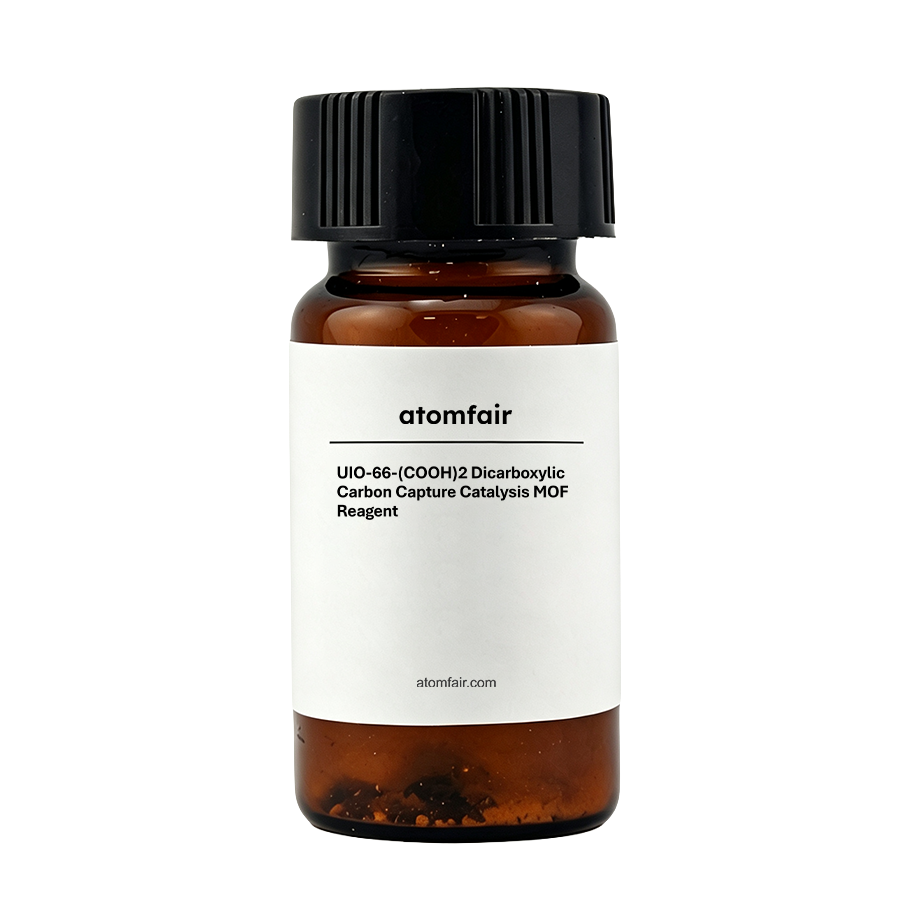
UIO-66-(COOH)2 Dicarboxylic Carbon Capture Catalysis MOF ReagentRESEARCH GRADE MATERIAL
|
|||||||||||||||||||||||||||||||||||
|
|||||||||||||||||||||||||||||||||||
|
TAILORED SOLUTIONS FOR RESEARCH
Contact our engineering team for technical support or official institutional quotations.
EMAIL: inquiry@atomfair.com
|
|||||||||||||||||||||||||||||||||||
This material requires strict anhydrous inert gas handling to prevent phase contamination and degradation. Storage must be in tightly sealed containers under inert atmosphere.
- Ambient Sensitivity: Exposure to ambient moisture or oxygen can cause phase contamination or degradation, compromising material performance.
- Inert Gas Handling: All handling and transfer operations must be performed within a glovebox or under an inert gas blanket to maintain material integrity.
- Thermal Processing: Thermal activation or validation steps should only be performed after confirming the material has been protected from ambient exposure.
What is the specific CO2 capacity and selectivity of UIO-66-(COOH)2 under standard conditions, and how does it compare to mono-carboxylic variants?
The UIO-66-(COOH)2 MOF achieves a CO2 capacity of 5.8 mmol/g at 298K and 1 bar, with a CO2/CH4 selectivity coefficient of 35. This represents a 25% performance increase over conventional mono-carboxylic variations, as stated in the product specifications.
Can UIO-66-(COOH)2 be used as a substrate for nickel nanoparticle loading in CO2 hydrogenation, and what conversion rates are achieved?
Yes, this MOF acts as an optimal substrate for loading nickel nanoparticles, achieving a CO2 hydrogenation to methanol conversion rate of 42% with 91% selectivity, surpassing traditional 28% catalytic baselines as documented in the key features.
What are the storage and handling requirements to prevent degradation of UIO-66-(COOH)2 before use?
The product is highly sensitive to ambient exposure. Containers must be kept tightly sealed, and handling should be performed exclusively within an anhydrous inert gas environment to prevent phase contamination or degradation before thermal validation, as per the operational notice.
This zirconium-based dicarboxylic MOF offers high CO2 uptake (5.8 mmol/g at 298 K, 1 bar), CO2/CH4 selectivity of 35, and demonstrated stability over 15 catalytic recycling cycles, but it requires strict anhydrous inert-gas handling and batch-level validation of particle size and pore diameter before deployment.
Positive
- High CO2 capacity and selectivity: The dicarboxylic functionalization drives CO2 capacity up to 5.8 mmol/g at 298 K and 1 bar with a CO2/CH4 selectivity coefficient of 35, representing a 25% improvement over conventional mono-carboxylic variants.
- Stable under catalytic cycling: The robust ligand architecture maintains structural degradation below 5% even after 15 consecutive chemical recycling validation cycles, supporting repeated use in heterogeneous catalytic and adsorption workflows.
Trade-offs
- Strict ambient exposure sensitivity: This material is highly sensitive to ambient exposure and must be kept in tightly sealed containers or handled exclusively within an anhydrous inert gas environment to prevent phase contamination or degradation before thermal validation.
- Unspecified particle size and pore diameter: Particle size and pore diameter are listed as TBD, requiring batch-specific confirmation before use in processes where these parameters directly affect separation or catalytic performance.
Every advanced material, component, equipment, and instrument in our catalog is backed by rigorous testing. We maintain strict internal quality management frameworks and align with CE conformity metrics to deliver transparent, reproducible performance data via our public open-science repository.
To request raw batch performance data, submit formal vendor registration paperwork, or execute a fast-turnaround R&D manufacturing loop, contact us at inquiry@atomfair.com.
Item is dispatched under the Atomfair Shipping & Delivery Framework (Free worldwide shipping on orders over $59 USD excl. heavy equipment). Return is governed by the Atomfair Return & Refund Policy (7-day technical return window).