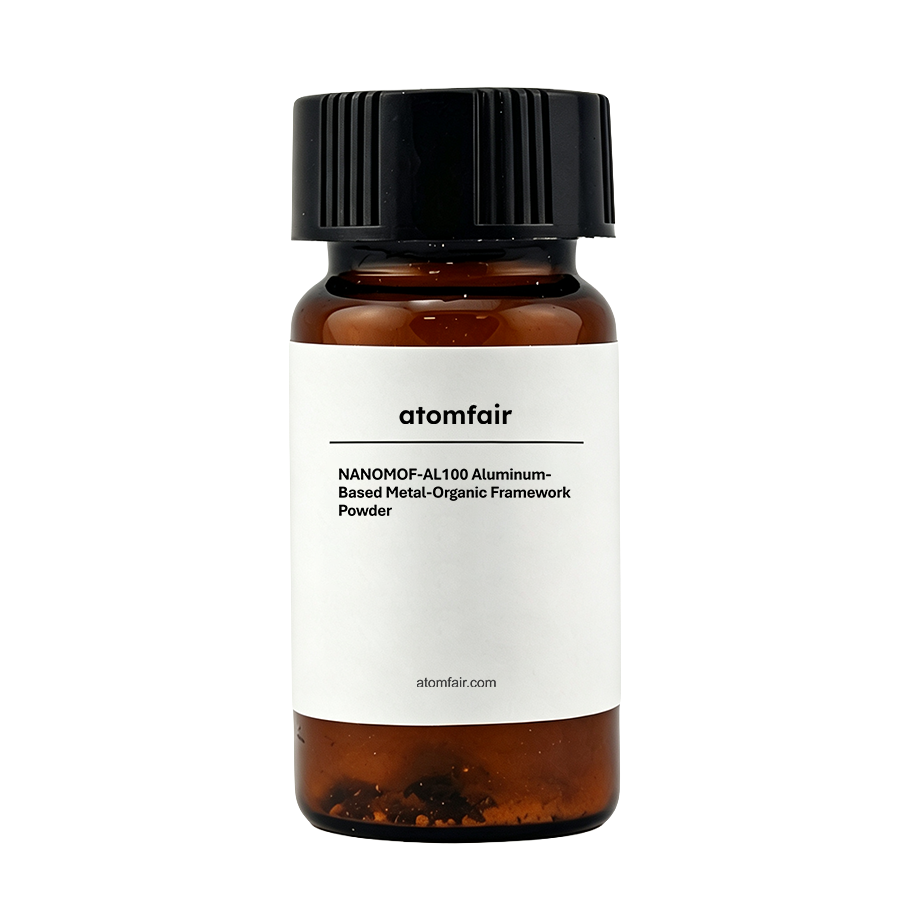
NanoMOF-Al100 Aluminum-Based Metal-Organic Framework PowderRESEARCH GRADE MATERIAL
|
||||||||||||||||||||
|
This material is highly sensitive to ambient exposure and requires anhydrous inert gas environment to prevent phase contamination or degradation. All handling and storage must maintain airtight seals and precede thermal validation for structural integrity.
- Ambient Sensitivity: Exposure to ambient atmosphere can cause phase contamination or degradation of the MOF crystalline structure.
- Inert Gas Handling: Transfer and handle the powder exclusively within an anhydrous inert gas environment such as a glovebox.
- Container Sealing: Keep containers tightly sealed at all times when not being transferred under inert atmosphere.
- Thermal Validation: Perform thermal validation prior to use to ensure the material has not undergone phase contamination or degradation.
How does the high BET surface area (>1000 m²/g) of NanoMOF-Al100 influence its performance in catalytic and adsorption applications?
The BET surface area exceeding 1000 m²/g maximizes available surface active sites for catalytic reactions and adsorption processes. This high surface area, combined with large mesoporous cavities, enables efficient multi-type chemical adsorption and stable substance encapsulation, as stated in the product's key features.
What are the specific handling precautions required for NanoMOF-Al100 to prevent degradation during laboratory use?
NanoMOF-Al100 is highly sensitive to ambient exposure. To prevent phase contamination or degradation, containers must be kept tightly sealed or handled exclusively within an anhydrous inert gas environment before thermal validation, as specified in the logistics and operational notice.
Can NanoMOF-Al100 be used for macromolecular protein packaging given its pore size range of 0.4–0.6 nm?
Yes, despite the microporous window size of 0.4–0.6 nm, NanoMOF-Al100 features large mesoporous cavities that provide structural spaces for macromolecular protein packaging. The product's key features explicitly state that its large cage parameters extend validation affinity to secure encapsulation and delivery of complex proteins.
NanoMOF-Al100 is an aluminum-based MOF with BET surface area >1000 m²/g and micropores (0.4–0.6 nm) suited for gas adsorption and protein encapsulation, but requires strict anhydrous handling and thermal validation to prevent structural degradation.
Positive
- High specific surface area: BET surface area exceeding 1000 m²/g provides abundant active sites for catalytic reactions and adsorption processes.
- Large cage parameters for protein encapsulation: Optimized porous structure with 0.4–0.6 nm pores and mesoporous cavities enables secure encapsulation and delivery of macromolecular proteins.
Trade-offs
- Ambient exposure sensitivity: Highly sensitive to moisture and air; requires storage in sealed containers or handling under anhydrous inert gas to prevent phase contamination.
- Thermal validation required: Material must undergo thermal validation after handling to avoid degradation; failure to do so risks structural integrity loss.
Every advanced material, component, equipment, and instrument in our catalog is backed by rigorous testing. We maintain strict internal quality management frameworks and align with CE conformity metrics to deliver transparent, reproducible performance data via our public open-science repository.
To request raw batch performance data, submit formal vendor registration paperwork, or execute a fast-turnaround R&D manufacturing loop, contact us at inquiry@atomfair.com.
Item is dispatched under the Atomfair Shipping & Delivery Framework (Free worldwide shipping on orders over $59 USD excl. heavy equipment). Return is governed by the Atomfair Return & Refund Policy (7-day technical return window).