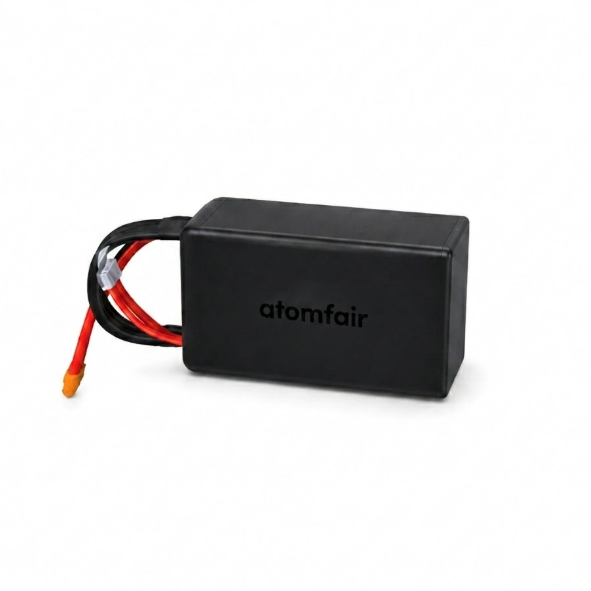
Wide-Voltage-Range High-Capacity Battery Series | ATOMFAIRCOMMERCIAL GRADE · PRODUCTION
|
||||||||||||||||||||||||||||||||||||||||
|
||||||||||||||||||||||||||||||||||||||||
|
TAILORED SOLUTIONS FOR RESEARCH
Contact our engineering team for technical support or official institutional quotations.
EMAIL: inquiry@atomfair.com
|
||||||||||||||||||||||||||||||||||||||||
|
Manufacturer: Atomfair LLC
Brand: ATOMFAIR®
|
This series of lithium-ion pouch cells requires strict adherence to voltage and temperature limits to prevent capacity fade and safety risks. A compatible BMS with over-discharge and over-current protection is mandatory for all applications.
- Charge Voltage Range: Maintain charge voltage between 2.5V and 4.3V for the 50Ah model (AFWRC101161231) or between 2.75V and 4.35V for the 58Ah model (AFWRC10161231).
- Discharge Temperature Range: Do not discharge the cells below -20°C or above 60°C to avoid irreversible damage.
- Storage Temperature Limit: Avoid prolonged exposure of the cells to temperatures exceeding 60°C.
- BMS Configuration: Use a BMS that provides over-discharge protection, over-current protection, and cell balancing.
- Pre-conditioning Requirement: Pre-condition new cells at 25°C before first use to stabilize performance.
Follow these steps to safely initialize and handle the ATOMFAIR battery cells. Proper preconditioning and BMS setup are critical for long cycle life and safe operation.
Required Equipment: Compatible Battery Management System (BMS)
- Pre-condition the cell
Pre-condition the new cell at 25°C for a specified period before first use. - Configure the BMS
Verify that the BMS is configured for over-discharge, over-current, and cell balancing protection. - Connect and charge
Connect the cell to the BMS and ensure the charge voltage remains within the recommended range. - Monitor temperature
Avoid exposing the cell to temperatures above 60°C during operation or storage.
What are the key differences between the 50Ah and 58Ah variants of the ATOMFAIR Wide-Voltage-Range High-Capacity Battery Series?
The primary differences are nominal capacity (50Ah vs 58Ah), nominal voltage (3.65V vs 3.7V), operating voltage range (2.5–4.3V vs 2.75–4.35V), charge temperature range (0–55°C vs 0–50°C), and cycle life (≥1200 vs ≥1500 cycles at 80% SOH). The 58Ah model offers higher capacity and longer cycle life but has a slightly narrower charge temperature window.
What BMS specifications are required for the ATOMFAIR wide-voltage-range pouch cells?
A compatible BMS must include over-discharge protection, over-current protection, and cell balancing. The BMS must be configured to operate within the cell's voltage range (2.5–4.3V for 50Ah, 2.75–4.35V for 58Ah) and support 1C charge / 3C discharge rates. The source explicitly recommends always using a compatible BMS with these features.
What are the pre-conditioning and storage requirements for the ATOMFAIR semi-solid electrolyte pouch cells?
New cells must be pre-conditioned at 25°C before first use. Avoid exposing cells to temperatures above 60°C for extended periods. The cells are packaged in moisture-barrier vacuum-sealed aluminum foil bags and stored in anti-static cartons. These requirements ensure safety and performance in marine environments.
The ATOMFAIR Wide-Voltage-Range High-Capacity Battery Series (50Ah and 58Ah variants) uses semi-solid electrolyte pouch cells with 1C/3C charge/discharge rates, delivering up to 1500 cycles at 80% SOH for marine propulsion. The 50Ah model operates 2.5–4.3V and the 58Ah model 2.75–4.35V, with corresponding nominal voltages of 3.65V and 3.7V, requiring application-specific BMS configuration.
Positive
- High capacity and wide voltage range: 50Ah and 58Ah options with operating voltage ranges of 2.5–4.3V and 2.75–4.35V respectively provide extended runtime and compatibility with diverse marine power systems.
- Long cycle life with stable power delivery: Up to 1500 cycles at 80% SOH and 1C/3C charge/discharge rates ensure consistent performance and reduced replacement frequency in demanding watercraft applications.
Trade-offs
- BMS and voltage compliance required: Must use a compatible BMS with over-discharge, over-current, and cell balancing protection; charge within the specified voltage range to prevent damage.
- Temperature sensitivity and preconditioning needed: Avoid prolonged exposure above 60°C; precondition new cells at 25°C before first use to ensure stable performance and cycle life.
Every advanced material, component, equipment, and instrument in our catalog is backed by rigorous testing. We maintain strict internal quality management frameworks and align with CE conformity metrics to deliver transparent, reproducible performance data via our public open-science repository.
To request raw batch performance data, submit formal vendor registration paperwork, or execute a fast-turnaround R&D manufacturing loop, contact us at inquiry@atomfair.com.
Item is dispatched under the Atomfair Shipping & Delivery Framework (Free worldwide shipping on orders over $59 USD excl. heavy equipment). Return is governed by the Atomfair Return & Refund Policy (7-day technical return window).