PEROVSKITE SOLAR CELL TEST FIXTURE N2-SEALED REUSABLE CLAMPRESEARCH GRADE EQUIPMENT
|
|||||||||||||||||||||||||||||
|
|||||||||||||||||||||||||||||
|
TAILORED SOLUTIONS FOR RESEARCH
Contact our engineering team for technical support or official quotations.
EMAIL: inquiry@atomfair.com
|
|||||||||||||||||||||||||||||
|
Manufacturer: Atomfair LLC
Brand: ATOMFAIR®
|
This fixture requires assembly under inert atmosphere to prevent perovskite degradation. The NBR sealing ring must be free of contamination and the temperature must not exceed 125°C to maintain seal integrity.
- Inert Atmosphere Assembly: Assembly and disassembly must be performed in a glovebox with H₂O and O₂ below 1 ppm to prevent moisture and oxygen exposure.
- Sealing Ring Condition: The NBR sealing ring must be properly seated and free of particulate contamination before each use to maintain hermetic integrity.
- Temperature Limit: The maximum operating temperature of 125°C must not be exceeded to preserve elastomeric sealing performance.
- Custom Filter Glass Verification: When specifying custom filter glass, verify optical transmission characteristics meet experimental requirements prior to ordering.
- Glovebox Compatibility: The split-body design is engineered for complete assembly and disassembly within a glovebox environment to preserve sample integrity.
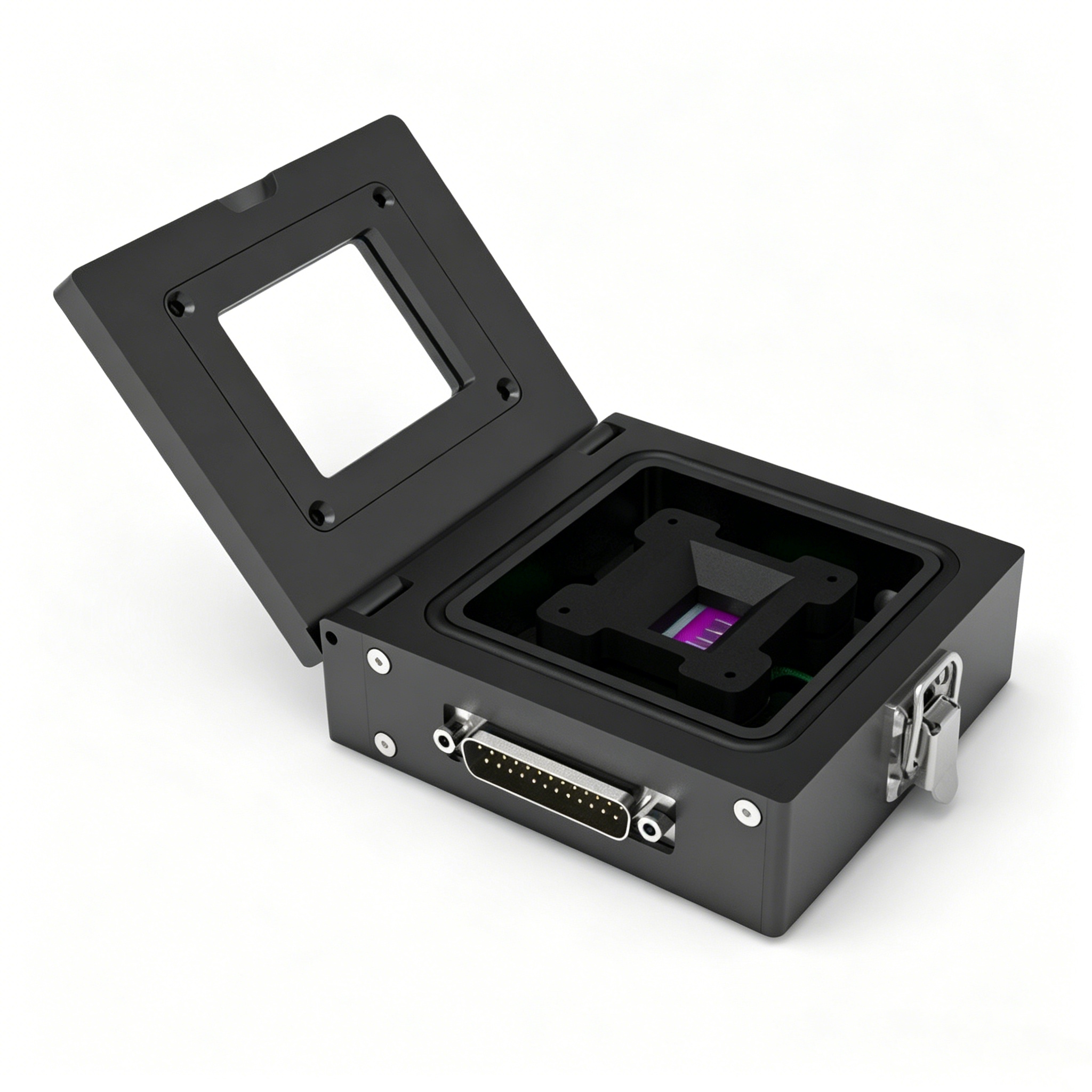
This procedure describes safe loading and sealing of perovskite devices under inert atmosphere. The fixture provides a reversible nitrogen-sealed barrier for non-encapsulated measurement.
Required Equipment: Glovebox with inert atmosphere (H₂O < 1 ppm, O₂ < 1 ppm), NBR sealing ring, Quartz viewing window
- Assemble in Glovebox
Assemble the test fixture within a glovebox under inert atmosphere to prevent moisture and oxygen exposure. - Inspect Sealing Ring
Ensure the NBR sealing ring is properly seated and free of particulate contamination before each use. - Load Sample
Place the perovskite device onto the fixture base and close the split-body clamp with spring-loaded pogo pins. - Verify Temperature Limit
Confirm the operating temperature does not exceed 125°C to preserve elastomeric sealing performance. - Perform Measurement
Conduct electrical characterization using the 4-wire Kelvin probe configuration while maintaining inert atmosphere.
What temperature range can the N2-sealed perovskite solar cell test fixture maintain without losing its hermetic water-oxygen barrier?
The fixture maintains seal integrity from -55°C to 125°C, while its NBR sealing ring is rated for hermetic water-oxygen isolation up to 120°C. The glass-sintered electrode feedthrough supports this same -55°C to 125°C operating envelope. Do not exceed 125°C, as that would degrade the elastomeric sealing performance.
Can this fixture be used for long-term stability testing of non-encapsulated perovskite solar cells under continuous illumination?
Yes. Its application scope includes long-term stability testing under continuous illumination with water and oxygen excluded, and the high-transmission quartz viewing window is designed for illuminated characterization. Because the split-body seal is reversible and requires no sintering, UV curing, or chemical reaction, the same non-encapsulated device can be measured repeatedly across aging time points without encapsulation-induced damage.
What glovebox atmosphere and handling conditions are required when loading air-sensitive perovskite devices into this test fixture?
Assembly and disassembly should be performed inside a glovebox under inert atmosphere with H₂O < 1 ppm and O₂ < 1 ppm to prevent moisture and oxygen exposure during loading. The NBR sealing ring must be properly seated and free of particulate contamination before each use to maintain hermetic integrity. These steps preserve the sample during repeated testing cycles.
This nitrogen-sealed reusable clamp fixture enables non-destructive, non-encapsulated current-voltage characterization of perovskite solar cells under controlled atmosphere, using an NBR hermetic seal rated to 120°C and a 4-wire Kelvin configuration. Its split-body design with spring-loaded pogo pins supports repeated sample cycling within a glovebox, avoiding high-temperature sintering or UV curing that could damage sensitive perovskite materials.
Positive
- Reusable nitrogen-sealed isolation: The NBR sealing ring provides a water-oxygen barrier at up to 120°C, allowing non-encapsulated perovskite devices to be measured and repeatedly tested under inert atmosphere without irreversible encapsulation-induced damage.
- 4-wire Kelvin probe accuracy: The integrated four-wire measurement configuration eliminates lead resistance contributions, ensuring accurate extraction of intrinsic cell efficiency metrics during I-V characterization.
Trade-offs
- Glovebox required for loading: Assembly and disassembly must be performed within a glovebox under inert atmosphere (H₂O < 1 ppm, O₂ < 1 ppm) to prevent ambient moisture and oxygen exposure to air-sensitive perovskite devices, adding laboratory infrastructure requirements.
- NBR sealing ring care needed: The NBR sealing ring must be properly seated and free of particulate contamination before each use to maintain hermetic integrity, and the maximum operating temperature of 125°C must not be exceeded to preserve elastomeric performance.
Every advanced material, component, equipment, and instrument in our catalog is backed by rigorous testing. We maintain strict internal quality management frameworks and align with CE conformity metrics to deliver transparent, reproducible performance data via our public open-science repository.
To request raw batch performance data, submit formal vendor registration paperwork, or execute a fast-turnaround R&D manufacturing loop, contact us at inquiry@atomfair.com.
Item is dispatched under the Atomfair Shipping & Delivery Framework (Free worldwide shipping on orders over $59 USD excl. heavy equipment). Return is governed by the Atomfair Return & Refund Policy (7-day technical return window).