
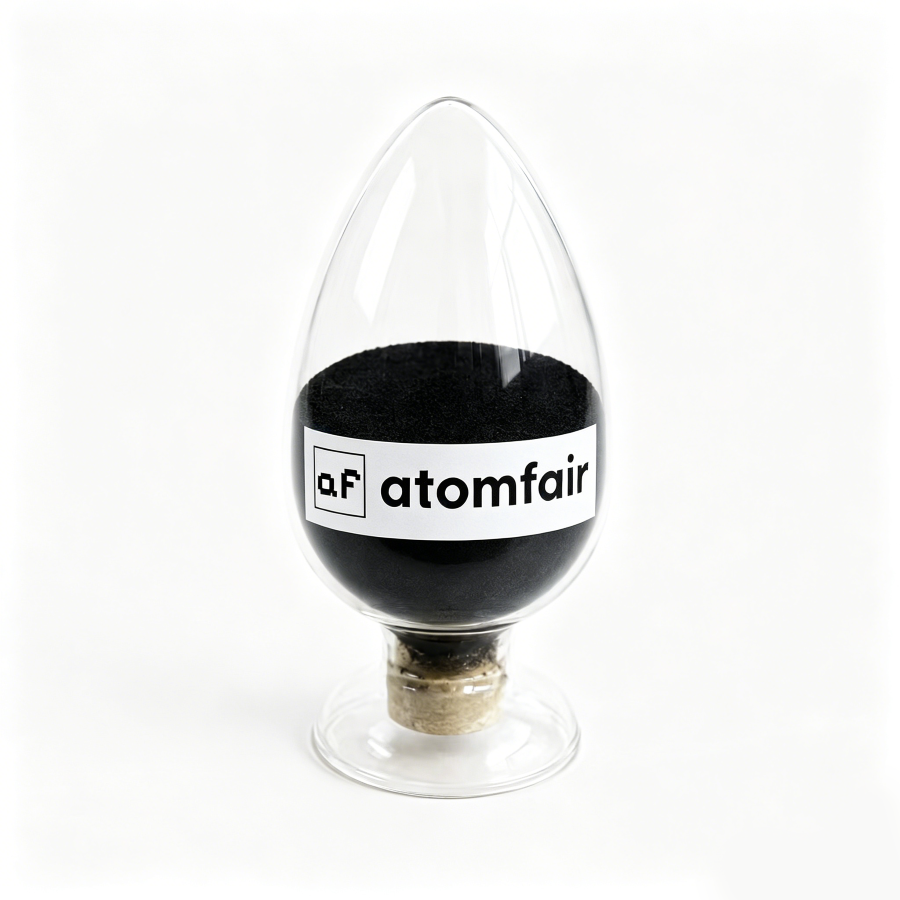
Sodium Iron Sulfate NFS Cathode Powder 95mAh/g ATOMFAIR®

Price range: $280.00 through $520.00

Institutional Procurement & Supply Compliance: As a verified US supplier, Atomfair accepts formal institutional Purchase Orders (POs), contract billing schedules, and custom procurement loops for university and national laboratories, and corporate R&D departments globally.

Research grade NFS sodium iron sulfate cathode powder. ≥97% ICE, ≥92 mAh/g discharge, ≥77 mAh/g at 5C, Na 14±1 wt%, Fe 22.5±1.5 wt%, carbon 1-3 wt%. Order now.

SKU: AAEMNFS000A0A0
Category:
Tags: ,
Brands:

Description

ATOMFAIR® High-Efficiency NFS Sodium Iron Sulfate Powder

RESEARCH GRADE | ADVANCED NFS SULFATE MATERIAL

Product Overview

Achieve uncompromised cell-to-cell consistency and robust baseline testing control with ATOMFAIR® High-Efficiency NFS Sodium Iron Sulfate Powder. This premium sodium-ion battery positive electrode material eliminates chemical variables during core electrolyte validation testing. Structured around a highly integrated polyanionic sulfate matrix, it yields an exceptional initial Coulombic efficiency alongside excellent fast-charge kinetic rates, matching premium market targets while securing reliable sodium iron sulfate powder price efficiencies for institutional researchers.

Technical Specifications

PARAMETER DETAILS
1. Core Device & Electrochemical Design (2.0V–4.5V Range)
0.1C Initial Charging Capacity ≥ 95 mAh/g
0.1C Initial Discharging Capacity ≥ 92 mAh/g
0.1C Initial Coulombic Efficiency (ICE) ≥ 97 %
5C Ultra Fast-Charge Capacity ≥ 77 mAh/g
2. Stoichiometric & Elemental Profiles
Sodium (Na) Mass Content 14 ± 1 wt% (Agilent ICP-OES Verified)
Iron (Fe) Mass Content Matrix 22.5 ± 1.5 wt%
Sulfur (S) Mass Content Matrix 20.5 ± 1.5 wt%
Carbon (C) Wrap Coating Ratio 1 – 3 wt% (Carbon-Sulfur Infrared Titration)
3. Impurity & Contamination Thresholds
Residual Moisture Content ≤ 1000 ppm (Karl Fischer 200°C Thermal Extraction)
Elemental Interferences (Al / Ca / K) Al ≤ 50 ppm | Ca ≤ 200 ppm | K ≤ 50 ppm
Elemental Interferences (Mg / Mn / Ti) Mg ≤ 100 ppm | Mn ≤ 150 ppm | Ti ≤ 50 ppm
Unbound Single Metals (Fe+Ni+Cr+Zn) ≤ 1 ppm Total
4. Physical Package & Microstructure Metrics
Particle Sizing Boundaries (D10 / D90) D10 ≥ 0.6 μm | D90 ≤ 10 μm
Median Particle Diameter (D50) 1.5 – 2.5 μm
Specific Surface Area (BET) 5 – 10 m²/g
Tapped Powder Density Range 0.7 – 1.2 g/cm³
Powder Compaction Density (@ 20MPa) 1.8 – 2.2 g/cm³
Manufacturing Rules Processed under strict high efficiency polyanionic nfs cathode parameter rules to minimize unbound metallic inclusions below 1 ppm thresholds.
Alternative Options Explore our extended catalog options for polyanionic phosphate modifications or high-compaction layered oxides. Contact support for bulk quotation requests.

Key Features & Advantages

  • Industry-Leading Coulombic Utilization: Outstanding initial cycle efficiency ceilings exceeding 97% dramatically limit active ion traps during early conditioning phases.
  • Superb Fast-Charge Transport: High electrical-network integration preserves capacities above 77 mAh/g even under rapid 5C charging routing profiles.
  • Strict Metal Purity Control: Total single magnetic/metal interferences are compressed below 1 ppm, eliminating parasitic short-circuiting risks inside wound architectures.
  • Predictable Rheological Dispersion: Fine submicron particle widths (D50: 1.5–2.5 μm) ensure outstanding slurry homogenization and smooth mechanical sheet casting.


APPLICATION SCOPE: High-performance polyanionic sodium-ion battery half/full cell configurations, ultra-safe stationary grids, and fast-charging device testing matrices.
PACKAGING & EXPIRATION: Vacuum hermetically sealed inside high-barrier industrial aluminum-plastic bags (10kg packs or 450kg commercial bulk tons). Preserves uncompromised baseline characteristics for 12 months under dark, sealed conditions.
IMPORTANT NOTICE: Sulfate polyanionic networks carry acute environmental humidity sensitivities. Workpieces must be stored under 45°C, kept strictly below 70%RH storage settings, and processed instantly post-opening within dry gas glovebox environments to satisfy how to handle moisture sensitive sodium battery materials rules.

Frequently Asked Technical Questions

Why is ATOMFAIR® High-Efficiency NFS Sodium Iron Sulfate Powder preferred as a sodium-ion battery positive electrode material?

ATOMFAIR® High-Efficiency NFS Sodium Iron Sulfate Powder functions as a premier sodium-ion battery positive electrode material for advanced systems. It skips typical polyanionic voltage bottlenecks to deliver a high 4.5V charging ceiling with an exceptional first-cycle efficiency $geq 97%$, significantly boosting performance metrics and phase purity during laboratory testing workflows.

How to handle moisture sensitive sodium battery materials?

To successfully solve how to handle moisture sensitive sodium battery materials without secondary contamination, this powder must be stored inside dry warehouse compartments beneath 45°C and blended into electrode slurries immediately following vacuum bag puncture inside low-dew-point gloveboxes.

How does ATOMFAIR® High-Efficiency NFS Sodium Iron Sulfate Powder compare to traditional alternative options regarding operational stability?

Compared to standard alternatives, the optimized matrix of ATOMFAIR® High-Efficiency NFS Sodium Iron Sulfate Powder incorporates specialized chemical doping that restricts total unbound trace metals (Fe+Ni+Cr+Zn) below an ultra-pure 1 ppm threshold. This unique architecture dramatically enhances structural resistance against degradation, preserving long-term validation integrity.
TAILORED SOLUTIONS FOR RESEARCH
Contact our engineering team for technical support or official institutional quotations.
EMAIL: inquiry@atomfair.com
Brand Owner: Atomfair LLC
Brand: ATOMFAIR®

This cathode powder requires strict moisture control during storage and handling to preserve its polyanionic sulfate structure. Electrolyte compatibility must be validated prior to cell assembly to ensure optimal electrochemical performance.

  • Storage Requirements: Store the powder in an airtight container under inert gas to prevent moisture absorption and oxidative degradation.
  • Electrolyte Compatibility: Validate electrolyte compatibility before use to avoid undesirable side reactions that could reduce Coulombic efficiency.

How does the carbon coating ratio of 1–3 wt% influence the electrochemical performance of this NFS cathode powder?

The 1–3 wt% carbon coating provides sufficient electronic conductivity to achieve a high initial Coulombic efficiency ≥97% and fast-charge capacity ≥77 mAh/g at 5C, without significantly reducing the active material fraction. This ratio is optimized within the specified impurity constraints (Al ≤50 ppm, etc.) to balance rate capability and capacity.

What are the impurity limits for transition metals like manganese and titanium in this NFS powder, and why are they important?

The impurity thresholds are Mn ≤150 ppm, Ti ≤50 ppm, and total unbound metals (Fe+Ni+Cr+Zn) ≤1 ppm. These strict limits prevent metal dissolution and cathode degradation during cycling, directly supporting the ≥97% initial Coulombic efficiency and stable fast-charge performance. The powder is Agilent ICP-OES verified for sodium content and contaminant levels.

What storage and handling protocols are required to maintain the specified moisture content below 1000 ppm?

The powder must be stored in sealed, dry containers (e.g., argon or vacuum) to keep residual moisture ≤1000 ppm, as confirmed by Karl Fischer at 200°C. Additionally, due to fine particle size (D90 ≤10 μm), handling should be conducted in a dry room or glovebox to prevent moisture uptake and electrostatic dust dispersion. The tapped density (0.7–1.2 g/cm³) suggests reasonable flow but fine particles require care.

This high-voltage NFS cathode powder delivers ≥97% initial Coulombic efficiency and ≥77 mAh/g at 5C, enabling fast-charge sodium-ion cells with tight cell-to-cell consistency, though its ≤1000 ppm moisture ceiling and sub-1 ppm unbound metal threshold demand rigorous dry-room and precursor purity controls.

Positive

  • Exceptional initial Coulombic efficiency: With a 0.1C ICE ≥ 97%, this material minimizes parasitic side reactions during formation, providing reliable baseline performance for electrolyte and cell validation studies.
  • Fast-charge kinetic capability: Maintaining ≥ 77 mAh/g at 5C discharge demonstrates robust rate performance, supporting high-power sodium-ion cell designs and rapid charging protocols.

Trade-offs

  • Moisture-sensitive handling required: Residual moisture content is capped at 1000 ppm (Karl Fischer at 200°C), meaning the powder must be stored and processed in a dry environment (≤ -40°C dew point) to prevent capacity fade from hydrolysis.
  • Ultra-low metallic impurity tolerance: Total unbound single metals (Fe+Ni+Cr+Zn) are limited to ≤ 1 ppm, which requires high-purity raw materials and dedicated processing lines to avoid contamination that could trigger self-discharge or voltage decay.

Every advanced material, component, equipment, and instrument in our catalog is backed by rigorous testing. We maintain strict internal quality management frameworks and align with CE conformity metrics to deliver transparent, reproducible performance data via our public open-science repository.

To request raw batch performance data, submit formal vendor registration paperwork, or execute a fast-turnaround R&D manufacturing loop, contact us at inquiry@atomfair.com.

Item is dispatched under the Atomfair Shipping & Delivery Framework (Free worldwide shipping on orders over $59 USD). Return is governed by the Atomfair Return & Refund Policy (7-day technical return window).

Additional information

weight

200g, 1000g