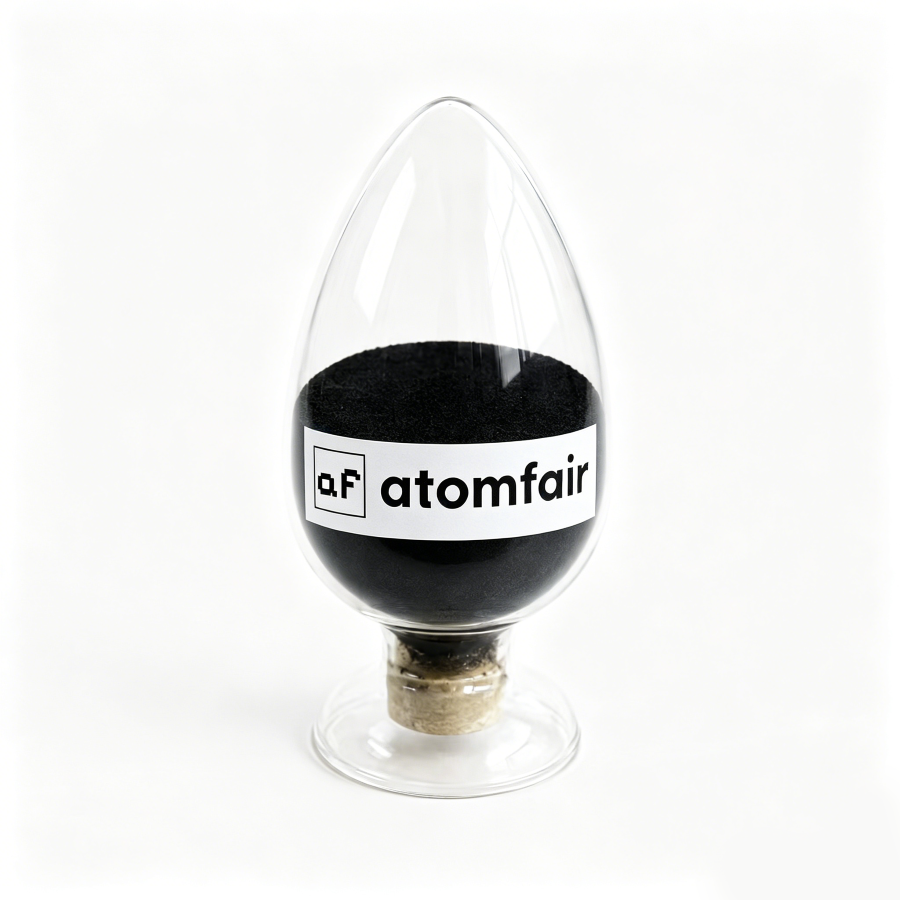
ATOMFAIR® O3-PHASE LAYERED TRANSITION METAL OXIDE POWDERRESEARCH GRADE MATERIAL
|
|||||||||||||||||||||||||||||||||||||||||||||||
|
|||||||||||||||||||||||||||||||||||||||||||||||
|
TAILORED SOLUTIONS FOR RESEARCH
Contact our engineering team for technical support or official institutional quotations.
EMAIL: inquiry@atomfair.com
|
|||||||||||||||||||||||||||||||||||||||||||||||
|
Manufacturer: Atomfair LLC
Brand: ATOMFAIR®
|
|||||||||||||||||||||||||||||||||||||||||||||||
This material exhibits strict moisture sensitivity with a maximum allowable moisture content of 0.10 wt% and a pH range of 10.0–12.0. Particle size distribution must be maintained within 9.0–15.0 µm D50 to ensure proper slurry processing and cell performance.
- Moisture Content Constraint: The powder must be stored and handled in an environment where moisture content remains at or below 0.10 wt% to prevent degradation.
- pH Range Constraint: The matrix pH value of 10.0–12.0 requires compatible electrolyte and binder systems to avoid unwanted side reactions.
- Particle Size Distribution Constraint: The D50 particle size of 9.0–15.0 µm is critical for achieving uniform slurry viscosity and consistent electrode coating thickness.
How does the specific capacity of this O3-phase layered oxide cathode change when cycling at elevated C-rates above 1C, and what is the trade-off between capacity retention and rate capability?
The reversible specific capacity at 0.1C is ≥120 mAh/g (typical 127 mAh/g). At 1.0C rate, capacity retention is ~90.16%, indicating a 9.84% loss from the 0.1C capacity. While higher rates yield lower capacity, the O3-phase structure enables ~98.43% retention at 0.2C and 95.04% at 0.5C, making it suitable for applications requiring moderate rate capability with minimal capacity sacrifice below 1C.
What are the critical slurry processing constraints when using this sodium-ion cathode powder with common organic solvents like NMP or water-based binders?
This O3-phase layered oxide has a matrix pH ≤13.00 (typical 12.86), which means it is highly alkaline and can cause gelation or binder degradation in certain solvent systems. The moisture content is ≤500 ppm (typical 432 ppm), requiring dry handling to prevent hydrolysis. For stable slurry processing, the material is manufactured to ensure reliable rheological matching for automated coin or pouch cell casting, but users must select binder systems compatible with high pH environments, such as PVDF in NMP, and avoid water-based binders unless specially formulated.
What storage and handling procedures are required to maintain the electrochemical performance of this high-pH O3-phase cathode powder?
The powder has a pH of ≤13.00, indicating strong alkalinity that can cause skin and eye irritation, so appropriate PPE (gloves, goggles) is mandatory. To maintain the moisture content limit of ≤500 ppm (typical 432 ppm), storage in an argon-filled glovebox or vacuum-sealed container with desiccant is recommended to prevent moisture uptake that could degrade performance. The material should be used as received and not exposed to ambient air for extended periods during slurry preparation.
This research-grade O3-phase layered transition metal oxide powder delivers a reversible capacity of ≥120 mAh/g at 0.1C with strong high-rate retention (90.16% at 1.0C) and fine-particle microstructure for consistent slurry casting. Its high native pH (12.86 typical) and moisture limit of ≤500 ppm mandate controlled dry handling to prevent performance degradation.
Positive
- High-rate capability retention: Retains ~90.16% of 0.1C capacity at 1.0C, enabling stable operation under moderate discharge rates for sodium-ion battery cathode evaluation.
- Outstanding slurry processing stability: Formulated for reliable rheological matching in automated coin or pouch cell casting, minimizing batch-to-batch variation during electrode fabrication.
Trade-offs
- High matrix pH value: With a pH ≤13.00 (typical 12.86), the powder is strongly alkaline, requiring corrosion-resistant handling equipment and compatibility checks with common slurry solvents and binders.
- Moisture sensitivity limit: Maximum residual moisture of 500 ppm (typical 432 ppm) necessitates dry-room or glovebox processing to prevent hydroxide formation and capacity fade.
Every advanced material, component, equipment, and instrument in our catalog is backed by rigorous testing. We maintain strict internal quality management frameworks and align with CE conformity metrics to deliver transparent, reproducible performance data via our public open-science repository.
To request raw batch performance data, submit formal vendor registration paperwork, or execute a fast-turnaround R&D manufacturing loop, contact us at inquiry@atomfair.com.
Item is dispatched under the Atomfair Shipping & Delivery Framework (Free worldwide shipping on orders over $59 USD excl. heavy equipment). Return is governed by the Atomfair Return & Refund Policy (7-day technical return window).