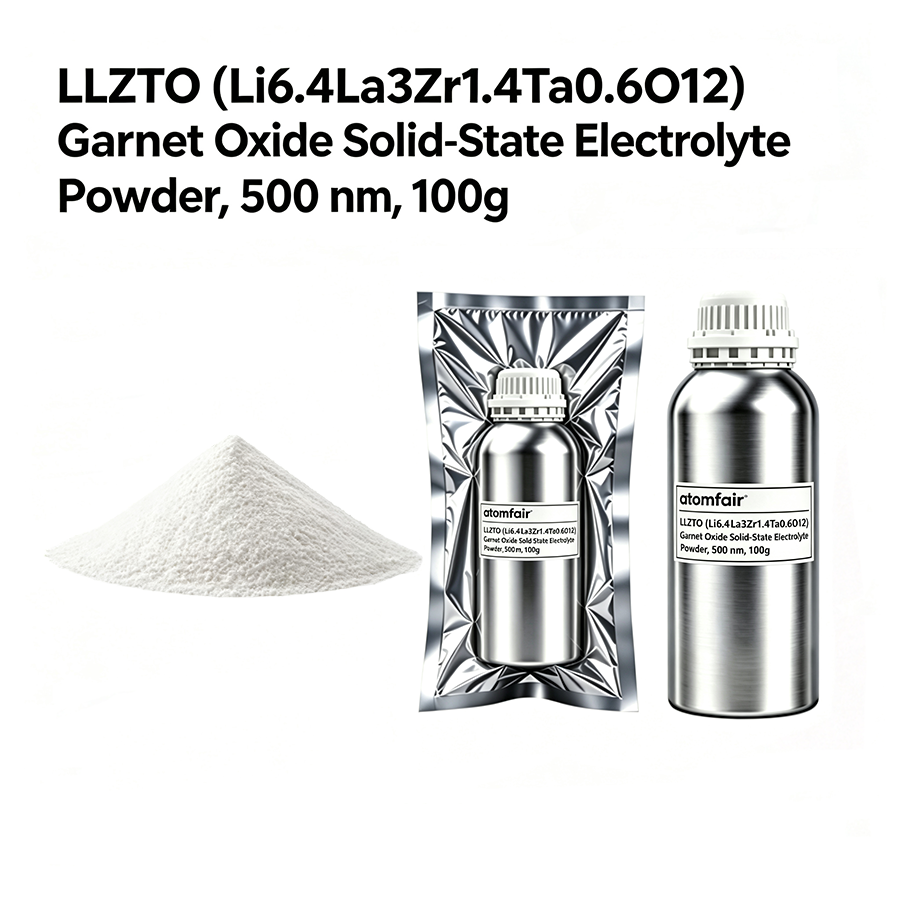
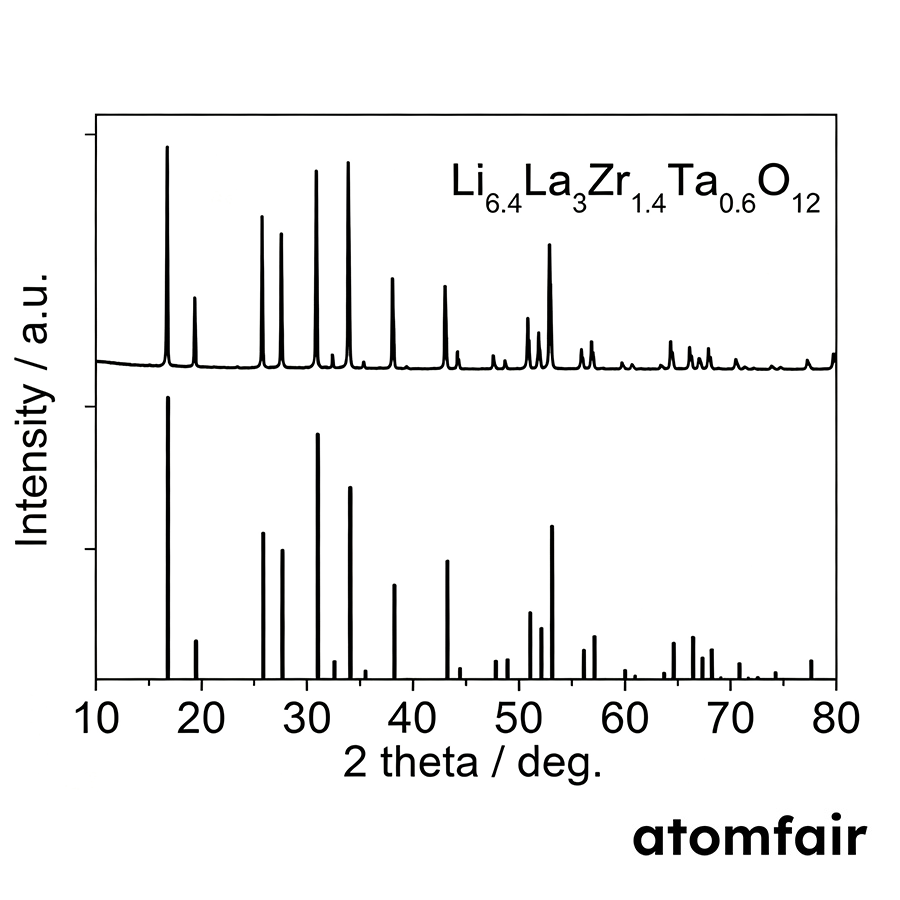
LLZTO (Li6.4La3Zr1.4Ta0.6O12) Garnet Oxide Solid-State Electrolyte Powder, 500 nmOxide Solid-State Electrolytes
|
|||||||||||||||||||||||||||||||
|
|||||||||||||||||||||||||||||||
|
The powder is moisture-sensitive with a ≤500 ppm limit, requiring storage in a sealed, dry container. Achieving the specified ionic conductivity of ~10⁻³ S/cm necessitates proper ceramic densification, such as high-temperature sintering.
- Moisture Sensitivity: Store and handle the powder in a sealed, dry container to prevent moisture uptake beyond the ≤500 ppm limit.
- Densification Requirement: Achieve the specified ionic conductivity of ~10⁻³ S/cm only after proper ceramic densification, such as sintering at high temperature.
- Compatibility with Lithium Metal: The material is compatible with lithium-metal anodes, but interface engineering may be required to control interfacial resistance.
- Handling Stability: Compared to sulfide electrolytes, LLZTO offers better handling stability in ambient conditions, but still requires controlled atmosphere for long-term storage.
- pH Constraint: The powder has a pH ≤12.5, indicating mild alkalinity that may affect handling and compatibility with certain solvents or binders.
What ionic conductivity can be expected from LLZTO powder as supplied, and what densification steps are required to achieve the ~10⁻³ S/cm range?
The LLZTO powder has a reported ionic conductivity of approximately 10⁻³ S/cm at 25°C, but this value is achieved after proper ceramic densification. The source states that garnet-type LLZO/LLZTO electrolytes are commonly reported in the ~10⁻³ S/cm range at room temperature following densification, meaning the as-supplied powder requires sintering or pressing into dense pellets to reach that performance.
How does LLZTO compare to sulfide electrolytes in terms of handling stability and compatibility with lithium-metal anodes?
LLZTO offers better handling stability than sulfide electrolytes and has a wide electrochemical stability window with strong compatibility potential for lithium-metal anodes and high-voltage cathode systems. The product description explicitly states that compared with sulfide electrolytes, LLZTO provides improved handling stability and is suitable for lithium-metal battery interface research.
What are the critical storage and handling requirements for LLZTO powder to prevent moisture uptake and degradation?
The powder must be stored in a sealed, dry container, with a supplier SDS/COA for specific handling guidelines. The product specification lists a moisture content of ≤500 ppm and pH ≤12.5, indicating that exposure to ambient humidity can degrade the material. Following the supplier's safety data sheet and certificate of analysis is recommended to maintain the powder's properties.
LLZTO garnet oxide solid-state electrolyte powder with D50 5.0 μm provides a room-temperature ionic conductivity of ~10⁻³ S/cm after densification, combined with superior handling stability over sulfide electrolytes and broad compatibility with lithium-metal anodes and high-voltage cathodes, making it suitable for all-solid-state battery research; however, its moisture sensitivity (≤500 ppm limit) and need for careful ceramic densification and alkaline pH handling impose operational constraints.
Positive
- High room-temperature ionic conductivity: Achieves ~10⁻³ S/cm at 25°C after proper ceramic densification, enabling fast Li⁺ migration through the 3D garnet framework for all-solid-state battery applications.
- Enhanced air stability and electrochemical compatibility: Compared to sulfide electrolytes, LLZTO offers better handling stability in air, a wide electrochemical stability window, and strong compatibility with lithium-metal anodes and high-voltage cathode systems.
Trade-offs
- Moisture-sensitive handling required: Moisture content is limited to ≤500 ppm, requiring sealed, dry storage and handling according to SDS/COA to prevent degradation of ionic conductivity and structural integrity.
- Processing-dependent conductivity performance: Stated ionic conductivity requires proper ceramic densification; as a powder, the final electrolyte performance is highly dependent on pellet preparation, sintering conditions, and density achieved.
Every advanced material, component, equipment, and instrument in our catalog is backed by rigorous testing. We maintain strict internal quality management frameworks and align with CE conformity metrics to deliver transparent, reproducible performance data via our public open-science repository.
To request raw batch performance data, submit formal vendor registration paperwork, or execute a fast-turnaround R&D manufacturing loop, contact us at inquiry@atomfair.com.
Item is dispatched under the Atomfair Shipping & Delivery Framework (Free worldwide shipping on orders over $59 USD excl. heavy equipment). Return is governed by the Atomfair Return & Refund Policy (7-day technical return window).