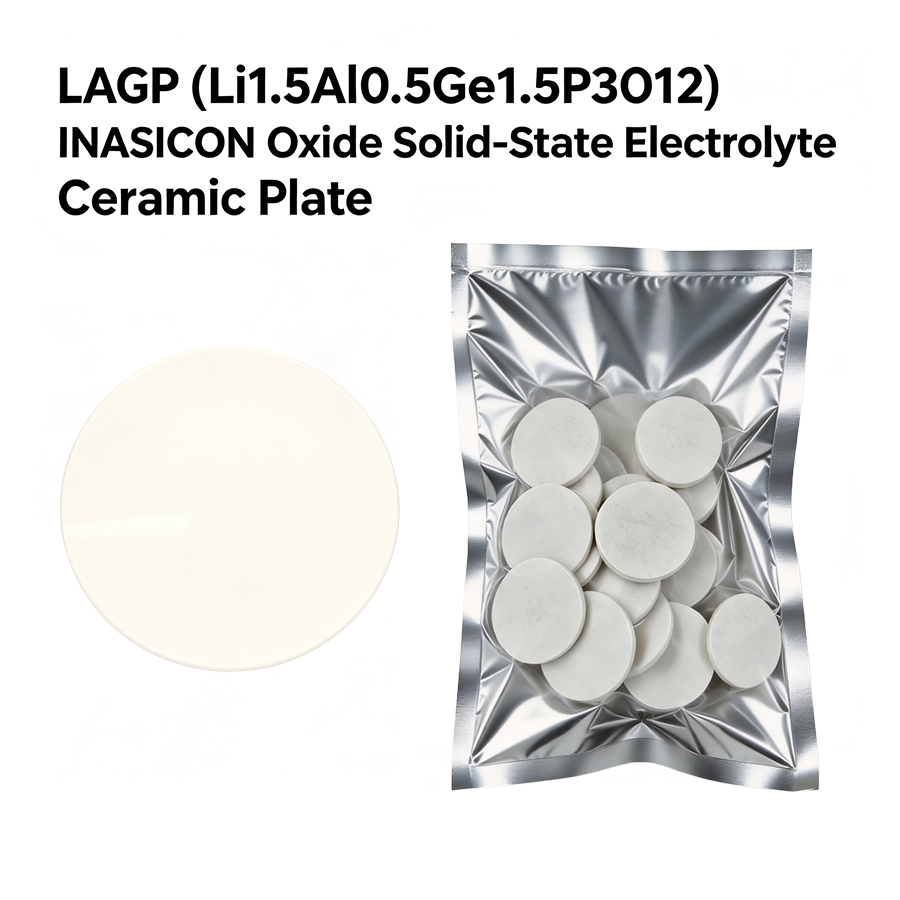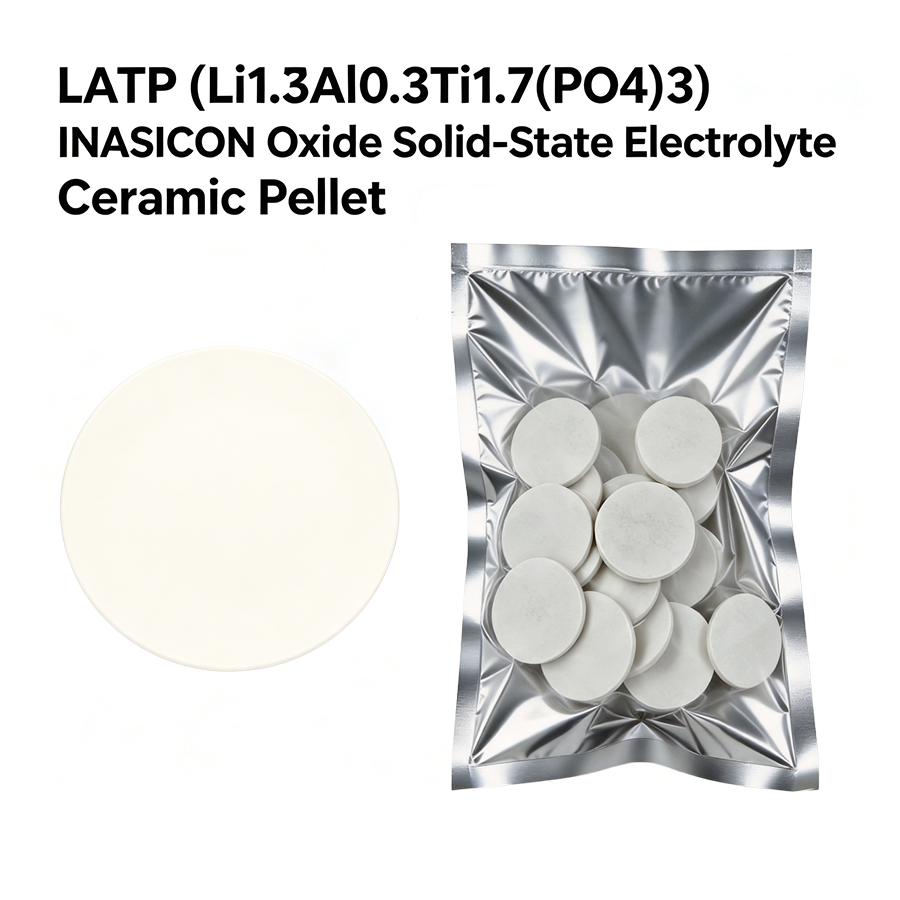
LATP (Li1.3Al0.3Ti1.7(PO4)3) NASICON Oxide Solid-State Electrolyte Ceramic PelletOxide Solid-State Electrolytes
|
||||||||||||||||||||||||||||||||||||||
|
||||||||||||||||||||||||||||||||||||||
|
The LATP pellet is a raw green-body ceramic susceptible to mechanical damage if mishandled. It requires storage in a sealed, dry environment to prevent moisture-induced degradation.
- Moisture Protection: Store the pellet in a sealed container in a cool, dry environment to protect from moisture.
- Mechanical Fragility: The pellet is supplied as a raw green body and may crack if subjected to mechanical stress.
- Reseal After Use: Reseal the packaging promptly after each use to maintain low humidity.
What is the ionic conductivity of this LATP ceramic pellet and how does it compare to other oxide solid electrolytes?
This LATP (Li1.3Al0.3Ti1.7(PO4)3) NASICON pellet has a specified ionic conductivity of ≥0.45 mS/cm. The source material does not provide comparative data against other oxide electrolytes; however, this value is a standard benchmark for NASICON-type LATP and is suitable for all-solid-state lithium battery testing and separator studies.
What thickness and diameter tolerances are available for this LATP pellet and how do they affect cell assembly?
The pellet thickness ranges from 100–500 μm with a tolerance of ±5%, and diameter ranges from 12–76 mm with a tolerance of ±0.5%. These dimensions allow direct integration into standard coin-cell or custom laboratory cell hardware, while the tight tolerances ensure reproducible interfacial contact during electrode–electrolyte assembly and electrochemical impedance testing.
What are the storage requirements for this LATP pellet to maintain its air-stable properties?
The product should be stored sealed in a cool, dry environment and protected from moisture. Although LATP is described as air-stable, the pellet is hygroscopic and must be resealed promptly after use to prevent degradation of its ionic conductivity and structural integrity.
LATP NASICON oxide ceramic pellet offers air-stable handling and controlled geometry for solid-state electrolyte research, but requires post-sintering of the green-body and careful moisture management during storage.
Positive
- Air-stable NASICON oxide: LATP is stable in ambient air, simplifying handling and storage compared to sulfide-based solid electrolytes, and enabling straightforward integration into laboratory assembly processes.
- Preformed pellet with controlled dimensions: Supplied as a ceramic pellet with thickness 100–500 μm (±5%) and diameter 12–76 mm (±0.5%), the geometry is directly suitable for cell assembly, impedance testing, and interface studies without additional shaping.
Trade-offs
- Green-body requires post-sintering: The pellet is supplied as raw green-body only; additional high-temperature sintering is necessary before electrochemical testing, requiring access to a programmable furnace and expertise in ceramic processing.
- Moisture sensitivity during storage: Despite air stability, the product must be stored sealed in a cool, dry environment and promptly resealed after use to prevent moisture uptake, which can degrade ionic conductivity.
Every advanced material, component, equipment, and instrument in our catalog is backed by rigorous testing. We maintain strict internal quality management frameworks and align with CE conformity metrics to deliver transparent, reproducible performance data via our public open-science repository.
To request raw batch performance data, submit formal vendor registration paperwork, or execute a fast-turnaround R&D manufacturing loop, contact us at inquiry@atomfair.com.
Item is dispatched under the Atomfair Shipping & Delivery Framework (Free worldwide shipping on orders over $59 USD excl. heavy equipment). Return is governed by the Atomfair Return & Refund Policy (7-day technical return window).