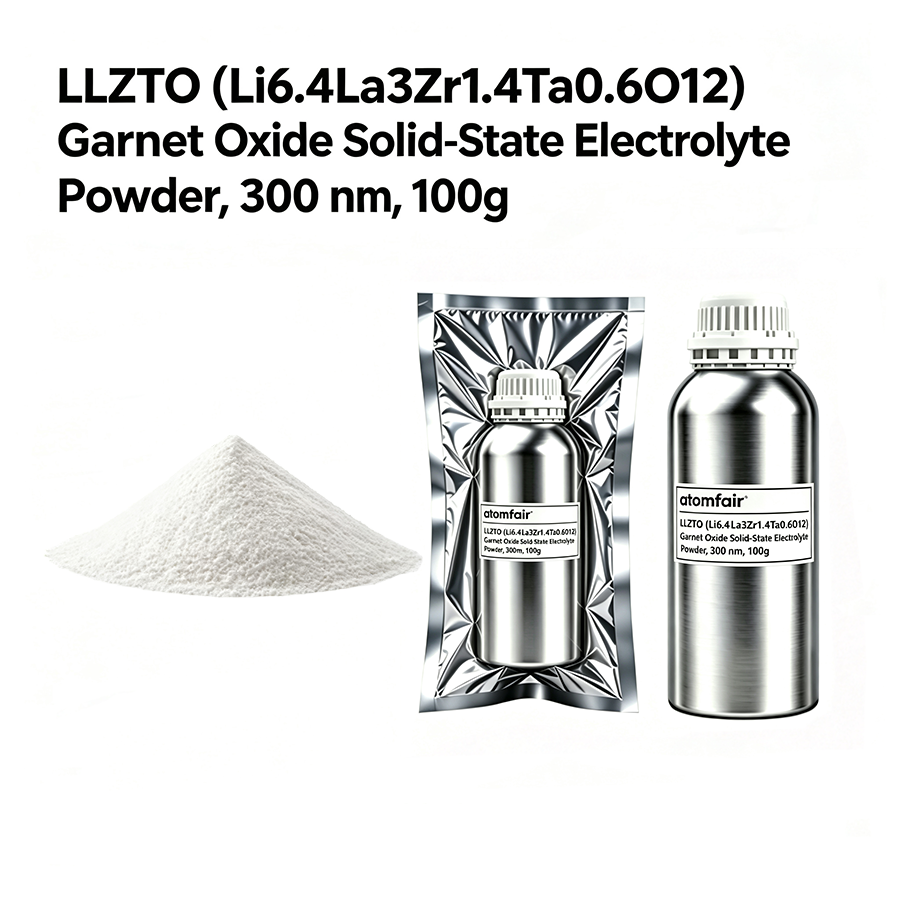
LLZTO (Li6.4La3Zr1.4Ta0.6O12) Garnet Oxide Solid-State Electrolyte Powder, 300 nmOxide Solid-State Electrolytes
|
|||||||||||||||||||||||||||||
|
|||||||||||||||||||||||||||||
|
This powder is moisture-sensitive and must be stored in a sealed, dry container to prevent degradation of ionic conductivity. Exposure to ambient humidity can compromise the garnet structure and reduce electrochemical performance.
- Moisture Sensitivity: Store in a sealed, dry container to avoid moisture uptake that can degrade ionic conductivity.
- pH Constraint: The powder exhibits a pH of 10 or higher, indicating alkalinity that may require compatible handling materials.
This procedure describes the densification of LLZTO powder into dense ceramic pellets for solid-state battery research. Proper handling and sintering are required to achieve the reported ionic conductivity of 1.0 × 10⁻³ S/cm.
Required Equipment: Die press, High-temperature furnace, Glovebox or dry room
- Transfer powder to glovebox
Transfer the LLZTO powder into an argon-filled glovebox or dry room to prevent moisture exposure. - Press into green pellet
Press the powder uniaxially in a die at 200–400 MPa to form a green pellet. - Sinter the pellet
Sinter the green pellet at 1100–1200 °C for 6–12 hours in a covered alumina crucible to achieve densification. - Cool and store
Cool the sintered pellet to room temperature and store it in a sealed, dry container until use.
How does the ~400 nm D50 particle size of this LLZTO powder influence the densification and ionic conductivity of sintered pellets?
The LLZTO powder is supplied with a D50 particle size of approximately 400 nm, which is suitable for preparing dense electrolyte pellets via ceramic processing. After proper densification, the material achieves an ionic conductivity of 1.0 × 10⁻³ S/cm at room temperature, as stated in the specification. Finer submicron particles typically enhance sintering kinetics and reduce porosity, directly impacting the final conductivity.
Is this LLZTO powder compatible with lithium-metal anodes and high-voltage cathode materials in solid-state batteries?
Yes, LLZTO (Li6.4La3Zr1.4Ta0.6O12) is designed for all-solid-state lithium battery research and offers strong compatibility potential with lithium-metal anodes and high-voltage cathode systems. It features a wide electrochemical stability window, which is advantageous for high-voltage operation, and its garnet structure provides a 3D lithium-ion conduction framework. The material's handling stability is also superior to sulfide electrolytes, making it a practical choice for interface engineering studies.
What special handling or storage conditions are required for this LLZTO powder given its pH ≥10 and hygroscopic nature?
The LLZTO powder has a pH of ≥10, indicating alkalinity, and should be stored in a sealed, dry container to prevent moisture absorption and potential reaction with atmospheric CO2. The supplier recommends following the Safety Data Sheet (SDS) and Certificate of Analysis (COA) for specific handling procedures. Compared to sulfide electrolytes, LLZTO offers better handling stability, but standard precautions for alkaline ceramic powders still apply.
LLZTO garnet oxide electrolyte powder offers a 3D Li⁺ conduction framework with 1.0×10⁻3 S/cm conductivity after densification, better air stability than sulfides, but requires careful sintering and handling due to high pH.
Positive
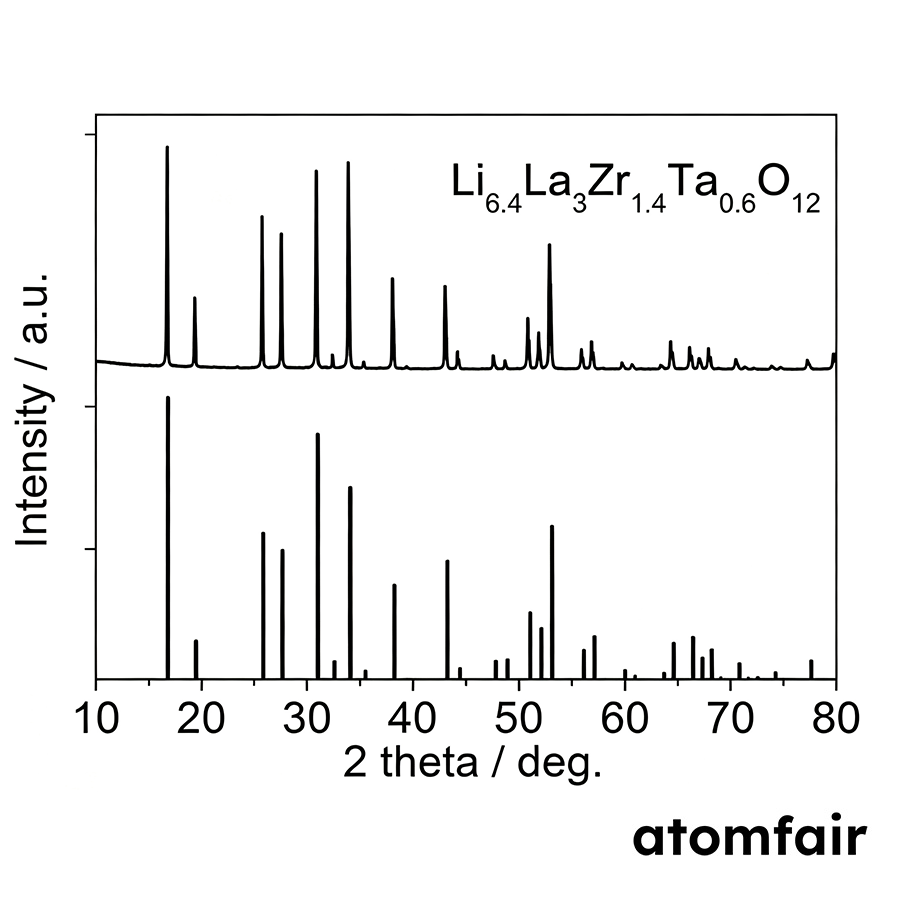
- Ta-doped cubic garnet structure: The Ta-doped cubic garnet structure provides a 3D lithium-ion conduction framework enabling fast Li⁺ migration, with ionic conductivity of 1.0×10⁻3 S/cm at room temperature after proper densification.
- Improved handling stability vs sulfides: Compared with sulfide electrolytes, LLZTO offers better handling stability, a wide electrochemical stability window, and strong compatibility with lithium-metal anodes and high-voltage cathodes.
Trade-offs
- Requires proper ceramic densification: The stated ionic conductivity of 1.0×10⁻3 S/cm is achieved only after proper ceramic densification; as-received powder may not exhibit this conductivity without additional sintering.
- High pH (≥10) requires careful handling: The powder has a pH of ≥10, indicating alkaline nature; it must be stored in sealed, dry containers and handled following SDS/COA to avoid moisture or skin contact.
Every advanced material, component, equipment, and instrument in our catalog is backed by rigorous testing. We maintain strict internal quality management frameworks and align with CE conformity metrics to deliver transparent, reproducible performance data via our public open-science repository.
To request raw batch performance data, submit formal vendor registration paperwork, or execute a fast-turnaround R&D manufacturing loop, contact us at inquiry@atomfair.com.
Item is dispatched under the Atomfair Shipping & Delivery Framework (Free worldwide shipping on orders over $59 USD excl. heavy equipment). Return is governed by the Atomfair Return & Refund Policy (7-day technical return window).