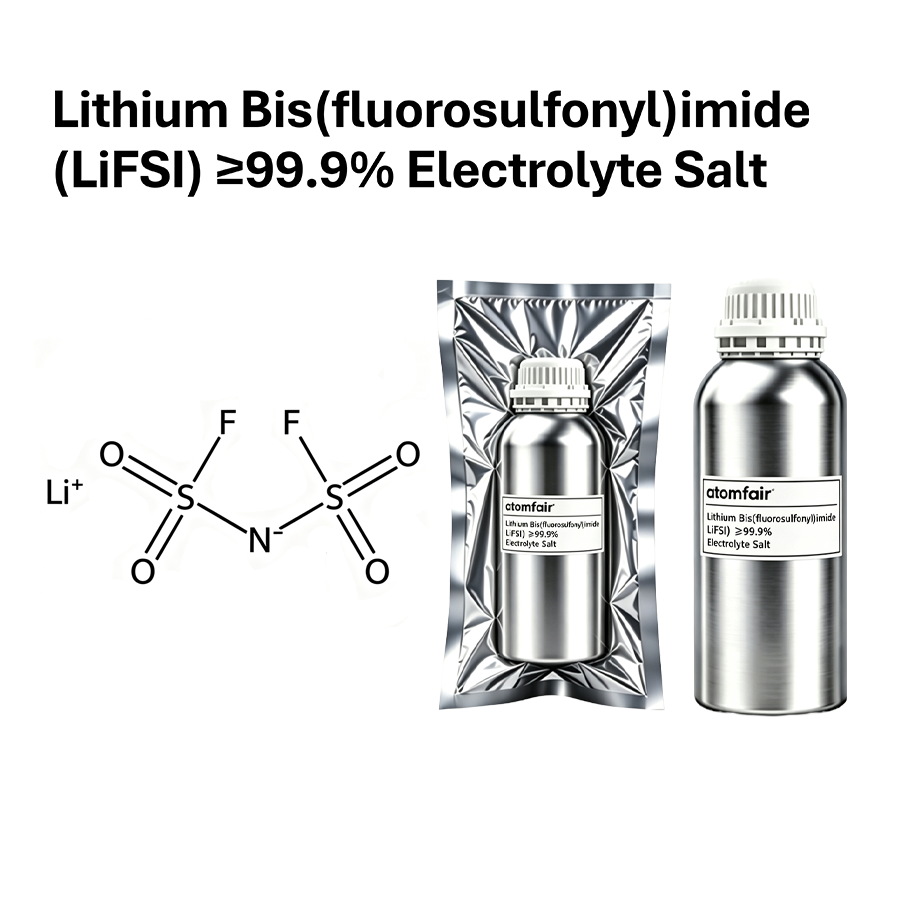
Lithium Bis(fluorosulfonyl)imide LiFSI 99.9% |
||||||||||||||||||
| Chemical Name: Lithium Bis(fluorosulfonyl)imide CAS Number: 171611-11-3 Grade: Research Grade Brand: ATOMFAIR® |
||||||||||||||||||
Product IntroductionLithium Bis(fluorosulfonyl)imide LiFSI 99.9% is a fast-moving lithium imide salt for advanced electrolyte development, especially where transport and wetting behavior need close attention. It is commonly selected in high-concentration and low-temperature studies, and it also fits lithium-metal or fast-charge screening programs where the electrolyte salt choice is part of the test matrix. Dry handling remains important, and the final solvent system still needs to be checked. |
||||||||||||||||||
Key Features
|
||||||||||||||||||
Specification
|
||||||||||||||||||
Application Areas
|
||||||||||||||||||
Handling and ProcurementDry handling: Keep sealed and dry; verify the target solvent system before blending. Procurement details: Check compatibility, documentation, and package size before procurement. Research-use notice: This material is intended for laboratory research and development. Final compatibility should be verified with the selected solvent, concentration, electrode, separator, and cell format.
|
||||||||||||||||||
Related Products |
||||||||||||||||||
|
TAILORED SOLUTIONS FOR RESEARCH
Contact our engineering team for technical support or official institutional quotations.
|
||||||||||||||||||
| Manufacturer: Atomfair LLC | Brand: ATOMFAIR® |
LiFSI is highly hygroscopic and must be stored in a sealed container under inert atmosphere to prevent moisture-induced degradation. Handling requires a dry, oxygen-free environment to maintain chemical stability and electrolyte performance.
- Moisture Sensitivity: LiFSI rapidly absorbs atmospheric moisture and undergoes hydrolysis, generating acidic byproducts that degrade electrolyte performance.
- Inert Atmosphere Requirement: All handling and storage operations must be performed in an argon-filled glovebox with very low moisture and oxygen levels to prevent contamination.
- Solvent Compatibility: LiFSI is soluble in standard organic carbonate solvents such as EC, DEC, and DMC, but must be dissolved under anhydrous conditions to avoid precipitation or decomposition.
- Temperature Stability: The salt is thermally stable up to 200°C, but prolonged exposure to elevated temperatures in the presence of moisture may accelerate hydrolytic decomposition.
How does LiFSI purity above 99.9% impact low-temperature electrolyte performance compared to standard LiPF6?
At ≥99.9% purity (typical 99.98%), LiFSI significantly lowers electrolyte viscosity and drastically enhances ionic mobility while inhibiting low-temperature crystallization, enabling stable discharge capacity under sub-zero cycling. This contrasts with LiPF6, which suffers from poor conductivity and crystallization at low temperatures. The minimized trace metal content (Na ≤10 ppm typical 1.12 ppm, Fe ≤10 ppm typical 1.73 ppm) further reduces catalytic side reactions, supporting high-rate performance in cold conditions.
Can LiFSI be used as a direct replacement for LiPF6 in standard carbonate-based electrolytes without modifying the electrolyte formulation?
No, LiFSI requires formulation adjustments because its higher ionic conductivity and lower viscosity alter the solvation structure and may increase aluminum current collector corrosion at elevated potentials. However, this high-purity LiFSI (≥99.9%) features structural balancing that suppresses standard oxidative pitting on current collectors, making it compatible with optimized next-generation electrolyte formulations that are not identical to standard LiPF6-based systems.
What are the critical storage and handling requirements for LiFSI to maintain its ≤150 ppm moisture specification?
LiFSI must be stored in a dry, inert atmosphere (e.g., argon-filled glovebox) to prevent moisture absorption and hydrolysis, as the product specification mandates moisture ≤150 ppm (typical 63.3 ppm). Handling should be performed under strict anhydrous conditions with immediate container resealing after use, since environmental moisture can elevate free acid levels beyond the ≤150 ppm limit (typical 46.3 ppm) and degrade battery-grade performance.
Atomfair LiFSI is a high-purity (≥99.9%) electrolyte salt offering superior ionic conductivity and low-temperature performance, with tightly controlled moisture and trace metal impurities for reliable battery research.
Positive
- Superior Conductivity Elevation: Yields exceptional ion transfer rates compared to standard lithium salts, optimizing power density profiles in next-generation batteries.
- Outstanding Sub-Zero Performance: Suppresses electrolyte phase crystallization thresholds, maintaining stable discharge capacity under cold environmental conditions.
Trade-offs
- Moisture Sensitivity Requires Dry Handling: With a certified moisture content ≤150 ppm, the salt must be stored and handled in low-humidity or inert environments to maintain its low moisture specification and prevent electrolyte contamination.
- Free Acid Content Monitoring Needed: Free acid levels ≤150 ppm necessitate controlled storage conditions to avoid hydrolysis and acid buildup that could degrade battery performance over time.
Every advanced material, component, equipment, and instrument in our catalog is backed by rigorous testing. We maintain strict internal quality management frameworks and align with CE conformity metrics to deliver transparent, reproducible performance data via our public open-science repository.
To request raw batch performance data, submit formal vendor registration paperwork, or execute a fast-turnaround R&D manufacturing loop, contact us at inquiry@atomfair.com.
Item is dispatched under the Atomfair Shipping & Delivery Framework (Free worldwide shipping on orders over $59 USD excl. heavy equipment). Return is governed by the Atomfair Return & Refund Policy (7-day technical return window).