Lithium Dicyano-2-trifluoromethylimidazole 99.9% |
||||||||||||||||||
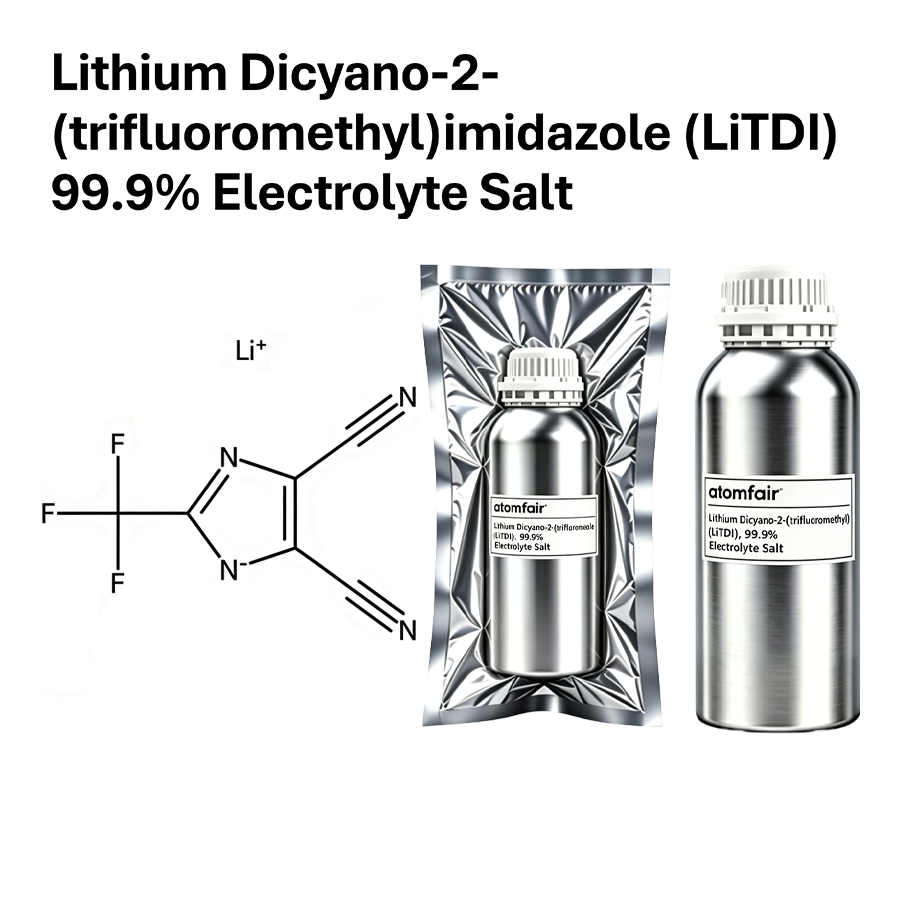
| Chemical Name: Lithium Dicyano-2-(trifluoromethyl)imidazole CAS Number: 761441-54-7 Grade: Research Grade Brand: ATOMFAIR® |
||||||||||||||||||
Product IntroductionLithium Dicyano-2-trifluoromethylimidazole 99.9% is a specialty heterocyclic lithium salt used in advanced electrolyte exploration rather than in routine baseline work. This kind of salt belongs in a page that sounds exploratory and precise: it is for researchers comparing solvation structures, salt families, and interphase behavior in a more experimental electrolyte matrix. The dry powder format is suitable for that kind of bench-scale work. |
||||||||||||||||||
Key Features
|
||||||||||||||||||
Specification
|
||||||||||||||||||
Application Areas
|
||||||||||||||||||
Handling and ProcurementDry handling: Treat it as an exploratory research salt and confirm the target formulation first. Procurement details: Check documentation and package size before procurement. Research-use notice: This material is intended for laboratory research and development. Final compatibility should be verified with the selected solvent, concentration, electrode, separator, and cell format.
|
||||||||||||||||||
Related Products |
||||||||||||||||||
|
TAILORED SOLUTIONS FOR RESEARCH
Contact our engineering team for technical support or official institutional quotations.
|
||||||||||||||||||
| Manufacturer: Atomfair LLC | Brand: ATOMFAIR® |
This material is moisture-sensitive and must be stored under an inert atmosphere to maintain its battery-grade quality. Any exposure to ambient humidity can compromise its electrochemical performance and accelerate degradation.
- Moisture Sensitivity: Store in a dry glovebox with <1 ppm water and oxygen to prevent hydrolysis of the lithium salt.
- Atmosphere Requirement: Always handle under argon or nitrogen purge; do not expose to air for extended periods.
- Temperature Stability: Maintain storage at 20–25 °C; avoid temperatures above 40 °C to prevent thermal decomposition.
- Container Integrity: Keep the original sealed container until use; reseal immediately after each withdrawal with a dry inert gas backfill.
- Contamination Prevention: Use only dedicated, anhydrous tools and spatulas to avoid cross-contamination with moisture or organics.
These steps ensure the material remains moisture-free during transfer and dissolution. Follow them in sequence to preserve the battery-grade specification for electrolyte formulation.
Required Equipment: Argon-filled glovebox (<1 ppm H2O, <1 ppm O2), Anhydrous polyethylene spatula, Pre-dried glass vial with PTFE-lined cap
- Transfer to Glovebox
Place the unopened container inside the glovebox antechamber and perform at least three vacuum-argon purge cycles before entry. - Open and Dispense
Open the container only inside the glovebox and quickly transfer the required mass using the anhydrous spatula into the pre-dried glass vial. - Reseal and Store
Immediately close the source container with its original cap, backfill with argon, and store both containers at room temperature in a dark, dry cabinet. - Prepare Solution
Add anhydrous solvent (e.g., EC/DMC) to the vial inside the glovebox and stir until the powder is fully dissolved, avoiding any splash above the liquid line.
How does the 99.9% purity of LiTDI affect electrochemical stability compared to standard lithium salts used in electrolyte formulations?
The 99.9% purity of LiTDI minimizes parasitic side reactions from trace impurities, enabling reproducible electrochemical performance in lithium-ion cells. Standard lower-purity salts introduce contaminants that degrade cycle life and coulombic efficiency. This battery-grade specification is critical for reliable electrolyte benchmarking and advanced anode/cathode studies.
What are the key compatibility constraints when incorporating LiTDI into a carbonate-based electrolyte system for high-voltage lithium-ion batteries?
LiTDI is designed as a battery-grade lithium salt for direct use in carbonate electrolyte systems such as EC/DMC, provided strict ambient moisture controls are observed. Its structural stability and high purity support compatibility with high-voltage cathode materials, but moisture ingress must be avoided to prevent hydrolysis that impairs ionic conductivity. The product's battery-grade moisture specification ensures reliable performance when handled under inert atmosphere.
What specific storage and handling conditions are required to preserve the battery-grade moisture integrity of LiTDI after opening the 50g package?
LiTDI must be stored and handled exclusively under strict ambient moisture controls, such as an argon-filled glovebox with moisture levels below 0.1 ppm, to maintain its battery-grade moisture specification. The 50g climate-controlled package ensures integrity during transit, but once opened, immediate use or resealing under inert atmosphere is mandatory. Exposure to ambient humidity will degrade the salt's performance in lithium-ion cell architectures.
Lithium 4,5-Dicyano-2-trifluoromethylimidazole (LiTDI) at 99.9% purity with battery-grade moisture control is assessed for high-precision electrolyte research. Its verified CAS identity and controlled handling requirements make it suitable for reproducible electrochemical studies, though users must manage moisture-sensitive storage and note its R&D-only designation.
Positive
- Ultra-high 99.9% purity: The 99.9% purity level is engineered for reproducible scientific research and advanced electrochemical analysis, minimizing variability in battery component studies.
- Battery-grade moisture control: Strict battery-grade moisture limits in the material ensure reliable performance inside lithium-ion cell architectures where trace water can degrade electrolytes.
Trade-offs
- Strict moisture handling required: The material must be handled under strict ambient moisture controls to preserve battery-grade integrity, necessitating glovebox or dry-room infrastructure.
- Research-grade only designation: Explicitly labeled for laboratory research and development only, this product is not approved for commercial battery manufacturing or clinical applications.
Every advanced material, component, equipment, and instrument in our catalog is backed by rigorous testing. We maintain strict internal quality management frameworks and align with CE conformity metrics to deliver transparent, reproducible performance data via our public open-science repository.
To request raw batch performance data, submit formal vendor registration paperwork, or execute a fast-turnaround R&D manufacturing loop, contact us at inquiry@atomfair.com.
Item is dispatched under the Atomfair Shipping & Delivery Framework (Free worldwide shipping on orders over $59 USD excl. heavy equipment). Return is governed by the Atomfair Return & Refund Policy (7-day technical return window).