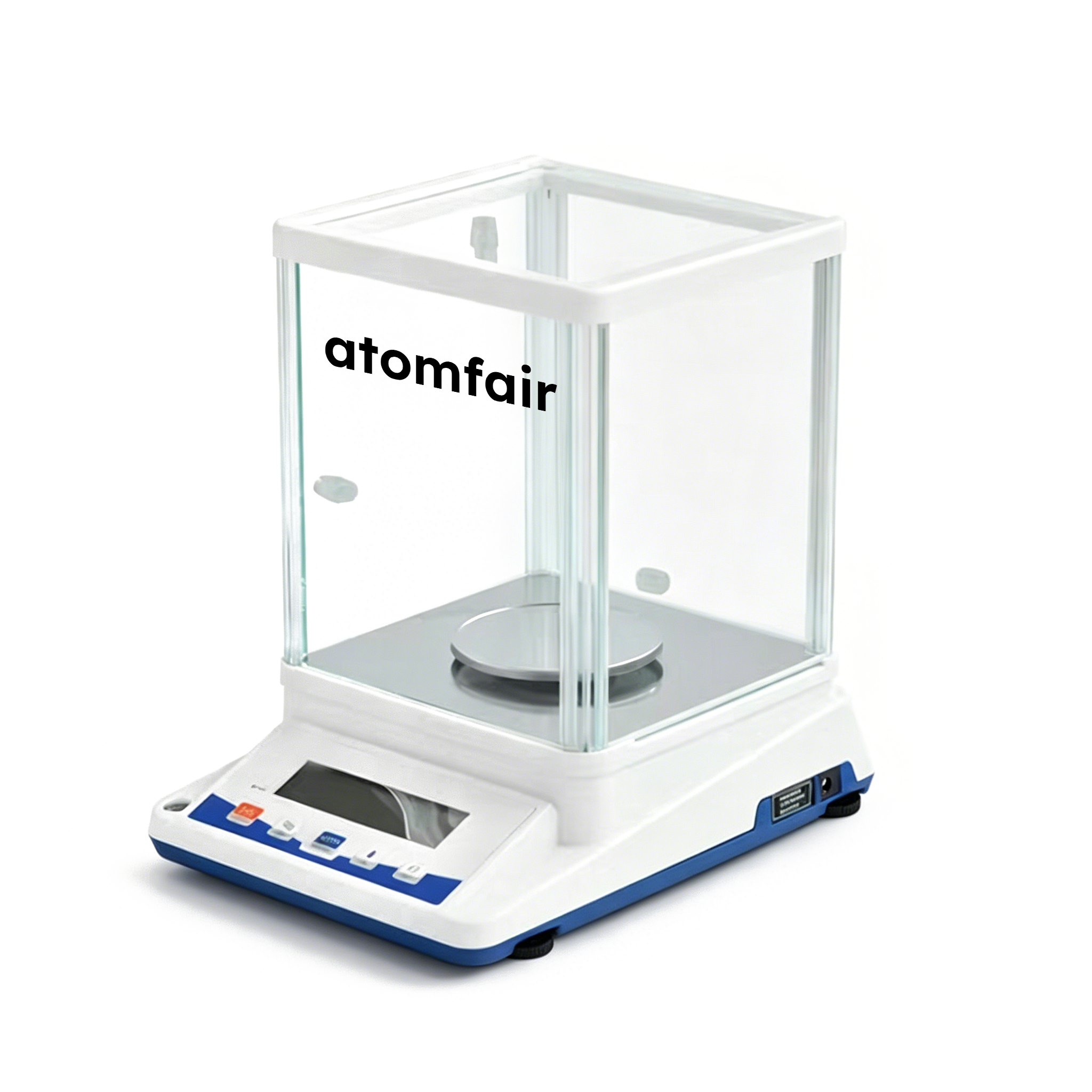
ATOMFAIR PRECISION ELECTRONIC ANALYTICAL BALANCE (110G / 0.001G)HIGH-PRECISION METROLOGY HARDWARE
|
|||||||||||||||||||||||||||||||||
|
|||||||||||||||||||||||||||||||||
|
TAILORED SOLUTIONS FOR RESEARCH
Contact our engineering team for technical support or customized equipment quotations.
EMAIL: INQUIRY@ATOMFAIR.COM
|
|||||||||||||||||||||||||||||||||
|
Manufacturer: Atomfair LLC
Brand: ATOMFAIR
|
An analytical balance requires a stable environment free from vibration and air currents to achieve 0.001 g resolution. External calibration with the provided 100 g standard must be performed prior to use to maintain accuracy.
- Environmental Conditions: Place the balance on a vibration-isolated bench away from drafts, vents, and direct sunlight to prevent measurement drift.
- Calibration Requirement: Activate the external calibration routine using the included 100 g standard weight each time the balance is moved or when operating conditions change significantly.
- Minimum Load Threshold: Ensure the sample mass exceeds 0.004 g to remain within the verified linearity range and avoid exceeding the minimum weighing threshold.
This procedure outlines the steps to set up and use the precision analytical balance for accurate mass determination. Following these steps ensures repeatable measurements within the instrument's specified tolerance.
Required Equipment: Draft shield analytical balance, External calibration weight (100 g)
- Position the Balance
Place the balance on a stable, vibration-free laboratory bench with the draft shield closed to isolate the weighing chamber from air currents. - Level the Instrument
Adjust the four leveling feet until the built-in bubble level indicator is centered, ensuring the balance sits horizontally. - Perform External Calibration
Press the calibration key and, when prompted, place the provided 100 g standard weight on the pan, then wait for the balance to confirm successful calibration. - Zero the Balance
Remove the calibration weight and press the tare/zero key to set the display to 0.000 g with the empty weighing pan. - Tare a Container
Place an empty weighing container on the pan and press the tare key to subtract its mass, zeroing the display again. - Add Sample and Measure
Carefully add the sample to the container using a clean spatula, ensuring no material contacts the draft shield walls, then close the shield door. - Read Stable Mass
After the stabilization indicator appears (within 3 seconds), record the displayed mass to 0.001 g resolution.
At what sample mass does the ±0.002 g repeatability become the dominant uncertainty contributor relative to the 0.001 g readability?
The ±0.002 g repeatability dominates measurement uncertainty for samples below approximately 20 mg. At the minimum weighing threshold of 0.001–0.004 g, the combined repeatability (±0.002 g) and linearity error (±0.003 g) can exceed 100% of the measured value, so routine weighing below 10 mg requires careful uncertainty budgeting and is not supported for absolute quantitative work.
Can this balance be integrated into a high-throughput pharmaceutical compounding workflow requiring consecutive measurements under five seconds?
Yes, with a stabilization time of ≤3 seconds and a 110 g capacity at 0.001 g resolution, the balance supports rapid serial measurements typical in pharmaceutical compounding. The draft shield must be fully closed between samples to avoid airflow artifacts, and external calibration with the included 100 g weight should be performed at the start of each session to maintain the ±0.003 g linearity specification.
What environmental conditions are critical to achieving the specified ±0.002 g repeatability over extended use?
The balance requires a vibration-free, level surface and stable ambient temperature; the integrated draft shield (175 mm × 180 mm × 205 mm) suppresses convection currents. External calibration with the supplied 100 g weight must be performed immediately after any environmental change to verify the ±0.003 g linearity envelope. Without these conditions, the repeatability tolerance of ±0.002 g cannot be guaranteed across the full 110 g range.
The ATOMFAIR 110g/0.001g analytical balance provides high-resolution 1 mg precision with a rapid ≤3 second stabilization and a draft shield for airflow isolation, but its external calibration requirement and 0.004 g minimum loading threshold introduce operational constraints for sub-milligram measurements.
Positive
- High-Resolution 1 mg Precision Core: Provides exceptional accuracy down to 0.001 g across a 110 g capacity, enabling precise micro-reagent weighing and delicate material measurements.
- Rapid ≤3 Second Stabilization: Refined balancing circuitry achieves stable readouts in under three seconds, streamlining high-volume measurement workflows.
Trade-offs
- External Calibration Required: Relies on manual external calibration using the included 100 g standard weight, requiring user intervention and proper technique to maintain accuracy.
- Minimum Loading Threshold of 0.004 g: Accurate measurements are reliable only above 0.004 g; samples below this threshold may fall outside the instrument's precision envelope.
Every advanced material, component, equipment, and instrument in our catalog is backed by rigorous testing. We maintain strict internal quality management frameworks and align with CE conformity metrics to deliver transparent, reproducible performance data via our public open-science repository.
To request raw batch performance data, submit formal vendor registration paperwork, or execute a fast-turnaround R&D manufacturing loop, contact us at inquiry@atomfair.com.
Item is dispatched under the Atomfair Shipping & Delivery Framework (Free worldwide shipping on orders over $59 USD excl. heavy equipment). Return is governed by the Atomfair Return & Refund Policy (7-day technical return window).