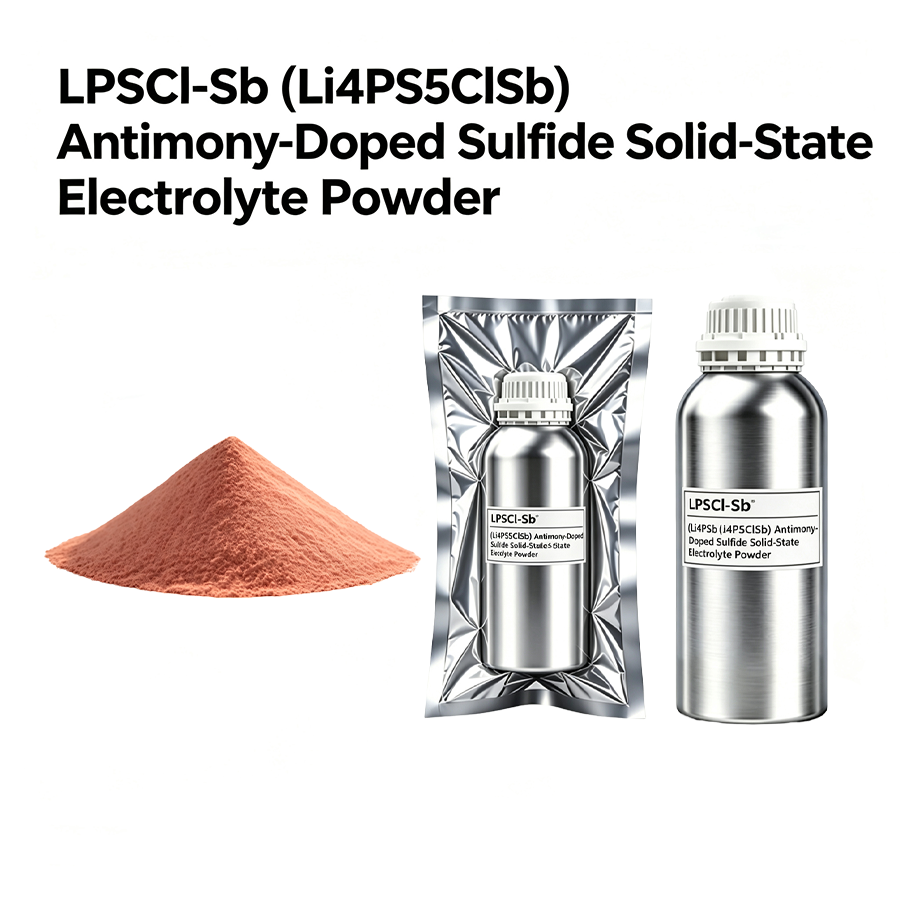
LPSCl‑Sb (Li4PS5ClSb) Antimony‑Doped Sulfide Solid‑State Electrolyte PowderSulfide Solid-State Electrolytes
|
|||||||||||||||||||||||||
|
|||||||||||||||||||||||||
|
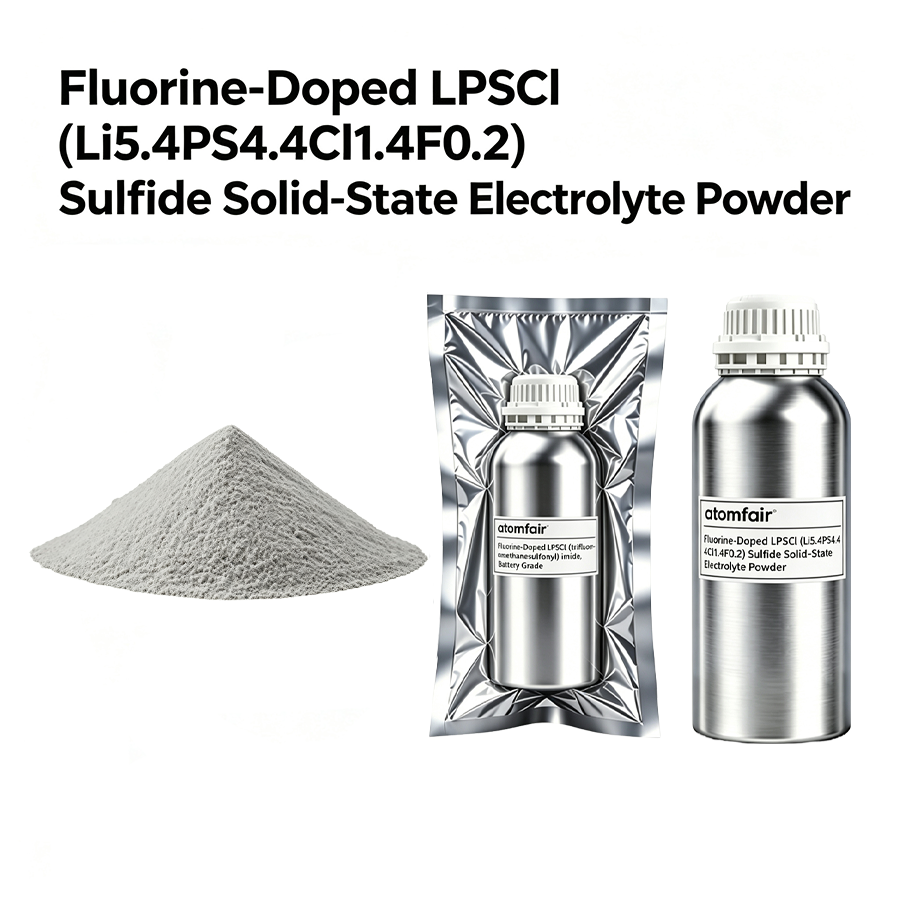
Store the powder in the original argon-filled vacuum-sealed package in a cool, dry environment. The material is highly moisture-sensitive and will release toxic sulfur-containing gases upon hydrolysis, requiring all handling to occur in an inert-atmosphere glovebox.
- Moisture Sensitivity: Exposure to ambient moisture causes hydrolysis and generation of toxic hydrogen sulfide gas.
- Storage Requirement: Keep sealed in original packaging under argon in a cool, dry location.
- Handling Environment: Open and sample the powder only inside a glovebox with controlled inert atmosphere.
- Post-Opening Stability: Use the material promptly after opening and avoid prolonged exposure to air.
- Gas Release Hazard: Hydrolysis produces toxic sulfur-containing gases; ensure adequate ventilation and safety protocols.
How does the ionic conductivity of LPSCl-Sb (Li4PS5ClSb) compare to standard LPSCl, and what benefit does antimony doping provide for lithium metal anode compatibility?
LPSCl-Sb maintains a high lithium-ion conductivity of 2 mS/cm at 25°C and 300 MPa, comparable to standard argyrodite LPSCl, while the antimony doping significantly improves interfacial compatibility with metallic lithium anodes, reducing side reactions and enabling stable cycling in all-solid-state batteries.
What are the critical handling and processing conditions for LPSCl-Sb powder to avoid decomposition during all-solid-state battery assembly?
LPSCl-Sb is highly moisture-sensitive and releases toxic sulfur-containing gas upon hydrolysis. It must be opened and handled only in an inert atmosphere glovebox, stored in an argon-filled vacuum-sealed package in a cool-dry environment, and used promptly after opening to avoid air exposure. Cold pressing at 300 MPa is recommended for dense pellet formation.
What safety precautions are required when working with LPSCl-Sb sulfide electrolyte powder in a laboratory setting?
Due to its high sensitivity to moisture, LPSCl-Sb must be handled exclusively in a glovebox under inert atmosphere. Upon exposure to water, it releases toxic sulfur-containing gases. The material should be stored in an argon-filled vacuum-sealed package in a cool, dry place. After opening, use immediately and avoid any contact with air.
LPSCl-Sb (Li4PS5ClSb) antimony-doped sulfide solid-state electrolyte powder offers a targeted improvement in interfacial compatibility with metallic lithium anodes while maintaining a high ionic conductivity of 2 mS/cm at 25°C and 300 MPa, making it suitable for all-solid-state lithium-metal battery research and composite catholyte preparation. The material is cold-pressable into dense pellets, but its extreme moisture sensitivity requires handling exclusively in an inert atmosphere glovebox and storage in argon-filled vacuum-sealed packaging to prevent hydrolysis and release of toxic sulfur-containing gases.
Positive
- Enhanced lithium anode compatibility: Antimony doping improves interfacial stability with metallic lithium anodes, reducing deleterious side reactions and enabling more reliable cycling in all-solid-state lithium-metal batteries.
- Cold-pressable into dense pellets: The powder can be directly cold-pressed into dense electrolyte pellets without high-temperature sintering, simplifying fabrication and preserving the argyrodite structure for laboratory cell assembly.
Trade-offs
- Extreme moisture sensitivity: The material is highly moisture-sensitive and releases toxic sulfur-containing gases upon hydrolysis; all handling and sampling must be performed exclusively in an inert atmosphere glovebox, and storage requires argon-filled vacuum-sealed packaging.
- Limited particle size range: The specified particle size of 2–10 µm may constrain slurry processing or composite cathode homogeneity, as finer or more monodisperse fractions are not available from this product listing.
Every advanced material, component, equipment, and instrument in our catalog is backed by rigorous testing. We maintain strict internal quality management frameworks and align with CE conformity metrics to deliver transparent, reproducible performance data via our public open-science repository.
To request raw batch performance data, submit formal vendor registration paperwork, or execute a fast-turnaround R&D manufacturing loop, contact us at inquiry@atomfair.com.
Item is dispatched under the Atomfair Shipping & Delivery Framework (Free worldwide shipping on orders over $59 USD excl. heavy equipment). Return is governed by the Atomfair Return & Refund Policy (7-day technical return window).