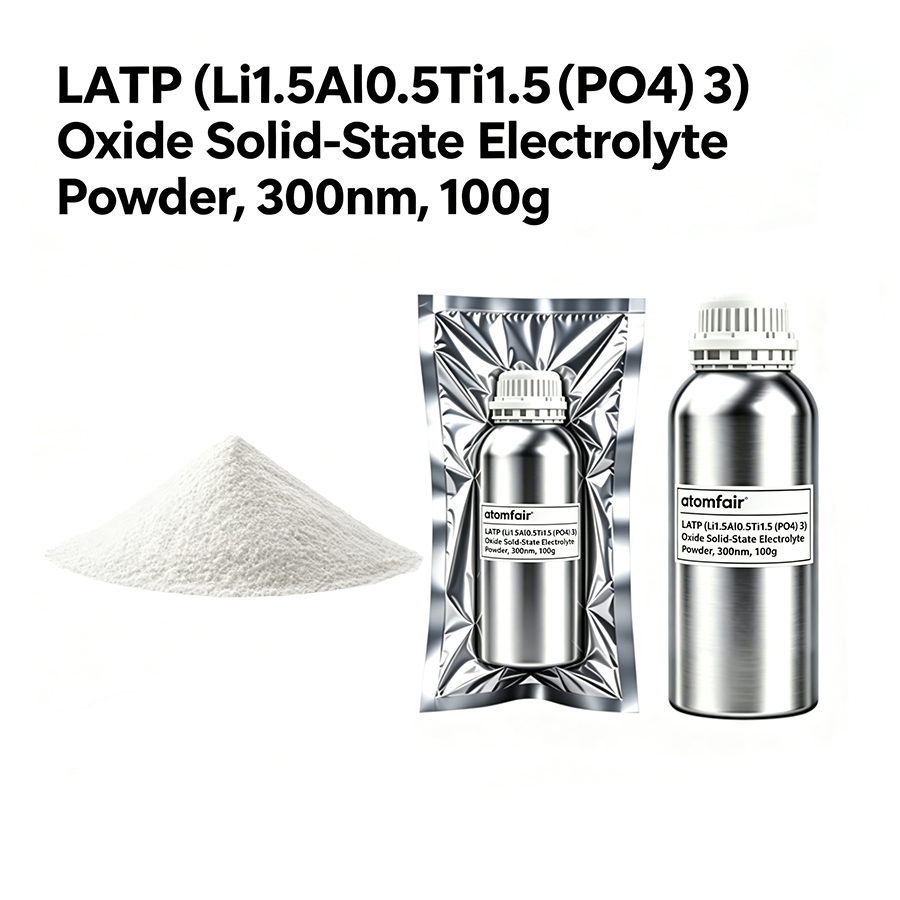
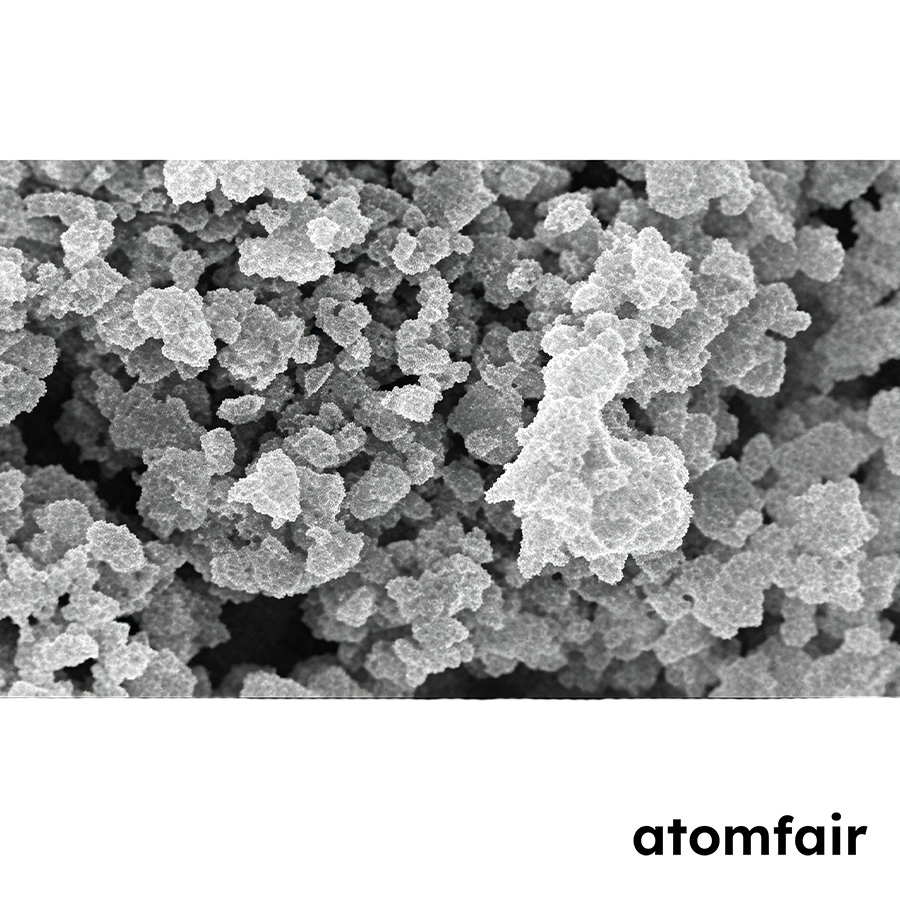
LATP (Li1.5Al0.5Ti1.5(PO4)3) Oxide Solid-State Electrolyte Powder,300nmOxide Solid-State Electrolytes
|
|||||||||||||||||||||||||||||||||
|
|||||||||||||||||||||||||||||||||
|
LATP oxide solid-state electrolyte powder requires controlled storage and handling to maintain its ionic conductivity and structural integrity. The material is air-stable but must be protected from moisture, and particle size selection is critical for optimal performance in solid-state battery applications.
- Moisture Sensitivity: Moisture content must be maintained below 2000 ppm to avoid degradation of ionic conductivity.
- Storage Requirements: Store sealed in a cool, dry environment and reseal promptly after use to preserve material integrity.
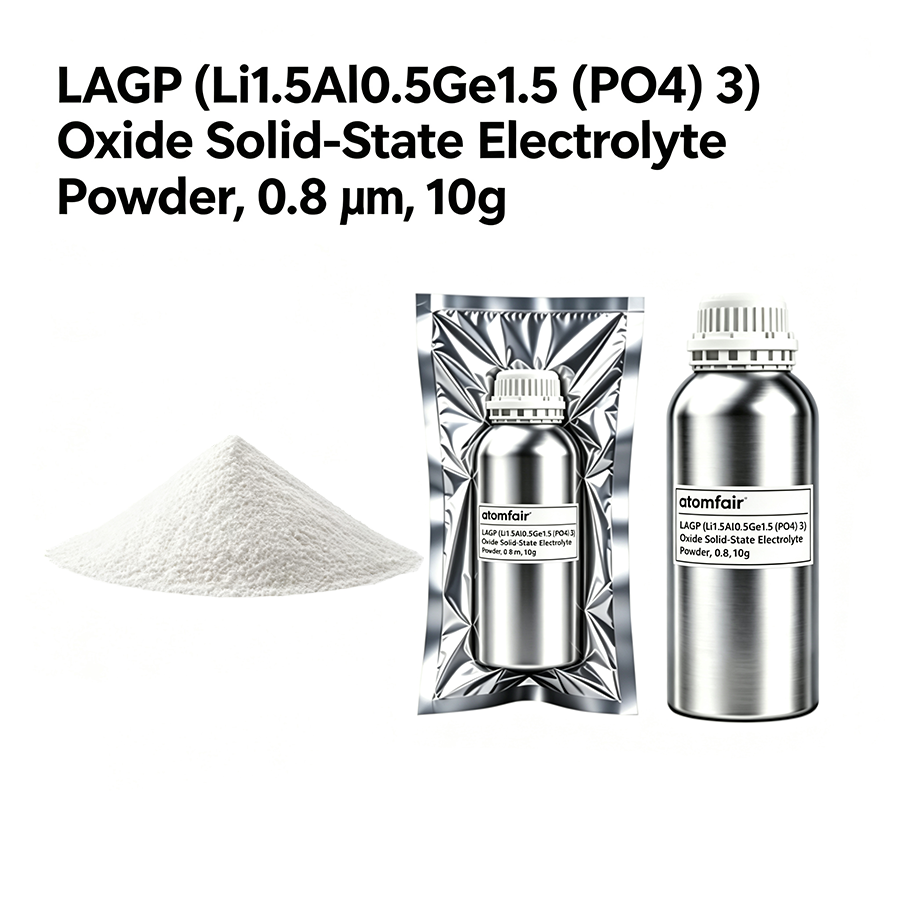
- Particle Size Selection: Select the appropriate particle size grade (5 µm, 600 nm, or 300 nm) to match the target application in pellets, films, or electrodes.
- Cathode Compatibility: Verify compatibility with NCM and LCO cathodes for the intended cell design, as interfacial reactions may affect performance.
- Handling Atmosphere: Basic handling can be performed in air, but prolonged exposure to high humidity should be avoided.
What specific advantages does the 300 nm particle size of LATP powder offer for solid-state battery composite electrolyte fabrication?
The 300 nm grade is designed for nanocomposite electrolyte films and high-loading composite electrodes, where sub-micron particles improve interfacial contact and film uniformity. The source lists this grade alongside 5 µm and 600 nm options, allowing researchers to match particle size to the specific processing method, with the 300 nm grade being optimal for polymer-ceramic composite systems and high-loading cathodes with NCM or LCO.
Is LATP 300 nm powder compatible with NCM and LCO cathodes in all-solid-state batteries?
Yes, the source explicitly states that LATP is compatible with NCM and LCO cathodes, making it suitable for use in composite cathodes. Its 3D NASICON framework provides a wide electrochemical window and fast Li⁺ migration pathways (ionic conductivity of 4×10⁻⁴ S/cm at 25°C), which supports stable operation with these cathode materials.
What are the handling and storage requirements for LATP 300 nm powder to preserve its ionic conductivity?
LATP is air-stable and can be handled without a glovebox, unlike sulfide electrolytes. The source specifies storing it sealed in a cool, dry environment protected from moisture, with a moisture content of <2000 ppm and a shelf life of 1 year when sealed. Resealing promptly after use is recommended to maintain low moisture levels.
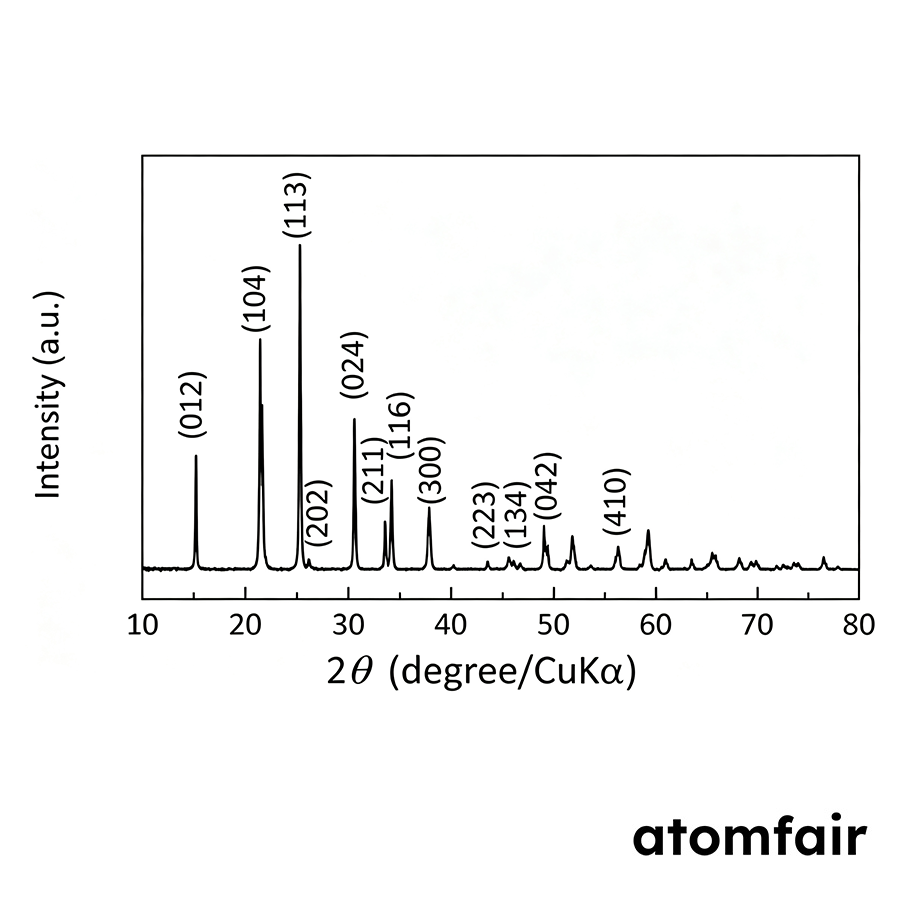
This 300 nm D50 LATP (Li1.5Al0.5Ti1.5(PO4)3) oxide solid-state electrolyte powder delivers a NASICON-structured framework with 4×10⁻⁴ S/cm ionic conductivity at 25°C while remaining air-stable for simplified handling outside a glovebox. The submicron particle size is specifically suited for nanocomposite films and high-loading composite electrodes in all-solid-state lithium battery research, though careful moisture control during storage and processing is required to maintain performance.
Positive
- Air-stable oxide chemistry: LATP is a NASICON-structured oxide that is stable in air and does not require a glovebox for basic handling, unlike sulfide electrolytes, simplifying lab workflow and reducing infrastructure demands.
- High ionic conductivity: With an ionic conductivity of 4×10⁻⁴ S/cm at 25°C, this material provides fast Li⁺ transport via its 3D NASICON framework, supporting efficient ion migration in solid-state battery architectures.
Trade-offs
- Moisture-sensitive storage: The powder must be stored sealed in a cool, dry environment and resealed promptly after use to maintain moisture content below 2000 ppm and ensure the 1-year shelf life; exposure to ambient moisture can degrade performance.
Every advanced material, component, equipment, and instrument in our catalog is backed by rigorous testing. We maintain strict internal quality management frameworks and align with CE conformity metrics to deliver transparent, reproducible performance data via our public open-science repository.
To request raw batch performance data, submit formal vendor registration paperwork, or execute a fast-turnaround R&D manufacturing loop, contact us at inquiry@atomfair.com.
Item is dispatched under the Atomfair Shipping & Delivery Framework (Free worldwide shipping on orders over $59 USD excl. heavy equipment). Return is governed by the Atomfair Return & Refund Policy (7-day technical return window).