High-Power Long-Duration Battery Series | ATOMFAIRCOMMERCIAL GRADE · PRODUCTION
|
|||||||||||||||||||||||||||||||||||||||||||||||||||
|
|||||||||||||||||||||||||||||||||||||||||||||||||||
|
TAILORED SOLUTIONS FOR RESEARCH
Contact our engineering team for technical support or official institutional quotations.
EMAIL: inquiry@atomfair.com
|
|||||||||||||||||||||||||||||||||||||||||||||||||||
|
Manufacturer: Atomfair LLC
Brand: ATOMFAIR®
|
These cells require moisture-barrier vacuum-sealed packaging for storage and must be operated within specified voltage and temperature ranges. Pre-conditioning at 25°C before first use and integration with a protective BMS are mandatory for safe operation.
- Voltage and Temperature Compliance: Operate the cell strictly within the voltage and temperature limits defined for each model to prevent degradation or failure.
- BMS Requirement: Always use a Battery Management System (BMS) with overcurrent, short-circuit, and temperature protection to ensure safe operation.
- Pre-Conditioning: Pre-condition the cell at 25°C before first use to stabilize internal chemistry and ensure reliable performance.
- Thermal Management for High-Rate Discharge: High-rate discharge may require active thermal management to maintain the cell within safe temperature limits.
Before first use, precondition the cell at 25°C and install a BMS with overcurrent, short-circuit, and temperature protection. For high-rate discharge applications, ensure active thermal management is in place to maintain temperature within safe limits.
Required Equipment: Battery Management System (BMS) with overcurrent, short-circuit, and temperature protection, Active thermal management system (for high-rate discharge applications)
- Inspect Packaging
Inspect the moisture-barrier vacuum-sealed packaging for any damage before opening the cell. - Pre-Condition Cell
Pre-condition the cell at 25°C before first use to stabilize its internal chemistry. - Install BMS
Install a Battery Management System (BMS) with overcurrent, short-circuit, and temperature protection to ensure safe operation. - Implement Thermal Management
Implement active thermal management if the cell will be operated at high discharge rates. - Operate Within Limits
Operate the cell within the specified voltage and temperature ranges for optimal performance and safety.
How does the cycle life vary across the 20Ah, 35Ah, and 50Ah models of the ATOMFAIR High-Power Long-Duration Battery Series, and what is the trade-off with discharge rate?
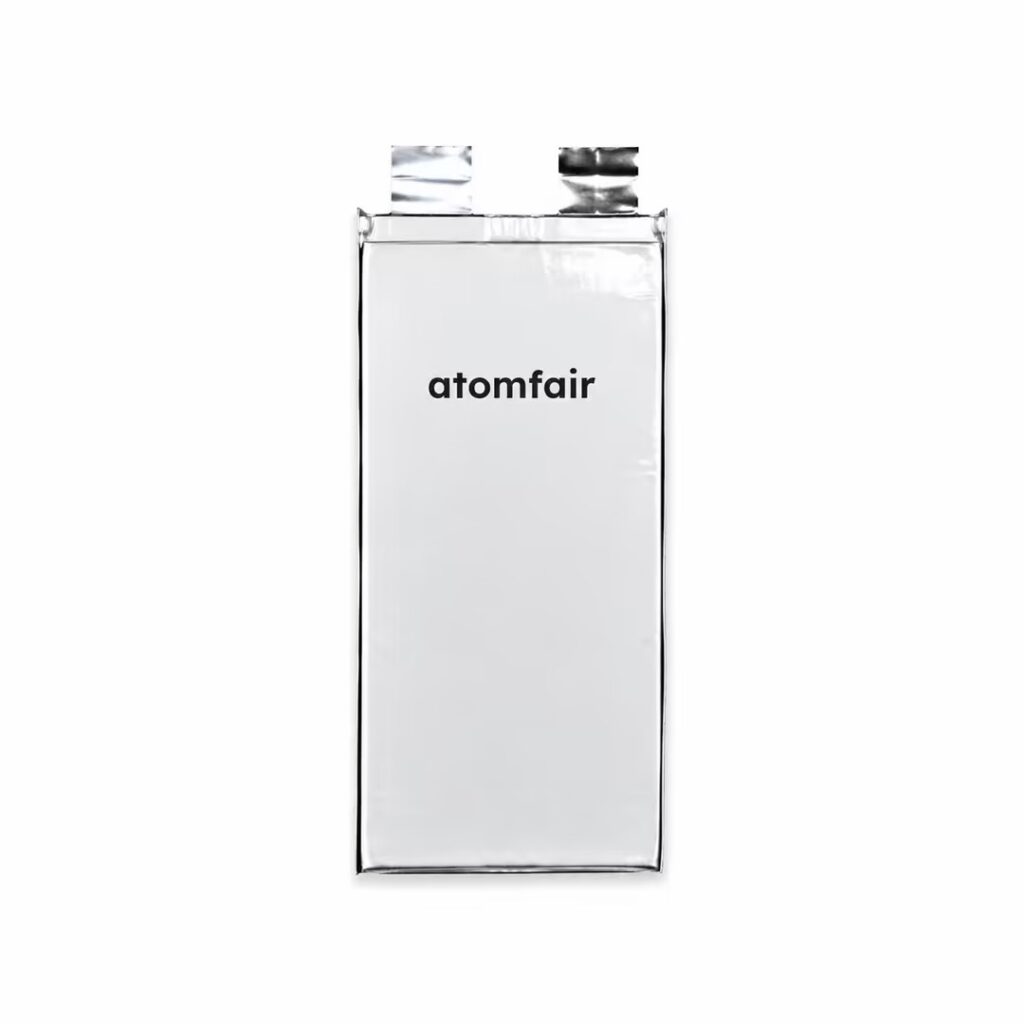
The 50Ah model (AFPD10161231) offers the longest cycle life at ≥2000 cycles at 80% SOH, while the 20Ah model (AFPD6974172) provides ≥800 cycles and the 35Ah model (AFPD99133202) ≥1200 cycles. However, the 35Ah model supports the highest maximum discharge rate of 5C, compared to 3C for both the 20Ah and 50Ah models, making it the preferred choice for applications requiring burst power without sacrificing cycle life as much as the 20Ah variant.
What BMS and thermal management are required when operating the ATOMFAIR semi-solid electrolyte battery at high discharge rates?
The manufacturer mandates using a BMS with overcurrent, short-circuit, and temperature protection. High-rate discharge—especially at 5C for the 35Ah model—may require active thermal management to keep the cell within the operating temperature range (-20°C to +65°C for discharge). Cells must be pre-conditioned at 25°C before first use to ensure stable performance.
What are the recommended storage, handling, and pre-conditioning procedures for the ATOMFAIR High-Power Long-Duration Battery cells?
Cells are shipped in moisture-barrier vacuum-sealed aluminum foil bags inside anti-static cartons to prevent moisture ingress. For optimal performance and safety, operate within specified voltage ranges (e.g., 2.5–4.3V for the 50Ah model) and avoid sustained temperatures above the recommended limits. Pre-condition at 25°C before first use, and always use a BMS with overcurrent, short-circuit, and temperature protection.
The ATOMFAIR High-Power Long-Duration Battery Series offers 20–50 Ah pouch cells with semi-solid electrolyte, delivering up to 5C discharge and 2000 cycles at 80% SOH, but requires active thermal management and mandatory BMS integration for safe operation.
Positive
- High discharge rate capability: The 35Ah model supports up to 5C continuous discharge, enabling high-power applications such as EV acceleration and industrial power tools.
- Extended cycle life: The 50Ah model achieves 2000 cycles at 80% state of health, significantly reducing total cost of ownership over the battery's lifetime.
Trade-offs
- Requires active thermal management: High-rate discharge (3C–5C) generates significant heat; active cooling systems are recommended to maintain safe operating temperatures.
- Mandatory BMS integration: Cells must be operated with a battery management system (BMS) providing overcurrent, short-circuit, and temperature protection to ensure safe operation.
Every advanced material, component, equipment, and instrument in our catalog is backed by rigorous testing. We maintain strict internal quality management frameworks and align with CE conformity metrics to deliver transparent, reproducible performance data via our public open-science repository.
To request raw batch performance data, submit formal vendor registration paperwork, or execute a fast-turnaround R&D manufacturing loop, contact us at inquiry@atomfair.com.
Item is dispatched under the Atomfair Shipping & Delivery Framework (Free worldwide shipping on orders over $59 USD excl. heavy equipment). Return is governed by the Atomfair Return & Refund Policy (7-day technical return window).