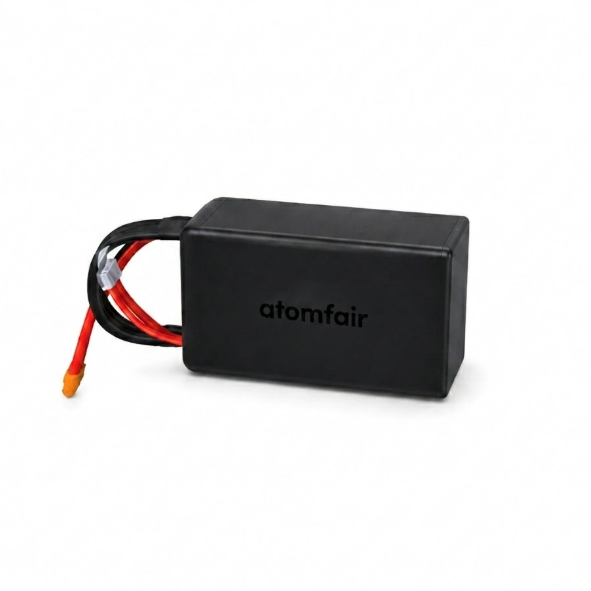
ES01 Compact Solid-State Cells (High-Energy UAV Series) | ATOMFAIRCOMMERCIAL GRADE · PRODUCTION
|
|||||||||||||||||||||||||||||||||||
|
|||||||||||||||||||||||||||||||||||
|
TAILORED SOLUTIONS FOR RESEARCH
Contact our engineering team for technical support or official institutional quotations.
EMAIL: INQUIRY@ATOMFAIR.COM
|
|||||||||||||||||||||||||||||||||||
|
MANUFACTURER: ATOMFAIR LLC
BRAND: ATOMFAIR®
|
|||||||||||||||||||||||||||||||||||
This solid-state cell requires a uniform external pressure boundary to maintain layer consolidation and must be operated within specified voltage and temperature limits. Use only with aerospace-grade management cards designed for real-time high-drain monitoring.
- Compression Fixture Requirement: Secure the cell within a rigid compression fixture plate array to ensure uniform physical contact.
- Voltage Threshold Compliance: Manage voltage configurations strictly within the manufacturer's recommended thresholds.
- Thermal Operational Range: Operate the cell within the specified temperature range of -40°C to +60°C for the ES0140140T1-6 model and -20°C to +60°C for the other models.
- Pulse Current Limitation: Transient pulse currents must not exceed 8C, and the cell surface temperature must remain below 45°C.
- Vibration Resistance: The solid electrolyte structure withstands high-frequency vibration but must be secured to prevent micro-peeling.
Follow these steps to secure the cell in a compression fixture, connect monitoring hardware, and configure voltage limits. Proper initialization ensures safe operation and long cycle life.
Required Equipment: Rigid compression fixture plate array, Aerospace-grade management card
- Secure Cell in Compression Fixture
Secure the solid-state cell within a rigid compression fixture plate array inside the battery pack chassis. - Attach Management Card
Attach an aerospace-grade management card to the cell terminals for real-time state of charge monitoring. - Configure Voltage Limits
Configure the voltage limits to the manufacturer's recommended thresholds to prevent overcharge or overdischarge.
What is the maximum gravimetric energy density and transient pulse current rating for the ES01 Compact Solid-State Cells?
The ES01 series achieves a gravimetric energy density of up to 320 Wh/kg, as specified for the ES0187187T1-36 variant. It supports an 8C transient pulse load path while maintaining cell surface thermal accumulation under 45 °C, enabling high-rate maneuver potential for UAV and eVTOL applications.
What are the thermal operational limits and lifecycle performance across the ES01 variants?
The ES0140140T1-6 variant operates from -40 °C to +60 °C, while the ES0174174T1-26 and ES0187187T1-36 variants operate from -20 °C to +60 °C. Verified lifecycle at a 1C/3C loop is ≥500 cycles for the 6 Ah variant and ≥700 cycles for the 26 Ah and 36 Ah variants.
What mechanical handling and integration requirements are critical for the ES01 solid-state pouch cells?
These solid-state thin-format pouch architectures require a uniform, controlled external pressure boundary to maintain physical layer consolidation. Cells must be secured within a rigid compression fixture plate array inside the battery pack chassis, and voltage configurations must be managed within recommended thresholds using aerospace-grade management cards for real-time high-drain state of charge monitoring.
This evaluation assesses the Atomfair ES01 Compact Solid-State Cells (High-Energy UAV Series) for their high gravimetric energy density (up to 320 Wh/kg) and extreme temperature resilience, balanced against the mandatory external compression fixture and strict voltage/thermal management requirements for safe operation.
Positive
- High Gravimetric Energy Density up to 320 Wh/kg: The ES01 series offers up to 320 Wh/kg, significantly extending mission runtime for weight-constrained UAV and eVTOL applications.
- Extreme Low-Temperature Operation Available: The 6 Ah variant (ES0140140T1-6) operates down to -40°C, enabling reliable discharge in arctic or high-altitude environments without capacity loss.
Trade-offs
- Requires Uniform External Pressure Fixture: Solid-state thin-format pouch cells must be secured within a rigid compression fixture plate array to maintain layer consolidation, adding mechanical design complexity to the battery pack.
- Voltage and Thermal Management Mandatory: Cells require precise voltage control within recommended thresholds and aerospace-grade BMS for real-time high-drain monitoring; thermal accumulation under 8C pulse must be kept under 45°C.
Every advanced material, component, equipment, and instrument in our catalog is backed by rigorous testing. We maintain strict internal quality management frameworks and align with CE conformity metrics to deliver transparent, reproducible performance data via our public open-science repository.
To request raw batch performance data, submit formal vendor registration paperwork, or execute a fast-turnaround R&D manufacturing loop, contact us at inquiry@atomfair.com.
Item is dispatched under the Atomfair Shipping & Delivery Framework (Free worldwide shipping on orders over $59 USD excl. heavy equipment). Return is governed by the Atomfair Return & Refund Policy (7-day technical return window).