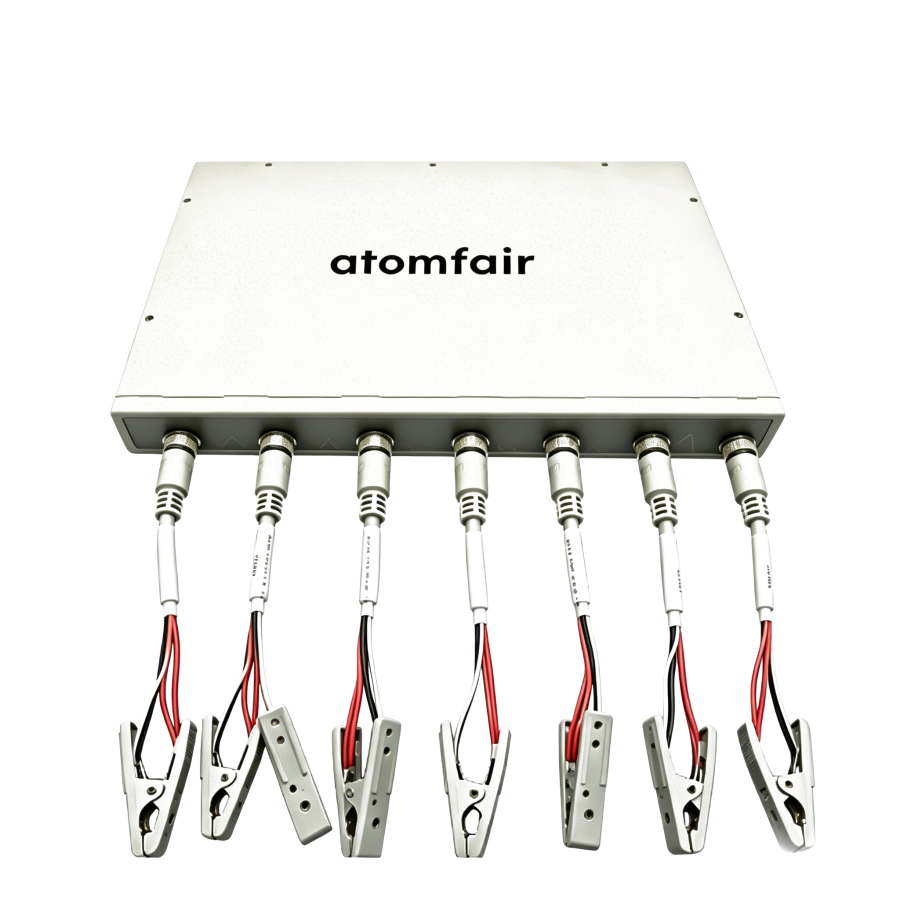
Multi-Channel Battery Testing System (8-Channel Precision 5V)COMMERCIAL GRADE · PRODUCTION
|
|||||||||||||||||||||||||||||
|
|||||||||||||||||||||||||||||
|
TAILORED SOLUTIONS FOR RESEARCH
Contact our engineering team for technical support or official institutional quotations.
EMAIL: INQUIRY@ATOMFAIR.COM
|
|||||||||||||||||||||||||||||
|
Manufacturer: PRODUCTION DIVISION · ADVANCED ENERGY STORAGE DIVISION
Brand: INDUSTRIAL TESTING HARDWARE
Specifications are representative and subject to change without notice. For the latest version and compliance certificates, contact official sales channel.
|
The device must be properly grounded and operated with sufficient ventilation to prevent thermal accumulation. Ensure the input power supply matches the selectable AC voltage configuration (110V or 220V) and frequency (50 Hz).
- Grounding Requirement: Ground the device housing correctly to safeguard against electrical shock and equipment damage.
- Ventilation Clearance: Maintain adequate clearance around the ventilation openings to prevent internal power transformer thermal accumulation.
- Power Supply Configuration: Select the correct input voltage range (110V or 220V) using the swappable switch prior to connecting mains power.
- Current Range Selection: Configure each channel to the appropriate current range (10mA, 20mA, or 50mA) before starting measurements.
- Channel Isolation: Keep all eight channels electrically isolated and avoid connecting external devices that could cause cross-talk.
Follow these steps to set up the instrument for precise electrochemical measurements. Proper grounding and ventilation are critical to safe operation.
Required Equipment: Coin cell clamp testing fixtures, AC power cable with appropriate plug
- Configure Power Input
Set the voltage selector switch to match your local mains voltage (110V or 220V) and verify the frequency is 50 Hz. - Connect Ground and Power
Connect the power cable to the device and plug into a grounded outlet, ensuring the grounding pin is intact. - Install Test Fixtures
Attach the coin cell clamp testing fixtures to the desired channels, securing them firmly to ensure electrical contact. - Select Current Range
Set the current range for each channel (10mA, 20mA, or 50mA) according to your test requirements. - Program Test Sequence
Load or define the charge/discharge cycle sequence with up to 65,535 steps using the control software. - Start Data Logging
Initiate the automated measurement and data logging process, monitoring each channel independently. - Verify Ventilation
Confirm that the ventilation openings are unobstructed during operation to prevent thermal buildup.
What performance trade-offs exist between the 5V10mA, 5V20mA, and 5V50mA current range options on this 8-channel battery testing system?
The primary trade-off is between current measurement resolution and maximum output capability. Lower-current ranges (5V10mA) provide finer granularity for sensitive half-cell and low-rate cycling studies, while the 5V50mA range supports higher-rate testing at the cost of reduced current step resolution. All ranges maintain ±0.05% FS voltage accuracy across the 25 mV to 5 V window, so selection depends on the required current density and precision for the application.
Can this 8-channel battery testing system interface with standard coin cell holders and existing laboratory calibration setups without custom adapters?
Yes, the system ships with premium coin cell clamp testing fixtures and interfaces directly with typical button-cell holder blocks and pouch clip lines. The decoupled 8-channel architecture and standard 483 mm × 310 mm × 48 mm chassis allow seamless integration into mainstream server rack layouts and existing calibration workflows without requiring custom intermediate hardware adjustments.
What electrical and ventilation infrastructure is required to safely operate this multi-channel battery testing system?
The system requires a grounded AC power source at 220V or 110V (±10%) with 50 Hz frequency, drawing a maximum of 25 W under peak continuous load. Proper grounding of the device housing is mandatory, and sufficient ventilation clearance must be maintained around the chassis to prevent thermal accumulation errors in the internal power transformer matrix.
This 8-channel precision galvanostat/potentiostat offers ±0.05% FS accuracy for coin cell cycling with up to 65,535 step sequences, but its low current range (10–50 mA) and 50 Hz power requirement limit deployment to specific low-power battery research applications.
Positive
- High-Precision ±0.05% FS Accuracy: The system delivers voltage and current measurement accuracy of ±0.05% Full Scale, enabling capture of subtle electrochemical transitions in coin cell cycling.
- Decoupled 8-Channel Asynchronous Operation: Eight independent channels allow simultaneous execution of distinct experimental routines, maximizing throughput and isolating channel interference.
Trade-offs
- Limited Current Ranges for Low-Power Cells: Available current configurations (10 mA, 20 mA, 50 mA) restrict applications to small-format coin cells and are unsuitable for higher-capacity or high-power battery testing.
- Input Power and Ventilation Requirements: The unit requires a swappable AC input (110V/220V) at 50 Hz and proper housing ventilation to prevent thermal accumulation errors, necessitating careful lab infrastructure planning.
Every advanced material, component, equipment, and instrument in our catalog is backed by rigorous testing. We maintain strict internal quality management frameworks and align with CE conformity metrics to deliver transparent, reproducible performance data via our public open-science repository.
To request raw batch performance data, submit formal vendor registration paperwork, or execute a fast-turnaround R&D manufacturing loop, contact us at inquiry@atomfair.com.
Item is dispatched under the Atomfair Shipping & Delivery Framework (Free worldwide shipping on orders over $59 USD excl. heavy equipment). Return is governed by the Atomfair Return & Refund Policy (7-day technical return window).