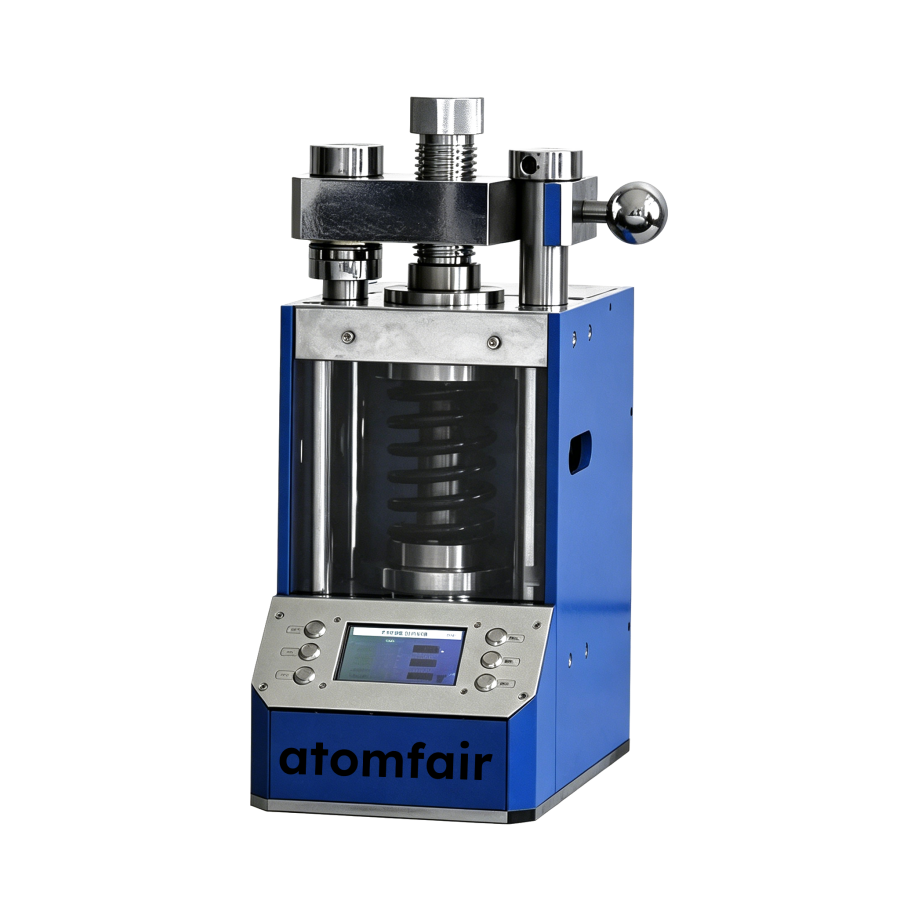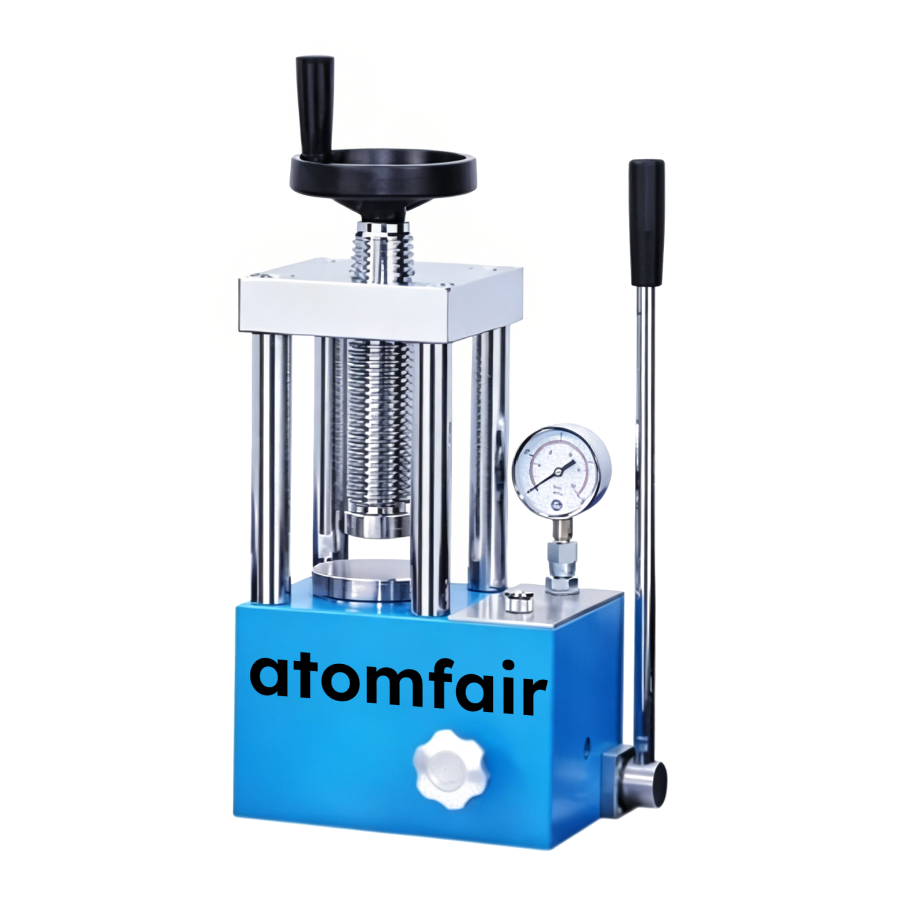
PTP-473 Manual Powder Pellet Press (0 – 40 Ton)VERSATILE HEAVY-DUTY MANUAL COMPACTION HARDWARE
|
|||||||||||||||||||||||||
|
|||||||||||||||||||||||||
|
TAILORED SOLUTIONS FOR RESEARCH
Contact our engineering team for technical support or official commercial quotations.
EMAIL: INQUIRY@ATOMFAIR.COM
|
|||||||||||||||||||||||||
|
Manufacturer: PRODUCTION DIVISION · ADVANCED ENERGY STORAGE DIVISION
Brand: INDUSTRIAL TESTING HARDWARE
Specifications are representative and subject to change without notice. For the latest version and compliance certificates, contact official sales channel.
|
This manual hydraulic press requires a workbench capable of supporting its 80 kg mass and must never be operated beyond the 40-ton maximum pressure limit to prevent structural failure. All compaction cycles must be performed on a flat, balanced surface to ensure uniform sample thickness and avoid microstructural shear cracks.
- Workbench Load Capacity: Confirm the selected workbench safely supports the solid 80 kg framework weight before installation.
- Pressure Limit: Never actuate the pumping handle beyond the maximum 40-ton limit threshold to maintain structural fluid line and seal tolerances.
- Surface Flatness: Always execute manual compaction cycles on flat, balanced surfaces to prevent uneven pressure distribution.
- Hydraulic Fluid Integrity: Inspect hydraulic fluid lines and seals regularly for signs of wear or leakage to ensure safe operation.
This procedure outlines the safe initialization and operation of the manual hydraulic press for powder compaction. Follow these steps to prepare the press, load the sample, and perform a controlled compression cycle.
Required Equipment: Manual pumping handle, Pellet mold assembly, Flat workbench
- Inspect press and workbench
Inspect the press frame and workbench surface for stability and cleanliness before placing the press. - Install pellet mold
Install the appropriate pellet mold assembly within the internal tooling clearance window of 106 mm × 185 mm. - Load powder sample
Load the powder sample into the mold cavity evenly to ensure uniform compaction. - Actuate pumping handle
Actuate the manual pumping handle slowly and steadily until the desired pressure is reached, never exceeding 40 tons. - Release pressure and retrieve pellet
Release the hydraulic pressure using the release valve and carefully remove the compacted pellet from the mold.
How does the 80 kg structural weight of the PTP-473 press affect benchtop stability for high-frequency manual compaction cycles?
The 80 kg rigid vibration-damping mass provides inherent stability to resist movement during manual compaction, but it also requires a workbench that can safely support that weight. The operational compliance notice explicitly states the workbench must support the 80 kg framework and that compaction cycles must be executed on flat, balanced surfaces. This trade-off between stability and portability makes the press ideal for dedicated lab benches rather than lightweight tables.
What pellet die dimensions are compatible with the PTP-473's internal tooling clearance window?
The press provides an internal tooling clearance of 106 mm × 185 mm pillar spacing, meaning any pellet die assembly must fit within those lateral and vertical boundaries. The oversized 130 mm piston core accommodates larger diameter dies, but the die body must be narrower than 106 mm to pass between the four pillars. For example, dies with an outer diameter up to 100 mm and a height up to 180 mm would be suitable.
What workbench requirements are necessary to safely operate the 80 kg PTP-473 manual press?
The press requires a workbench that can safely support its 80 kg framework weight and remain flat and stable during manual compaction cycles up to 40 tons. The operational compliance notice warns against operating on uneven surfaces and stresses never actuating the pumping handle beyond the 40-ton limit. Additionally, the unpowered design avoids grid dependencies but necessitates a sturdy, level surface to prevent frame tilt during high-pressure use.
The PTP-473 Manual Powder Pellet Press delivers a calibrated 40-ton load capacity within a rigid four-column frame to produce uniform sample pellets, but its 80 kg chassis and strict 40-ton pressure limit demand careful workspace planning and operational discipline.
Positive
- 40-Ton Manual Load Capacity: The press provides up to 40 metric tons of manual compressive force, capable of consolidating routine chemical powders and medium-hardness ceramic blends into flat, cohesive disks for laboratory analysis.
- Rigid Four-Column Alignment Frame: The four-pillar frame distributes high mechanical pressures evenly across the compression plane, preventing microstructural shear cracks and ensuring uniform sample thickness during compaction.
Trade-offs
- Heavy 80 kg Framework Weight: The 80 kg net weight requires a workbench rated to safely support the press, limiting portability and demanding sturdy laboratory furniture for stable operation.
- Maximum 40-Ton Pressure Limit: The press must never be actuated beyond its 40-ton limit to avoid compromising hydraulic seals and fluid line integrity, requiring careful operator attention during high-force cycles.
Every advanced material, component, equipment, and instrument in our catalog is backed by rigorous testing. We maintain strict internal quality management frameworks and align with CE conformity metrics to deliver transparent, reproducible performance data via our public open-science repository.
To request raw batch performance data, submit formal vendor registration paperwork, or execute a fast-turnaround R&D manufacturing loop, contact us at inquiry@atomfair.com.
Item is dispatched under the Atomfair Shipping & Delivery Framework (Free worldwide shipping on orders over $59 USD excl. heavy equipment). Return is governed by the Atomfair Return & Refund Policy (7-day technical return window).