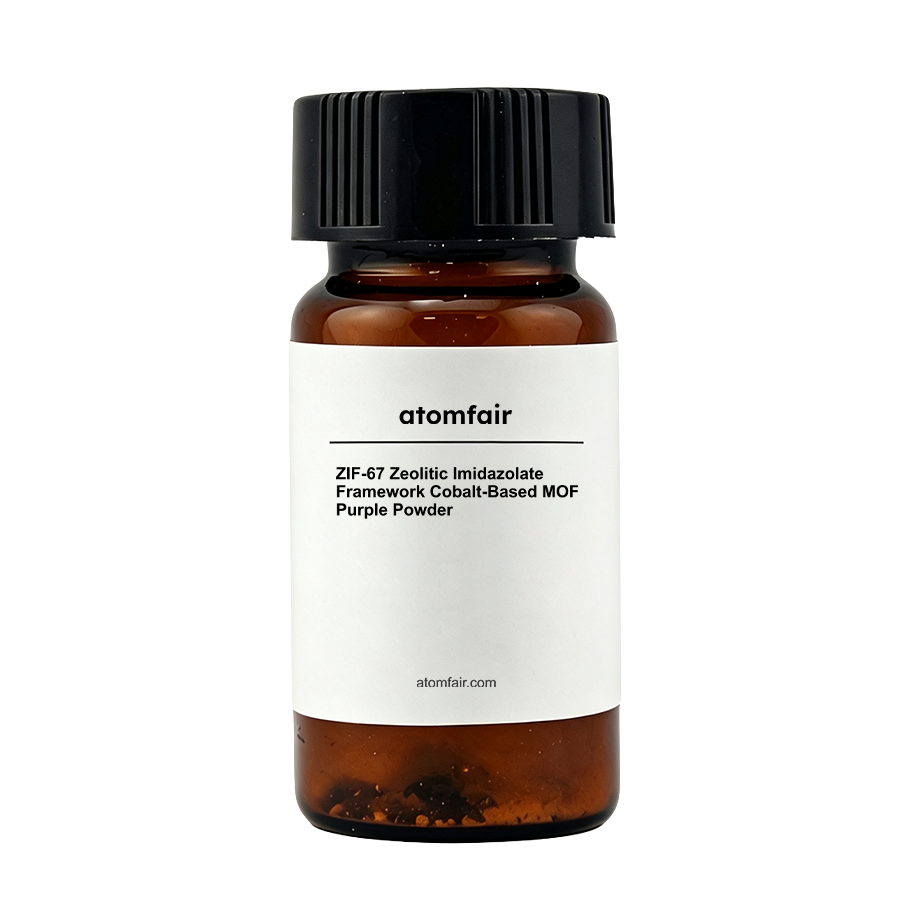
ZIF-67 (AF-MO-D-ZF67-4620-0000)RESEARCH GRADE MATERIAL
|
|||||||||||||||||||||||||||||||||||
|
|||||||||||||||||||||||||||||||||||
This material requires specific handling and storage conditions to maintain its structural integrity. It must be protected from acidic environments and activated under vacuum before use.
- Storage Condition: Store in a dry, tightly sealed container away from humidity, preferably under ambient or cryogenic temperatures.
- Chemical Stability: The material is unstable under aggressive acidic conditions and must be kept away from strong acids.
- Thermal Decomposition: Thermal decomposition occurs above 400°C, which limits high-temperature processing applications.
- Pre-Activation Requirement: Prior to analytical use, the material requires activation under vacuum at 120°C for 12 hours to release full framework porosity.
How does the dual-pore structure (0.34 nm and 1.1 nm) of ZIF-67 influence its performance in gas capture versus molecular adsorption applications?
ZIF-67's dual-pore system (0.34 nm micropores and 1.1 nm mesopores) allows selective adsorption based on molecular size. The micropores enable high-capacity small-molecule gas capture (e.g., CO₂, H₂), while the mesopores facilitate diffusion and adsorption of larger hazardous molecules, making it suitable for both gas storage and liquid-phase adsorption. This is supported by a BET surface area of 1500 m²/g and a pore volume of 0.66 cm³/g.
What are the chemical stability limitations of ZIF-67 for use in acidic environments?
ZIF-67 exhibits long-term phase retention in ambient air, standard water solutions, and strong alkaline media, but is unstable under aggressive acidic conditions. Therefore, it is not recommended for applications involving strong acids, as the framework will degrade. For acidic environments, alternative MOFs or pretreatment would be required.
What are the recommended storage and activation conditions for ZIF-67 to ensure maximum porosity and performance?
ZIF-67 should be stored in a dry, tightly sealed container to prevent humidity exposure, under ambient or cryogenic low-temperature ranges. Before analytical use, it requires pre-activation under vacuum at 120°C for 12 hours to release full framework porosity. This ensures removal of guest molecules trapped in the pores.
ZIF-67 (CAS 46201-07-4) is a cobalt-based zeolitic imidazolate framework with a BET surface area of 1500 m²/g and a dual-pore distribution (0.34 nm and 1.1 nm), providing high-capacity adsorption and uniform guest molecule diffusion. It exhibits thermal stability above 400°C and good phase retention in ambient air and alkaline media, but requires pre-activation under vacuum at 120°C for 12 hours to release full porosity and is unstable under aggressive acidic conditions.
Positive
- High specific surface area: BET surface area of 1500 m²/g provides an uncompromised configuration of structural adsorption nodes for high-capacity gas capture and molecular adsorption.
- Dual-pore structural uniformity: Engineered with tight micro-mesoporous parameters (0.34 nm and 1.1 nm) ensuring uniform guest molecule diffusion pathways for consistent performance in separation or delivery applications.
Trade-offs
- Acid sensitivity: The crystalline framework is unstable under aggressive acidic validation conditions, limiting its use in low-pH environments.
- Pre-activation required: To release full framework porosity before analytical testing, the material must be activated under vacuum at 120°C for 12 hours, adding a preparatory step to laboratory workflows.
Every advanced material, component, equipment, and instrument in our catalog is backed by rigorous testing. We maintain strict internal quality management frameworks and align with CE conformity metrics to deliver transparent, reproducible performance data via our public open-science repository.
To request raw batch performance data, submit formal vendor registration paperwork, or execute a fast-turnaround R&D manufacturing loop, contact us at inquiry@atomfair.com.
Item is dispatched under the Atomfair Shipping & Delivery Framework (Free worldwide shipping on orders over $59 USD excl. heavy equipment). Return is governed by the Atomfair Return & Refund Policy (7-day technical return window).