UIO-66-F4 (KAR-F30-F4)RESEARCH GRADE MATERIAL
|
|||||||||||||||||||||||||||||||||||||||||||||||||||
|
|||||||||||||||||||||||||||||||||||||||||||||||||||
This material is highly sensitive to ambient moisture and oxygen, requiring storage in tightly sealed containers or under anhydrous inert gas. Exposure to ambient conditions can cause phase contamination or structural degradation, compromising performance in catalytic or adsorption applications.
- Moisture and Oxygen Sensitivity: The material is highly sensitive to ambient moisture and oxygen, requiring rigorous exclusion to prevent degradation.
- Inert Atmosphere Handling: All handling and transfer operations must be performed under an anhydrous inert gas atmosphere to avoid phase contamination.
- Sealed Storage: Containers must remain tightly sealed when not in use, and any exposure to ambient conditions should be minimized.
- Thermal Validation Precondition: The material requires protection from ambient exposure until thermal validation is performed to activate or stabilize the structure.
How does fluorine functionalization in UIO-66-F4 affect its catalytic stability compared to pristine UiO-66?
Fluorine functionalization enhances catalytic stability and performance. The UIO-66-F4 (KAR-F30-F4) achieves a biodiesel yield of 92% with less than 4% degradation after 12 cycles, and a +28% acid density enhancement via Zr4⁺-fluorine synergetic promotion. It also shows a 1.3x higher toluene adsorption capacity (180 mg/g at 298K/1 bar) over pristine UiO-66, and a narrowed photocatalytic bandgap of 2.8 eV, enabling improved transfer kinetics.
What are the handling and storage requirements for UIO-66-F4 to prevent structural degradation?
UIO-66-F4 is highly sensitive to ambient exposure. Containers must be kept tightly sealed, and the material should be handled exclusively within an anhydrous inert gas environment to prevent phase contamination or structural degradation before thermal validation. The material is thermally stable above 300°C, but moisture and air exposure must be avoided.
What is the optimal pH range for using UIO-66-F4 in heavy metal adsorption applications?
UIO-66-F4 is chemically stable across pH 2–11, making it suitable for a wide range of conditions. For Pb²⁺ adsorption, the material achieves 480 mg/g capacity at pH 5, with equilibrium reached in 15 minutes and residual concentration below 0.001 mg/L. The framework also exhibits high Hg²⁺/Cd²⁺ selectivity of 58, confirming its effectiveness in mixed-metal systems.
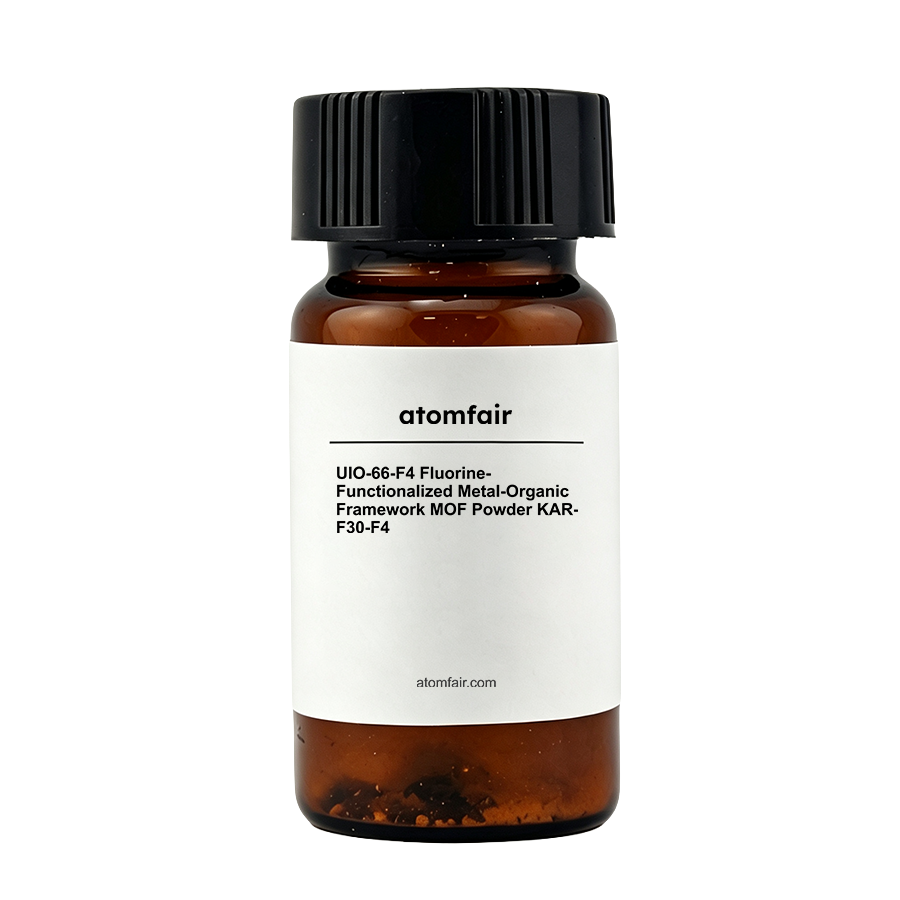
UIO-66-F4 (KAR-F30-F4) is a fluorine-functionalized Zr-MOF with a 0.8–1.0 nm microporous framework, 1000–1300 m²/g surface area, pH 2–11 chemical stability, and >300°C thermal decomposition temperature. Its condition-specific catalytic, adsorption, and electrochemical metrics support research deployment in VOC treatment, heavy-metal filtration, catalysis, and energy-storage validation, provided anhydrous inert handling is maintained.
Positive
- Fluorine-functionalized framework with broad stability: The Zr6O4(OH)4 nodes with BDC-F4 carboxylate linkages combine targeted fluorine-mediated hydrophobicity with operational stability across pH 2–11 and resistance to thermal degradation above 300°C.
- Multifunctional adsorption and energy storage metrics: The microporous 0.8–1.0 nm framework delivers reported toluene uptake of 180 mg/g, Pb²⁺ adsorption of 480 mg/g, supercapacitor capacitance of 165 F/g, and Li-S initial capacity of 1200 mAh/g under the stated test conditions.
Trade-offs
- Ambient exposure sensitivity requires inert handling: This material is highly sensitive to ambient exposure; containers must remain tightly sealed or handling must be performed exclusively in an anhydrous inert gas environment to prevent phase contamination or structural degradation before thermal validation.
- Performance metrics are condition-specific: Reported adsorption, catalytic, and electrochemical values are tied to defined operating parameters such as pH 5 for Pb²⁺ uptake, 298 K/1 bar for toluene adsorption, 6 M KOH at 1 A/g for capacitance, and 0.1C for Li-S capacity.
Every advanced material, component, equipment, and instrument in our catalog is backed by rigorous testing. We maintain strict internal quality management frameworks and align with CE conformity metrics to deliver transparent, reproducible performance data via our public open-science repository.
To request raw batch performance data, submit formal vendor registration paperwork, or execute a fast-turnaround R&D manufacturing loop, contact us at inquiry@atomfair.com.
Item is dispatched under the Atomfair Shipping & Delivery Framework (Free worldwide shipping on orders over $59 USD excl. heavy equipment). Return is governed by the Atomfair Return & Refund Policy (7-day technical return window).