|
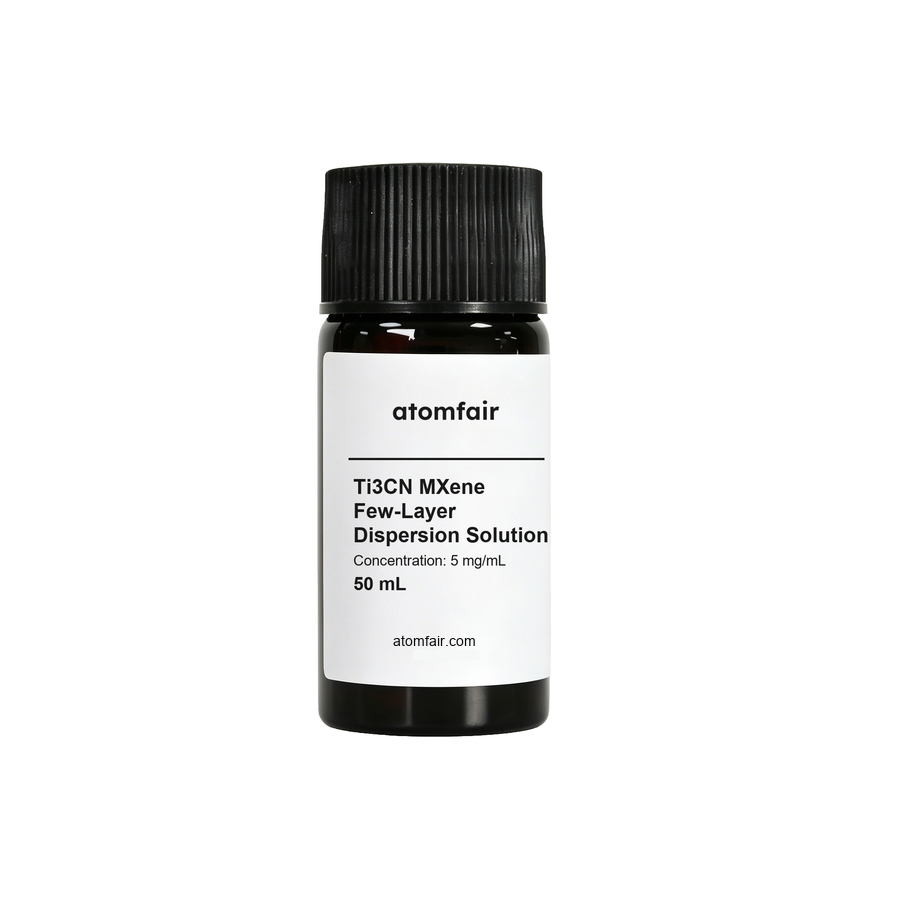
Ti3CN MXene Few-Layer Dispersion Solution, Concentration: 5 mg/mL, Package: 50 mL
Product Type: MXene dispersion / solution
Research-grade laboratory product
|
|||||||||||||||||||||||||
|
|||||||||||||||||||||||||
|
LABORATORY PROCUREMENT SUPPORT
For material selection, specification confirmation and package-size quotation support, contact our technical sales team.
E-MAIL: inquiry@atomfair.com
|
|||||||||||||||||||||||||
|
Supplier: Atomfair
Brand: ATOMFAIR®
|
Manufacturer: Atomfair LLC
Brand: ATOMFAIR®
How does the few-layer thickness (1–4 nm) of this Ti3CN MXene dispersion affect its performance in supercapacitor electrodes?
The specified thickness of 1–4 nm corresponds to few-layer MXene stacks (approximately 2–5 layers), which provide a balance between high accessible surface area and electrical conductivity—key for capacitive charge storage. The lateral size of 0.2–2 μm further supports uniform electrode film formation, though no specific capacitance values are provided in the product description.
Can this water-based Ti3CN MXene dispersion be directly integrated with inkjet printing or spray-coating processes?
Yes, the dispersion is supplied in water at 5 mg/mL, a concentration and solvent system commonly used for solution-based deposition. The few-layer flakes (0.2–2 μm lateral size) are suitable for nozzle-based techniques, but the product description does not specify additives or viscosity modifiers, so process optimization may be required.
What is the solid content (wt/vol) and what handling precautions apply to this 50 mL Ti3CN MXene dispersion?
The solid content is 0.5% w/v, derived from the 5 mg/mL concentration. The product is a black aqueous solution supplied in 50 mL; no specific storage or safety data is provided in the description, so standard MXene handling (inert atmosphere, light protection) is recommended as a precaution.
This Ti3CN MXene few-layer dispersion in water at 5 mg/mL offers a well-defined nanomaterial with consistent thickness (1–4 nm) and lateral size (0.2–2 µm) for research applications, but the fixed concentration and aqueous solvent may require additional processing steps for certain integration workflows.
Positive
- Few-layer morphology with small lateral dimensions: Thickness of 1–4 nm and lateral size of 0.2–2 µm enable uniform coating and integration into thin-film devices.
- Water-based dispersion for facile processing: Dispersion in water as solvent allows for environmentally friendly deposition and compatibility with common laboratory handling.
Trade-offs
- Fixed concentration and volume constraints: Supplied at a fixed concentration of 5 mg/mL and in a 50 mL package, requiring dilution or concentration steps for applications demanding different material densities or volumes.
- Aqueous solvent may limit substrate compatibility: Water as solvent may not be suitable for hydrophobic substrates or water-sensitive materials without additional surface treatments or processing steps.
Every advanced material, component, equipment, and instrument in our catalog is backed by rigorous testing. We maintain strict internal quality management frameworks and align with CE conformity metrics to deliver transparent, reproducible performance data via our public open-science repository.
To request raw batch performance data, submit formal vendor registration paperwork, or execute a fast-turnaround R&D manufacturing loop, contact us at inquiry@atomfair.com.
Item is dispatched under the Atomfair Shipping & Delivery Framework (Free worldwide shipping on orders over $59 USD excl. heavy equipment). Return is governed by the Atomfair Return & Refund Policy (7-day technical return window).