|
Si-C Silicon-Carbon Anode, 4.5 mg/cm² per side
Single-Sided Anode Sheet
|
||||||||||||||||||||||||||||||||||||||||||||||||
|
This electrode sheet requires controlled drying and handling to maintain structural integrity and electrochemical performance. Deviations from specified conditions may introduce contamination, delamination, or inaccurate cell calculations.
- Drying Requirement: Dry the electrode sheet at 90-100°C for 12-24 hours prior to cell assembly to remove residual solvent and moisture.
- Handling Environment: Maintain a clean, dry handling environment after drying to prevent moisture adsorption and contamination.
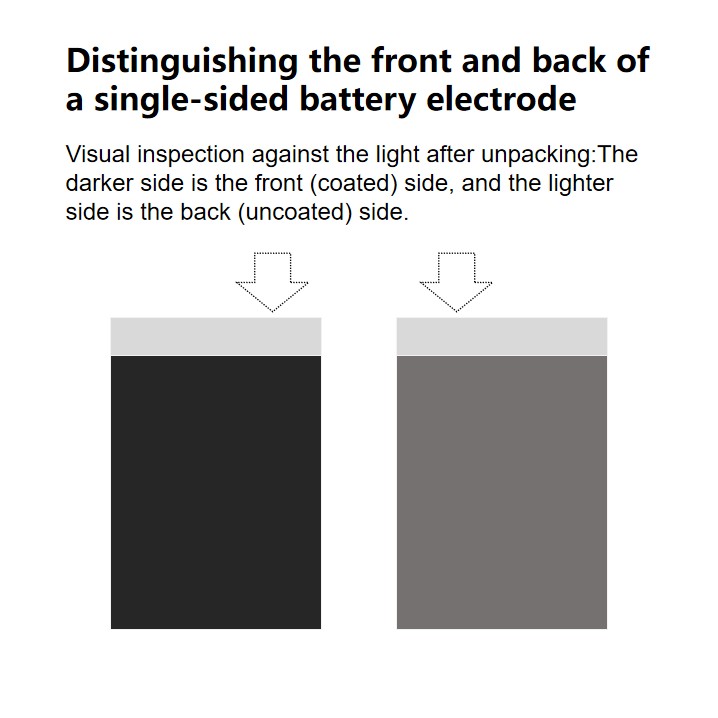
- Mechanical Integrity: Avoid bending, scratching, or contaminating the coated surface during cutting, punching, transfer, and stacking to prevent delamination or performance loss.
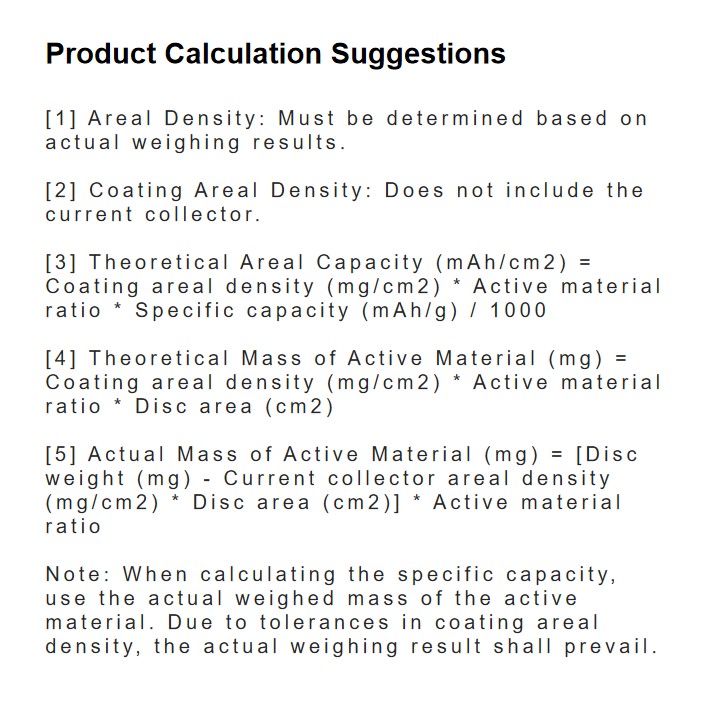
- Mass Calculation: Use the actual punched electrode mass, not the areal loading alone, to determine active material content for cell calculations.
- Capacity Reference: The 1600 mAh/g specific capacity is an active-material reference value and does not guarantee cell-level performance.
This procedure outlines the required drying and handling steps for the silicon-carbon anode sheet before cell assembly. Proper execution ensures electrode integrity and reliable electrochemical data.
Required Equipment: Drying oven capable of maintaining 90-100°C
- Dry the electrode sheet
Dry the electrode sheet at 90-100°C for 12-24 hours in a drying oven to remove residual solvent and moisture. - Transfer to clean environment
Transfer the dried sheet to a clean, dry handling environment such as a glovebox or dry room to prevent recontamination. - Punch or cut electrodes
Punch or cut electrodes from the sheet while supporting the coated surface to avoid bending, scratching, or contamination. - Weigh each electrode
Weigh each punched electrode to record the actual mass for accurate active material and capacity calculations.
How should the 1600 mAh/g specific capacity be used in cell-level calculations for this Si-C anode sheet?
The 1600 mAh/g value is an active-material reference capacity, not a guaranteed cell-level result. Actual cell capacity depends on the punched electrode mass and the active material ratio of 90.30%. Do not substitute a constituent silicon capacity for the supplied composite electrode; use the actual punched mass in cell calculations.
What is the current collector structure of this Si-C anode sheet and how does it affect cell assembly?
The current collector is carbon-coated copper foil with a structure of 1 µm C / 6 µm Cu / 1 µm C. This carbon coating provides adhesion and conductivity for the silicon-carbon composite layer. During handling, avoid bending, scratching, or contaminating the coated surface to maintain integrity during cutting, punching, and stacking.
What are the recommended drying conditions for this Si-C anode sheet before cell assembly?
Dry the electrode sheet at 90–100°C for 12–24 hours prior to cell assembly. After drying, use a clean, dry handling environment and avoid any bending, scratching, or contamination of the coated surface to ensure optimal electrode performance.
This Si-C (silicon-carbon) composite anode sheet is configured as a single-sided coating on carbon-coated copper foil at 4.5 mg/cm2 areal loading with 90.30% active material ratio and a specific capacity reference of 1600 mAh/g. It is a ready-to-use research electrode for lab-scale lithium-ion cell assembly, requiring a 12-24 hour drying step at 90-100°C and careful handling to preserve coating integrity.
Positive
- Ready-to-use Si-C anode sheet: Supplied in a defined single-sided, 4.5 mg/cm2 areal loading configuration for immediate laboratory cell assembly, eliminating coating preparation steps.
- Defined material composition: Active material system (Si-C), active material ratio (90.30%), and current collector structure (carbon-coated copper foil) are specified, enabling reproducible cell studies.
Trade-offs
- Extended drying requirement: Electrode sheet must be dried at 90-100°C for 12-24 hours before cell assembly, requiring oven access and careful scheduling.
- Handling sensitivity: Coated surface must not be bent, scratched, or contaminated during cutting, punching, transfer, and stacking; clean dry handling environment is mandatory after drying.
Every advanced material, component, equipment, and instrument in our catalog is backed by rigorous testing. We maintain strict internal quality management frameworks and align with CE conformity metrics to deliver transparent, reproducible performance data via our public open-science repository.
To request raw batch performance data, submit formal vendor registration paperwork, or execute a fast-turnaround R&D manufacturing loop, contact us at inquiry@atomfair.com.
Item is dispatched under the Atomfair Shipping & Delivery Framework (Free worldwide shipping on orders over $59 USD excl. heavy equipment). Return is governed by the Atomfair Return & Refund Policy (7-day technical return window).