|
Graphite Single-Sided Anode, 27.4 mg/cm² per side
Single-Sided Anode Sheet
|
||||||||||||||||||||||||||||||||||||||||||||||||
|
This document outlines handling and storage constraints for the graphite anode electrode sheet. It specifies moisture sensitivity, mechanical integrity requirements, and mass calculation procedures.
- Moisture Sensitivity: The electrode coating is sensitive to moisture and must be handled and stored in a dry environment or inert atmosphere to prevent degradation.
- Mechanical Integrity: The coated surface must not be touched, bent, scratched, or contaminated to avoid compromising electrode performance.
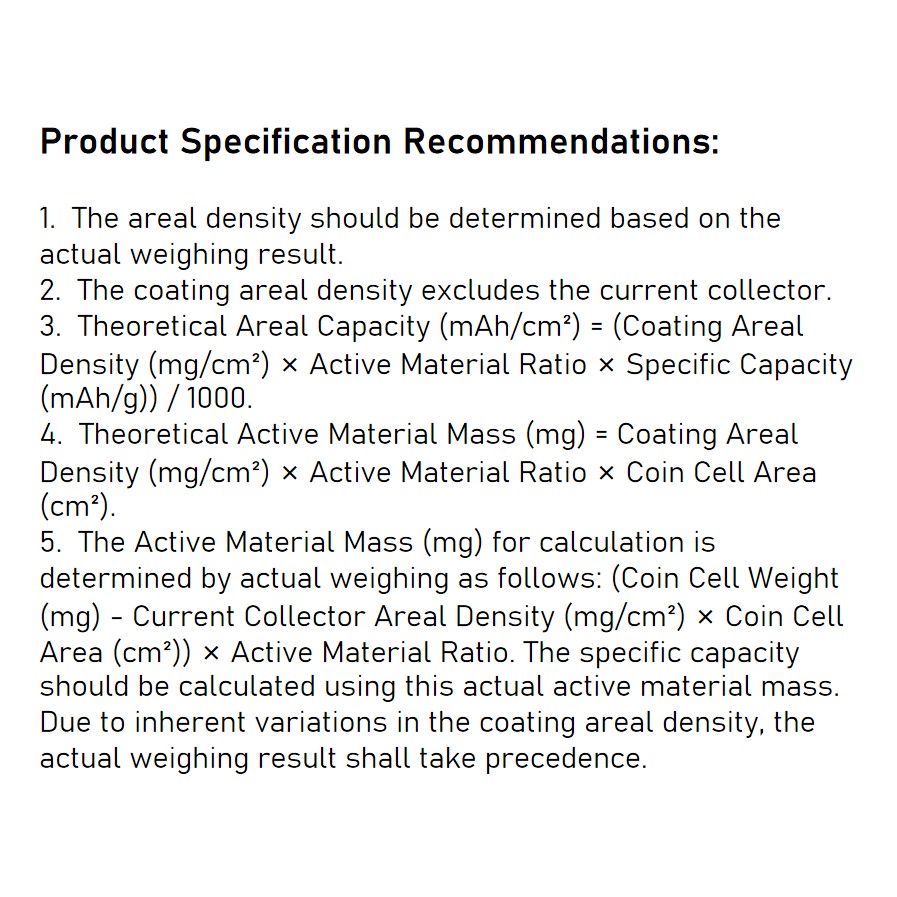
- Mass Calculation Requirement: Active material mass must be calculated from coating loading, active material ratio, and punched electrode area for accurate cell balancing.
This procedure describes the steps for handling and preparing the graphite anode electrode sheet before cell assembly. It ensures proper moisture control, surface integrity, and mass calculation.
Required Equipment: Glovebox
- Transfer to dry environment
Transfer the electrode sheet to a dry environment or inert atmosphere before opening the package. - Inspect coated surface
Inspect the coated surface for any visible defects such as scratches or contamination. - Calculate active material mass
Calculate the active material mass using the coating loading, active material ratio, and punched electrode area.
How does the compaction density of 1.31 g/cm3 affect the electrochemical performance of this graphite anode?
The compaction density of 1.31 g/cm3 indicates the electrode's porosity and electronic connectivity, directly influencing rate capability and cycle life. Combined with a coating loading of 27.4 mg/cm2 and 96.00% active material ratio, this electrode is designed for balanced ionic and electronic transport in half-cell or full-cell experiments. The dry process coating further affects the electrode's mechanical integrity and electrolyte wetting behavior.
How should I calculate the active material mass for cell balancing when using this single-sided graphite anode?
Multiply the coating loading (27.4 mg/cm2) by the punched electrode area (in cm2) to obtain total coating mass, then multiply by the active material ratio (0.96) to get active graphite mass. This calculation is essential for setting the N/P ratio when matching with a cathode, as noted in the product's handling and research use case guidance.
What storage conditions are required to prevent moisture degradation of this dry-process graphite anode sheet?
Store opened sheets in a dry environment or inert atmosphere (e.g., argon or nitrogen glovebox) to minimize moisture exposure before use. The dry process coating and carbon-coated copper foil current collector are sensitive to ambient humidity, which can degrade electrode performance. A dry handling environment is also recommended during punching and cell assembly.
The 27.4 mg/cm² graphite anode sheet with 96% active material ratio and dry-process coating on carbon-coated copper foil provides a consistent baseline for electrolyte screening and cathode matching, but requires careful dry handling and mechanical protection of the coated surface.
Positive
- High active material ratio: 96.00% active material ratio provides a well-defined electrode composition for repeatable half-cell or full-cell experiments.
- Dry process coating for baseline studies: Dry-process coating enables direct comparison with wet-process electrodes and supports process variable studies.
Trade-offs
- Moisture-sensitive handling required: Dry handling environment and inert atmosphere storage are recommended to prevent moisture exposure on the coated electrode surface.
- Fragile coated surface requires careful handling: The coated surface must not be touched, bent, scratched, or contaminated during punching, transfer, and stacking to avoid compromising electrode integrity.
Every advanced material, component, equipment, and instrument in our catalog is backed by rigorous testing. We maintain strict internal quality management frameworks and align with CE conformity metrics to deliver transparent, reproducible performance data via our public open-science repository.
To request raw batch performance data, submit formal vendor registration paperwork, or execute a fast-turnaround R&D manufacturing loop, contact us at inquiry@atomfair.com.
Item is dispatched under the Atomfair Shipping & Delivery Framework (Free worldwide shipping on orders over $59 USD excl. heavy equipment). Return is governed by the Atomfair Return & Refund Policy (7-day technical return window).