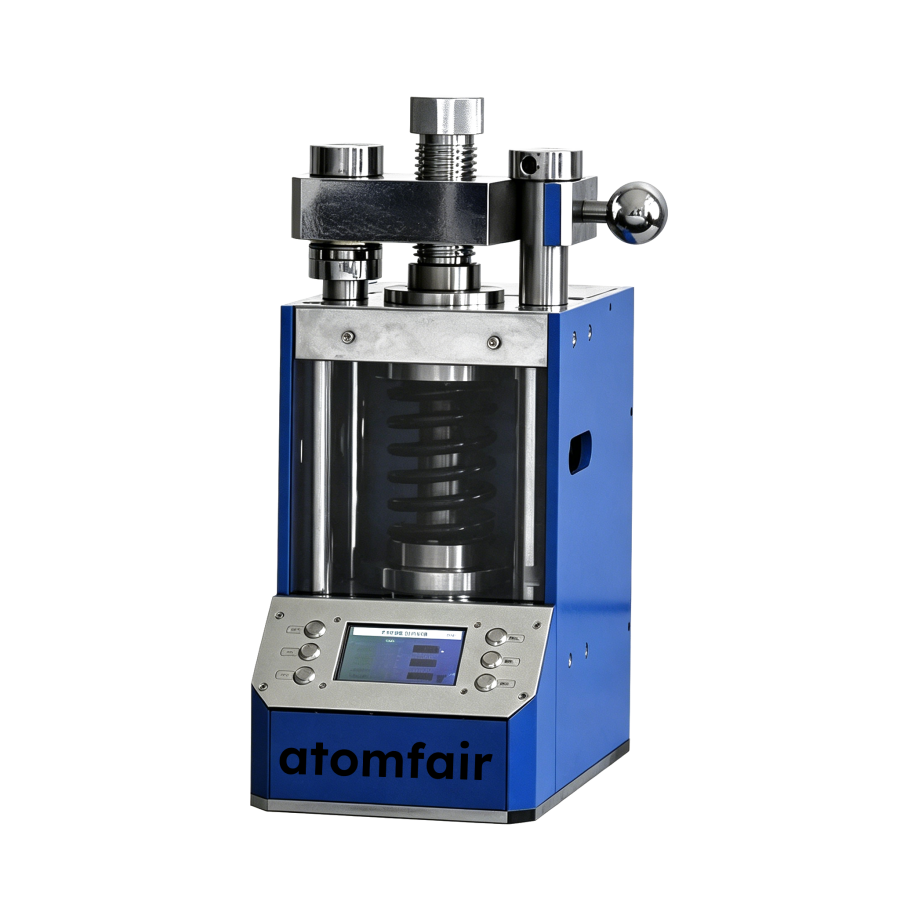
PTP-691 Manual Powder Pellet Press (0 – 60 Ton)HEAVY-DUTY INDUSTRIAL COMPACTION HARDWARE
|
|||||||||||||||||||||||||
|
|||||||||||||||||||||||||
|
TAILORED SOLUTIONS FOR PRODUCTION
Contact our engineering team for technical support or official commercial quotations.
EMAIL: INQUIRY@ATOMFAIR.COM
|
|||||||||||||||||||||||||
|
Manufacturer: PRODUCTION DIVISION · ADVANCED ENERGY STORAGE DIVISION
Brand: INDUSTRIAL TESTING HARDWARE
Specifications are representative and subject to change without notice. For the latest version and compliance certificates, contact official sales channel.
|
This heavy-duty manual press must be operated on a flat, horizontal workbench capable of supporting its 150 kg chassis. Never exceed the 60-ton hydraulic limit to preserve seal integrity and prevent mechanical failure.
- Workbench Load Capacity: The supporting workbench must safely sustain the 150 kg net equipment weight to avoid structural collapse.
- Operating Surface Flatness: All compaction cycles must be executed on flat, horizontal testing tables to prevent torque deflection and tool misalignment.
- Pressure Limit Compliance: The manual handle must never be pushed beyond the 60-ton metric load limit to protect hydraulic line tolerances and seal integrity.
- Tooling Clearance Constraints: Die sets and tooling must fit within the 185 mm × 250 mm column clearance window to avoid stress deflection during compression.
- Post-Cycle Inspection: Hydraulic lines and seals should be inspected after each cycle to detect any fluid leaks or damage that could compromise safety.
This procedure outlines the safe operation of the manual hydraulic press for powder compaction. Confirm workbench stability and load capacity before initiating any cycle.
Required Equipment: Manual operating rods, Standard maintenance toolsets
- Verify Workbench Capacity
Confirm that the selected laboratory workbench can safely sustain the 150 kg framework load before positioning the press. - Position on Flat Surface
Place the press on a flat, horizontal testing table to ensure stable load distribution during operation. - Attach Operating Rod
Insert the manual operating rod into the hydraulic pump mechanism to prepare for force application. - Apply Compaction Force
Apply gradual, controlled force to the manual handle while monitoring the load, never exceeding the 60-ton maximum limit. - Inspect System After Cycle
Release the hydraulic pressure, then inspect hydraulic lines and seals for any signs of leakage or damage before the next use.
How does the 150 mm piston diameter of the PTP-691 affect sample density uniformity compared to smaller pistons at the same tonnage?
The oversized 150 mm piston face uniformly distributes linear load over the 50 mm ram travel, delivering high sample density without structural cracking. The larger piston area reduces pressure per unit area, enabling more uniform compaction across wider diameter samples—critical for preventing density gradients in high-hardness minerals, ceramics, and metallic powders.
What is the maximum tooling diameter that can be accommodated in the PTP-691 manual powder pellet press?
The press provides an internal tooling clearance window of 185 mm × 250 mm, designed to accept large-diameter industrial tooling setups without causing stress deflection or tool misalignment. The exact maximum tooling diameter depends on the die geometry, but the column spacing accommodates dies and molds up to that clearance area.
What are the critical infrastructure requirements for safely installing the PTP-691 60-ton manual press?
The workbench must safely sustain the 150 kg frame weight. The press must be operated on a flat, horizontal testing table. The manual handle must never be pushed past the maximum 60-ton load limit to preserve hydraulic line tolerances and seal integrity. The press ships in a heavy-duty wooden crate, pre-tested, with manual operating rods and standard maintenance tools.
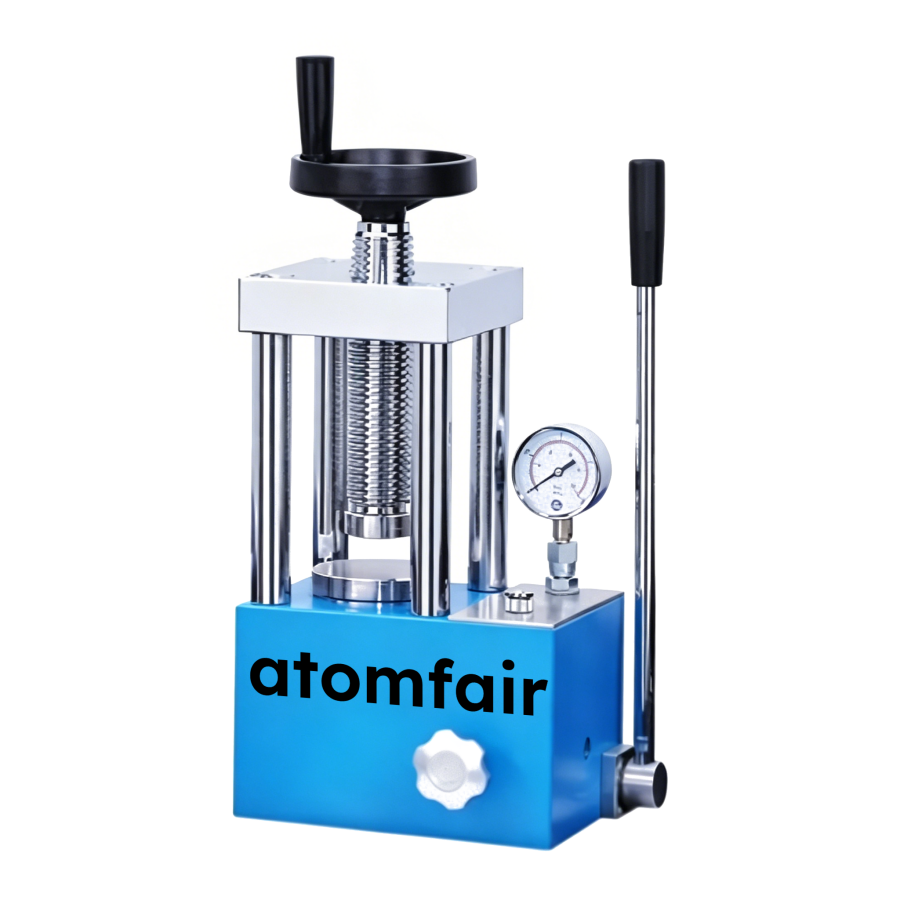
The PTP-691 manual powder pellet press delivers 60-ton hydraulic capacity and a reinforced 150 kg frame for compacting high-hardness minerals, ceramics, and metallic powders, but its 50 mm ram stroke and manual operation limit sample thickness and throughput.
Positive
- High-Capacity 60-Ton Hydraulic Press for Hard Materials: The 60-ton load limit and oversized 150 mm piston face uniformly distribute force, enabling compaction of high-hardness minerals, ceramics, and metallic powders that require extreme consolidation pressure.
- Robust Frame with Wide Tooling Clearance: The 150 kg reinforced enclosure and 185×250 mm column clearance minimize torque deflection under high load and accept large-diameter industrial dies, extending tool lifespan and alignment accuracy.
Trade-offs
- Heavy Chassis Requires Sturdy Workbench: The 150 kg frame necessitates a laboratory workbench rated for the weight, limiting placement options and potentially requiring floor reinforcement in standard lab settings.
- Manual Operation with Short Ram Stroke: The 50 mm vertical ram displacement restricts the maximum sample thickness that can be pressed, and manual hydraulic cycling demands significant operator effort at the 60-ton limit.
Every advanced material, component, equipment, and instrument in our catalog is backed by rigorous testing. We maintain strict internal quality management frameworks and align with CE conformity metrics to deliver transparent, reproducible performance data via our public open-science repository.
To request raw batch performance data, submit formal vendor registration paperwork, or execute a fast-turnaround R&D manufacturing loop, contact us at inquiry@atomfair.com.
Item is dispatched under the Atomfair Shipping & Delivery Framework (Free worldwide shipping on orders over $59 USD excl. heavy equipment). Return is governed by the Atomfair Return & Refund Policy (7-day technical return window).