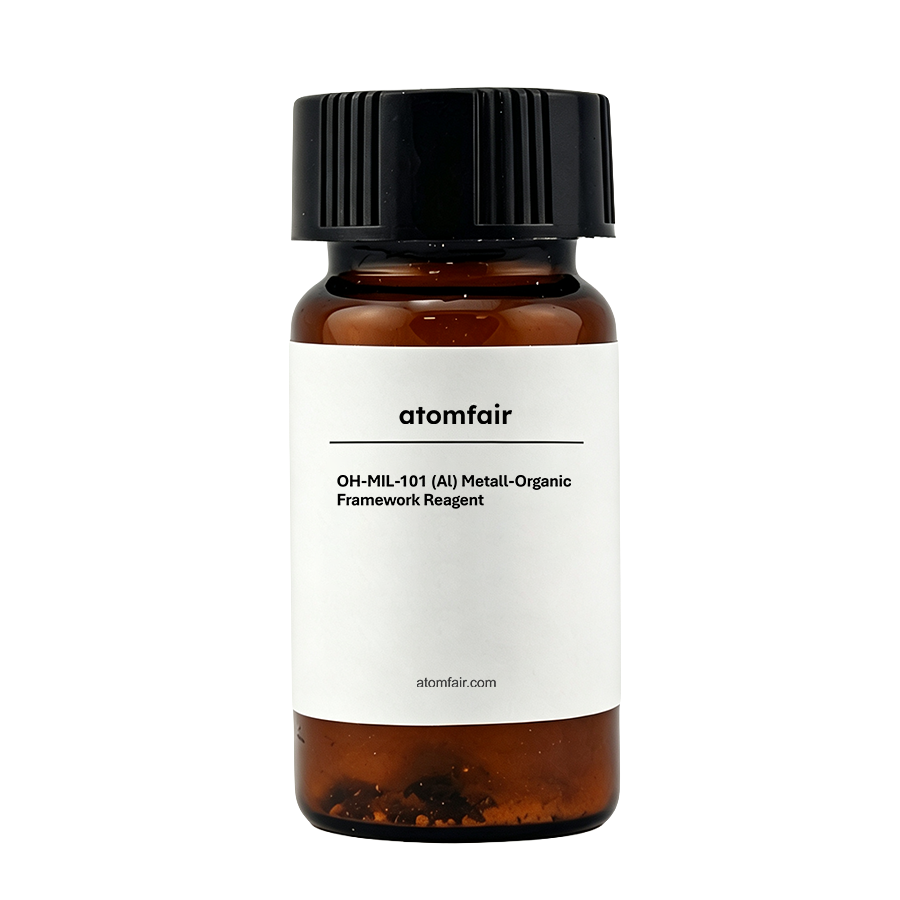
OH-MIL-101 (Al) METALL-ORGANIC FRAMEWORK REAGENTRESEARCH GRADE MATERIAL
|
||||||||||||||||||||||||||||||||||||||||||||||||||||||||||||||||
|
||||||||||||||||||||||||||||||||||||||||||||||||||||||||||||||||
This material exhibits thermal stability with decomposition onset above 350°C. It is chemically stable across a pH range of 3 to 12.
- Thermal Stability: Thermal decomposition onset exceeds 350°C.
- pH Stability: The material remains stable across a pH range of 3 to 12.
How does the hydroxyl functionalization in OH-MIL-101(Al) improve its catalytic and adsorption performance compared to pristine MIL-101(Al)?
The hydroxyl groups enhance hydrophilicity and active site accessibility, leading to a 95% Knoevenagel condensation yield versus 82% for pristine MIL-101(Al) and a 1.4x higher methylene blue adsorption capacity of 500 mg/g at 298 K. Additionally, the photocatalytic degradation rate for methyl orange reaches 0.22 min⁻¹ with 98% total degradation and 85% mineralization efficiency.
What are the pH and thermal stability limits of OH-MIL-101(Al) for use in aqueous or high-temperature reactions?
OH-MIL-101(Al) is chemically stable across a pH range of 3 to 12, making it suitable for mildly acidic to basic conditions. Its thermal decomposition onset is above 350°C, allowing operation in moderate-temperature catalytic and adsorption processes without structural degradation.
What is the regeneration capability of OH-MIL-101(Al) for repeated adsorption cycles?
The adsorbent exhibits excellent regenerability, with less than 7% capacity loss after 20 thermal regeneration cycles at 70°C. This indicates robust structural integrity and reusability for continuous flow purification or batch adsorption applications.
OH-MIL-101 (Al) is a hydroxyl-functionalized aluminum MOF with high BET surface area (2500-3000 m²/g) and mesoporous structure, offering superior catalytic and adsorption performance compared to pristine MIL-101(Al) in applications such as Knoevenagel condensation, heavy metal removal, and supercapacitor electrodes.
Positive
- High surface area and mesoporosity: BET specific surface area of 2500-3000 m²/g with 2-3 nm mesopores provides abundant active sites and rapid mass transport for catalytic and adsorption processes.
- Enhanced catalytic and adsorption performance: Hydroxyl functionalization yields 95% Knoevenagel conversion, 500 mg/g methylene blue uptake (1.4x pristine), and 120 mg/g As⁵⁺ adsorption with rapid equilibrium within 20 minutes.
Trade-offs
- Variable particle size and CAS: Particle size and CAS registry depend on customized batch profile, potentially affecting reproducibility in standardized protocols.
- Fine powder handling required: White powder form may necessitate dust control measures and careful storage to maintain stability and prevent contamination in sensitive applications.
Every advanced material, component, equipment, and instrument in our catalog is backed by rigorous testing. We maintain strict internal quality management frameworks and align with CE conformity metrics to deliver transparent, reproducible performance data via our public open-science repository.
To request raw batch performance data, submit formal vendor registration paperwork, or execute a fast-turnaround R&D manufacturing loop, contact us at inquiry@atomfair.com.
Item is dispatched under the Atomfair Shipping & Delivery Framework (Free worldwide shipping on orders over $59 USD excl. heavy equipment). Return is governed by the Atomfair Return & Refund Policy (7-day technical return window).