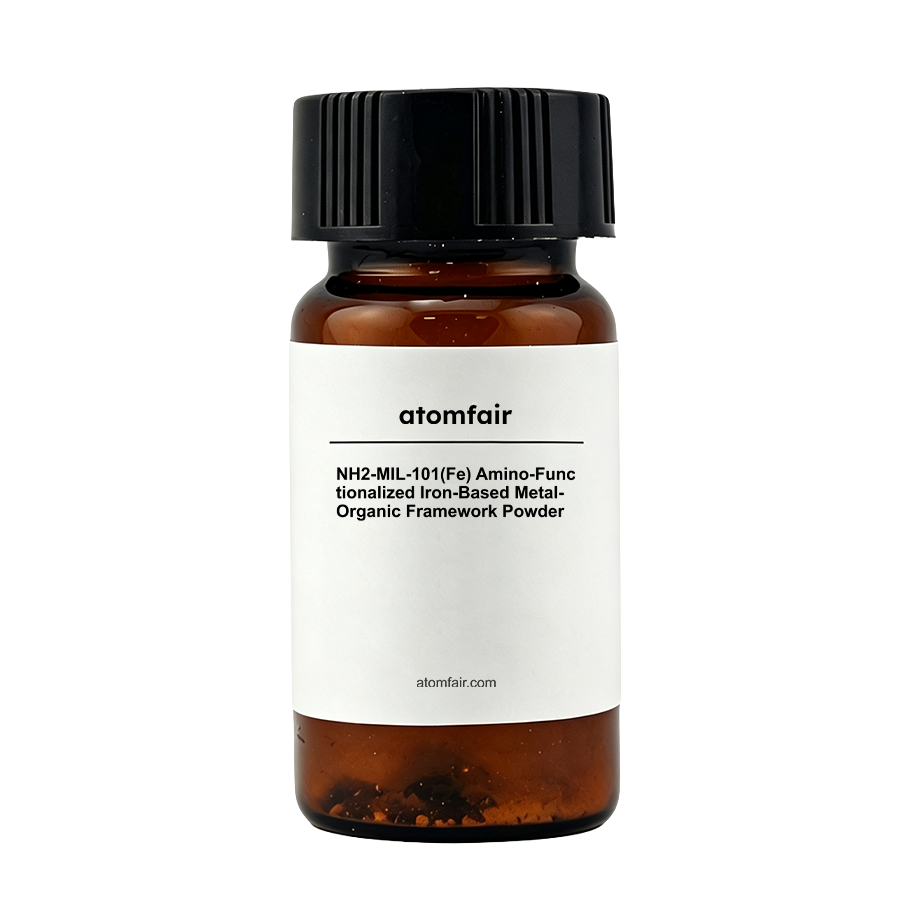
NH2-MIL-101(Fe) (AF-MO-D-M101-1189-0000)RESEARCH GRADE MATERIAL
|
|||||||||||||||||||||||||||||||||||||
|
|||||||||||||||||||||||||||||||||||||
This metal-organic framework powder is highly sensitive to ambient moisture and oxygen exposure. Handling must be performed exclusively under anhydrous inert gas to prevent phase contamination and structural degradation.
- Ambient sensitivity: The powder is highly sensitive to ambient moisture and oxygen, requiring strict anhydrous inert gas handling.
- Container handling: Containers must be kept tightly sealed and opened only under inert gas atmosphere.
- Degradation risk: Phase contamination or structural degradation can occur if the material is exposed to ambient conditions before thermal validation.
What is the significance of the hierarchical dual-pore structure (1.0 nm windows and 2.3–2.7 nm cages) in NH2-MIL-101(Fe) for electrocatalytic applications?
The hierarchical dual-pore structure ensures uncompromised electrochemical diffusion access by providing distinct window-to-cage distributions: the 1.0 nm windows allow selective molecular sieving while the larger 2.3–2.7 nm cages offer ample space for reaction intermediates. This configuration enhances electron transfer kinetics and minimizes internal parasitic resistance, as specified in the product's key features.
Can NH2-MIL-101(Fe) be used for heavy metal detection, and how does its structure enable sensitivity?
Yes, NH2-MIL-101(Fe) is validated for trace heavy metal extraction tracking, specifically for targeted lead ion (Pb2+) detection via highly sensitive electrochemical coordination pathways. The amino-functionalized iron MOF provides active coordination sites for heavy metal ions, while the high BET surface area (1100–2300 m²/g) and dual micro-mesoporous configuration amplify electrochemical signal transduction.
What are the storage and handling requirements for NH2-MIL-101(Fe) to maintain its structural integrity?
NH2-MIL-101(Fe) is highly sensitive to ambient exposure. To prevent phase contamination or structural degradation before thermal validation, containers must be kept tightly sealed and the material handled exclusively within an anhydrous inert gas environment, as stated in the product's logistics and operational notice.
NH2-MIL-101(Fe) is an amino-functionalized iron MOF with a dual micro-mesoporous structure (1.0 nm windows, 2.3-2.7 nm cages) and high surface area up to 2300 m²/g, designed for electrocatalysis and sensing applications. Its performance is contingent on strict inert atmosphere handling to prevent ambient degradation.
Positive
- Hierarchical Dual-Pore Matrix: Features distinct window (1.0 nm) and cage (2.3-2.7 nm) pores with high BET surface area (1100-2300 m²/g) and pore volume (0.8-1.8 cm³/g), ensuring uncompromised electrochemical diffusion access.
- Enhanced Charge Transport Kinetics: Amino groups and iron clusters provide rapid charge transport paths and minimize internal parasitic resistance, beneficial for electrocatalysis and sensing.
Trade-offs
- Ambient Exposure Sensitivity: Highly sensitive to ambient moisture and air; phase contamination or structural degradation can occur if exposed. Requires sealed containers or anhydrous inert gas environment.
- Specialized Handling Infrastructure: Handling exclusively within an inert gas environment is necessary to prevent degradation before thermal validation, demanding appropriate lab infrastructure.
Every advanced material, component, equipment, and instrument in our catalog is backed by rigorous testing. We maintain strict internal quality management frameworks and align with CE conformity metrics to deliver transparent, reproducible performance data via our public open-science repository.
To request raw batch performance data, submit formal vendor registration paperwork, or execute a fast-turnaround R&D manufacturing loop, contact us at inquiry@atomfair.com.
Item is dispatched under the Atomfair Shipping & Delivery Framework (Free worldwide shipping on orders over $59 USD excl. heavy equipment). Return is governed by the Atomfair Return & Refund Policy (7-day technical return window).