MOF-808 (Zr)RESEARCH GRADE MATERIAL
|
|||||||||||||||||||||||||
|
|||||||||||||||||||||||||
MOF-808 (Zr) requires strict exclusion of ambient moisture and oxygen to prevent phase contamination and structural degradation. All handling must be performed in an anhydrous inert gas environment, such as a glovebox filled with argon or nitrogen, prior to thermal validation.
- Moisture Sensitivity: Ambient moisture exposure causes irreversible structural degradation and loss of catalytic activity.
- Inert Gas Handling: Transfer and storage must be conducted under anhydrous inert gas to maintain phase purity and prevent contamination.
What are the specific surface area and pore size distribution of MOF-808 (Zr), and how do they support catalytic performance?
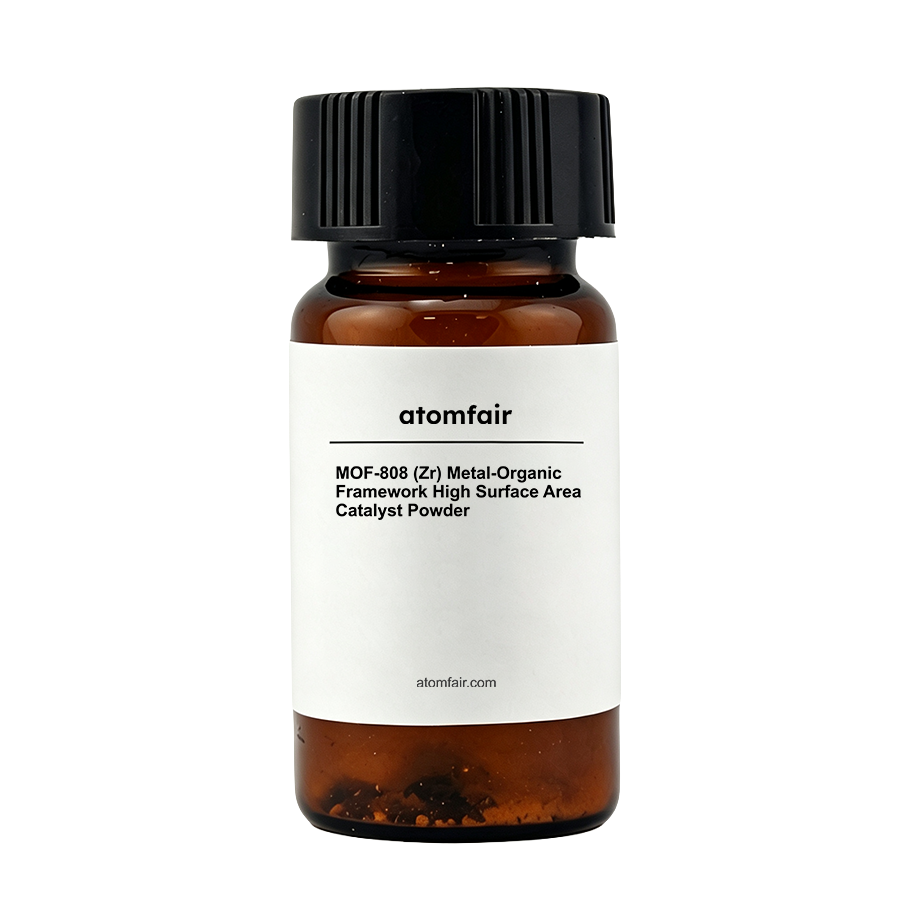
MOF-808 (Zr) exhibits a specific surface area greater than 1500 m²/g and a pore size distribution of 0.4–1.6 nm. These features, combined with large internal cavities and stable open coordination sites, enhance transfer kinetics and chemical reaction thresholds, making it an optimized platform for catalytic and adsorption workflows.
In which specific research applications is MOF-808 (Zr) demonstrated to be effective?
MOF-808 (Zr) is specified for methane oxidation to methanol, heavy metal ion capture, superacid catalysis, water adsorption, and selective catalysis. These applications leverage its engineered microstructure, high surface area, and stable metallic coordination centers.
What handling and storage conditions are required to maintain the structural integrity of MOF-808 (Zr)?
MOF-808 (Zr) is highly sensitive to ambient moisture and environmental exposure. To prevent phase contamination or structural degradation, it must be handled exclusively within an anhydrous inert gas environment prior to thermal validation. Storage under the same conditions is recommended.
MOF-808 (Zr) combines a surface area exceeding 1500 m2/g, 0.4–1.6 nm pore distribution, and stable open Zr coordination sites for methane oxidation, heavy metal capture, superacid catalysis, water adsorption, and selective catalysis research, but requires anhydrous inert-gas handling prior to thermal validation because of its sensitivity to ambient moisture.
Positive
- High surface area and microporosity: Specific surface area exceeds 1500 m2/g with pore sizes distributed from 0.4 to 1.6 nm, providing large internal cavities that support adsorption and catalytic testing workflows.
- Stable open coordination centers: The framework is engineered with highly stable open metallic coordination sites, promoting phase validation integrity and catalytic kinetics across methane oxidation, heavy metal capture, superacid catalysis, water adsorption, and selective catalysis applications.
Trade-offs
- Ambient moisture sensitivity: The material is highly sensitive to ambient moisture and environmental exposure, and such exposure risks phase contamination or structural degradation before thermal validation.
- Anhydrous inert-gas handling required: Handling must be performed exclusively within an anhydrous inert-gas environment prior to thermal validation, adding an infrastructure requirement for laboratory deployment.
Every advanced material, component, equipment, and instrument in our catalog is backed by rigorous testing. We maintain strict internal quality management frameworks and align with CE conformity metrics to deliver transparent, reproducible performance data via our public open-science repository.
To request raw batch performance data, submit formal vendor registration paperwork, or execute a fast-turnaround R&D manufacturing loop, contact us at inquiry@atomfair.com.
Item is dispatched under the Atomfair Shipping & Delivery Framework (Free worldwide shipping on orders over $59 USD excl. heavy equipment). Return is governed by the Atomfair Return & Refund Policy (7-day technical return window).