|
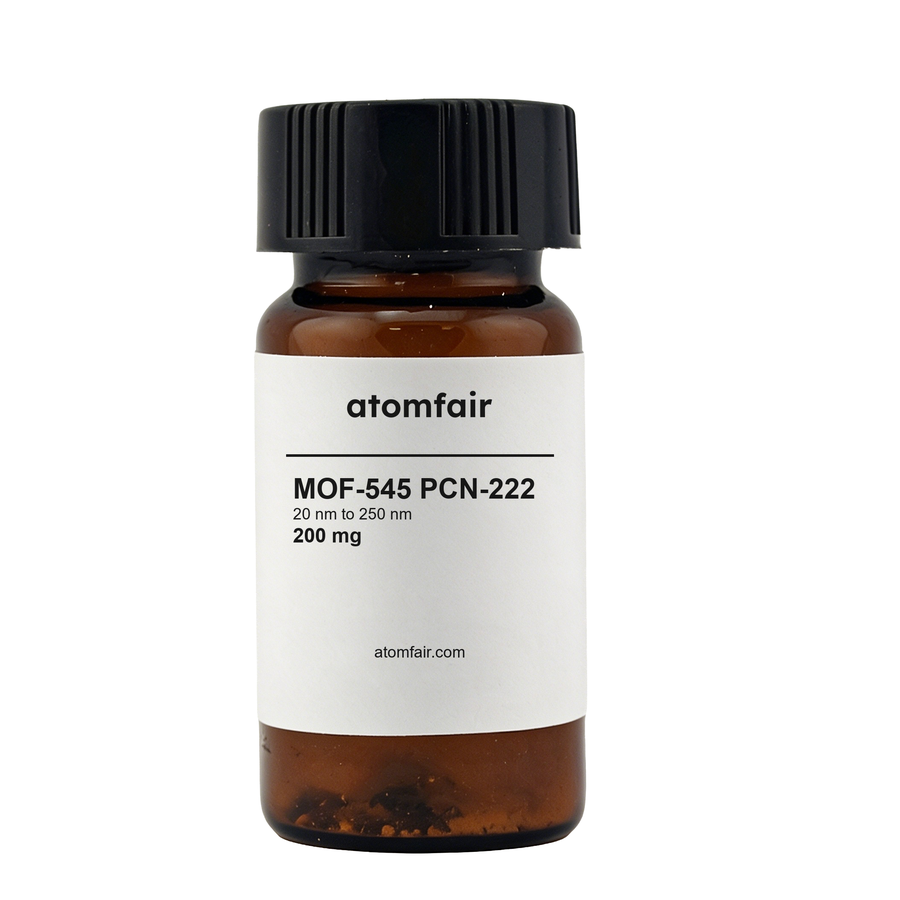
MOF-545 PCN-222(H), 20 nm to 250 nm, 200 mg
Product Type: Metal-organic framework material
Research-grade laboratory product
|
|||||||||||||||||||||||||||
|
|||||||||||||||||||||||||||
|
LABORATORY PROCUREMENT SUPPORT
For MOF composition, particle size, pore data, package size or quotation confirmation, contact our technical sales team.
E-MAIL: inquiry@atomfair.com
|
|||||||||||||||||||||||||||
|
Manufacturer: Atomfair LLC
Brand: ATOMFAIR®
|
What is the specific surface area of MOF-545 PCN-222(H) and how do the dual pore sizes at 3.7 nm and 1.3 nm affect its adsorption performance?
The specific surface area is approximately 1463 m2/g. The material exhibits two theoretical pore diameters: 3.7 nm (mesopore) and 1.3 nm (micropore). This hierarchical porosity can provide distinct adsorption sites for guest molecules of varying sizes, potentially enhancing selective uptake in gas storage or separation applications.
What are the typical particle dimensions of MOF-545 PCN-222(H) and how might its rod-like morphology influence its use in catalysis or membrane fabrication?
The product has a diameter of 20 nm to 250 nm and a length of 0.5 µm to 2.5 µm, indicating a rod- or needle-like morphology. Such anisotropic particles can affect packing density, diffusion pathways, and orientation in composite membranes or fixed-bed catalytic reactors, which may require careful dispersion or alignment strategies.
MOF-545 PCN-222(H) is a zirconium-based porphyrinic metal-organic framework supplied as a dark purple powder with a specific surface area of ~1463 m2/g and dual micropores of 3.7 nm and 1.3 nm, suitable for adsorption, catalysis, and biomedical applications.
Positive
- High specific surface area: A specific surface area of ~1463 m2/g provides abundant active sites for adsorption, catalysis, and gas storage applications.
- Dual microporous structure: Theoretical porous diameters of 3.7 nm and 1.3 nm offer size-selective pore access for guest molecules of different dimensions.
Trade-offs
- Wide particle size distribution: Diameter range of 20 nm to 250 nm and length of 0.5 µm to 2.5 µm implies polydispersity that may require pre-sieving or characterization for consistency in applications demanding uniform particle dimensions.
- Theoretical pore values may vary: The listed 3.7 nm and 1.3 nm porous diameters are theoretical; actual accessible pore size depends on activation conditions and framework integrity.
Every advanced material, component, equipment, and instrument in our catalog is backed by rigorous testing. We maintain strict internal quality management frameworks and align with CE conformity metrics to deliver transparent, reproducible performance data via our public open-science repository.
To request raw batch performance data, submit formal vendor registration paperwork, or execute a fast-turnaround R&D manufacturing loop, contact us at inquiry@atomfair.com.
Item is dispatched under the Atomfair Shipping & Delivery Framework (Free worldwide shipping on orders over $59 USD excl. heavy equipment). Return is governed by the Atomfair Return & Refund Policy (7-day technical return window).