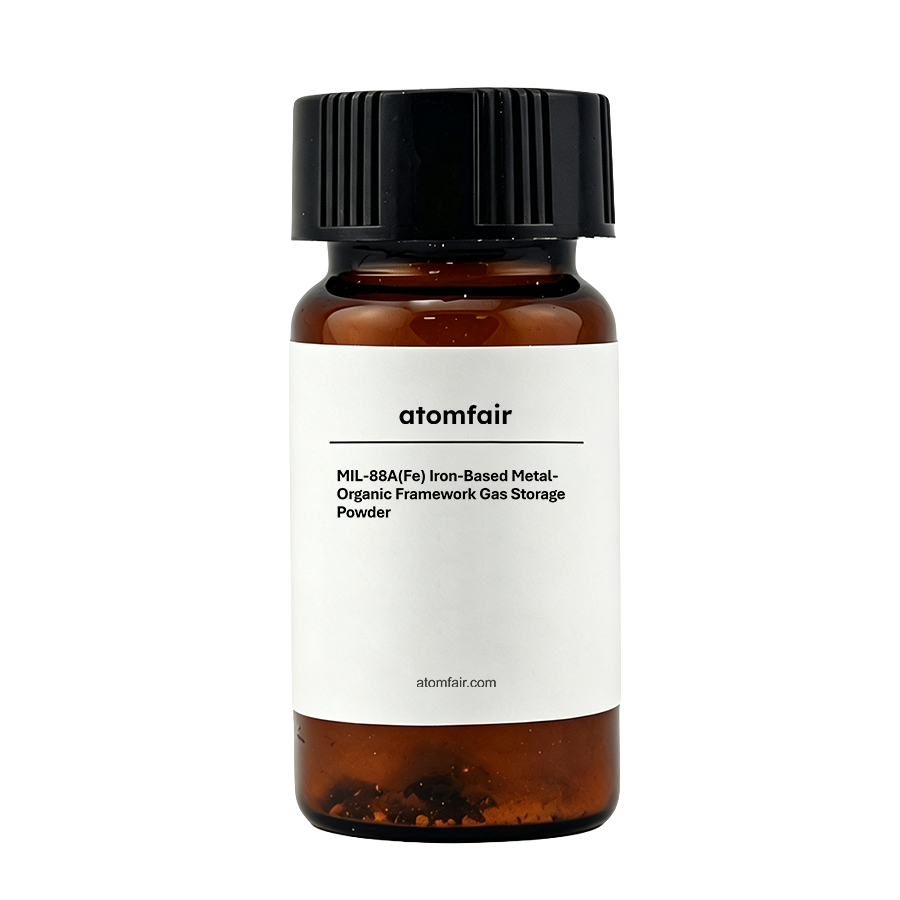
MIL-88A(Fe) Iron-Based Metal-Organic Framework PowderRESEARCH GRADE MATERIAL
|
||||||||||||||||||||
|
This material is highly sensitive to ambient moisture and oxygen, requiring handling exclusively within an anhydrous inert gas environment to prevent phase contamination. Thermal validation under controlled conditions is necessary before use to ensure structural integrity and performance.
- Ambient Sensitivity: Exposure to ambient atmosphere causes phase contamination and degradation of the crystalline framework.
- Inert Gas Handling: All transfers and manipulations must be performed inside a glovebox or under a continuous flow of dry inert gas.
- Sealed Storage: Containers must be kept tightly sealed when not in use to prevent moisture ingress.
- Thermal Validation: Thermal activation or pre-treatment under vacuum or inert gas is required to remove adsorbed species before catalytic or adsorption experiments.
- Material Stability: The rod-like crystalline structure and unsaturated metal sites are stable only under anhydrous conditions.
This procedure ensures the material remains uncontaminated and structurally intact before experimental use. All steps must be performed under anhydrous inert gas conditions to prevent degradation.
Required Equipment: Inert gas glovebox, Vacuum oven, Gas-tight storage container
- Transfer to inert atmosphere
Transfer the MIL-88A(Fe) powder into an anhydrous inert gas glovebox prior to any handling. - Seal container after use
Seal the container immediately after each use to prevent ambient contamination. - Perform thermal activation
Perform thermal activation under vacuum or inert gas flow before experimental use.
What is the significance of the BET surface area (>100 m²/g) and pore size range (0.4–2.0 nm) for MIL-88A(Fe) in gas adsorption applications?
The BET surface area exceeding 100 m²/g indicates a high surface-to-volume ratio critical for maximizing gas adsorption capacity. The microporous structure with pore sizes from 0.4 to 2.0 nm enables selective capture of small gas molecules such as CO2 or N2, making it suitable for gas separation and storage. This combination supports efficient mass-transfer kinetics and consistent baseline performance in solid-state adsorption workflows.
How does MIL-88A(Fe) achieve visible-light absorption for photocatalytic applications?
MIL-88A(Fe) contains unsaturated iron metal sites that coordinate with organic linkers, giving it a strong visible-light absorption spectrum. This property enables efficient electron-hole pair generation under solar irradiation, making it effective for heterogeneous photocatalysis, such as pollutant photodegradation and nitrogen reduction reactions. The iron nodes also facilitate charge transfer, enhancing conversion yields in photocatalytic setups.
What handling precautions are required for MIL-88A(Fe) to prevent degradation?
MIL-88A(Fe) is highly sensitive to ambient moisture and oxygen. It must be stored in tightly sealed containers and handled exclusively within an anhydrous inert gas environment, such as a glovebox filled with argon or nitrogen. Failure to maintain these conditions can lead to phase contamination or structural degradation, compromising its performance in gas adsorption or catalytic validation.
MIL-88A(Fe) is a rod-like iron-based MOF with unsaturated metal sites and visible-light absorption, offering advantages for photocatalysis and gas adsorption, but requires inert handling due to ambient sensitivity and has a limited pore size range.
Positive
- Unsaturated Iron Active Sites: Coordinated iron nodes provide superior structural affinity, enhancing catalytic efficiency in nitrogen reduction reactions and other targeted catalytic workflows.
- Engineered Rod-Like Microstructure: High-aspect-ratio crystals with uniform size (50 nm width, 500–2000 nm length) ensure consistent mass-transfer kinetics, ideal for gas adsorption, separation, and solid-state storage applications.
Trade-offs
- Ambient Exposure Sensitivity: This material is highly sensitive to ambient exposure; containers must be kept tightly sealed and handled exclusively within an anhydrous inert gas environment to prevent phase contamination or degradation before thermal validation.
- Narrow Pore Size Range: With a pore size range of 0.4–2.0 nm, the framework may be unsuitable for applications involving larger molecule adsorption or separation, limiting its scope to small-molecule target species.
Every advanced material, component, equipment, and instrument in our catalog is backed by rigorous testing. We maintain strict internal quality management frameworks and align with CE conformity metrics to deliver transparent, reproducible performance data via our public open-science repository.
To request raw batch performance data, submit formal vendor registration paperwork, or execute a fast-turnaround R&D manufacturing loop, contact us at inquiry@atomfair.com.
Item is dispatched under the Atomfair Shipping & Delivery Framework (Free worldwide shipping on orders over $59 USD excl. heavy equipment). Return is governed by the Atomfair Return & Refund Policy (7-day technical return window).