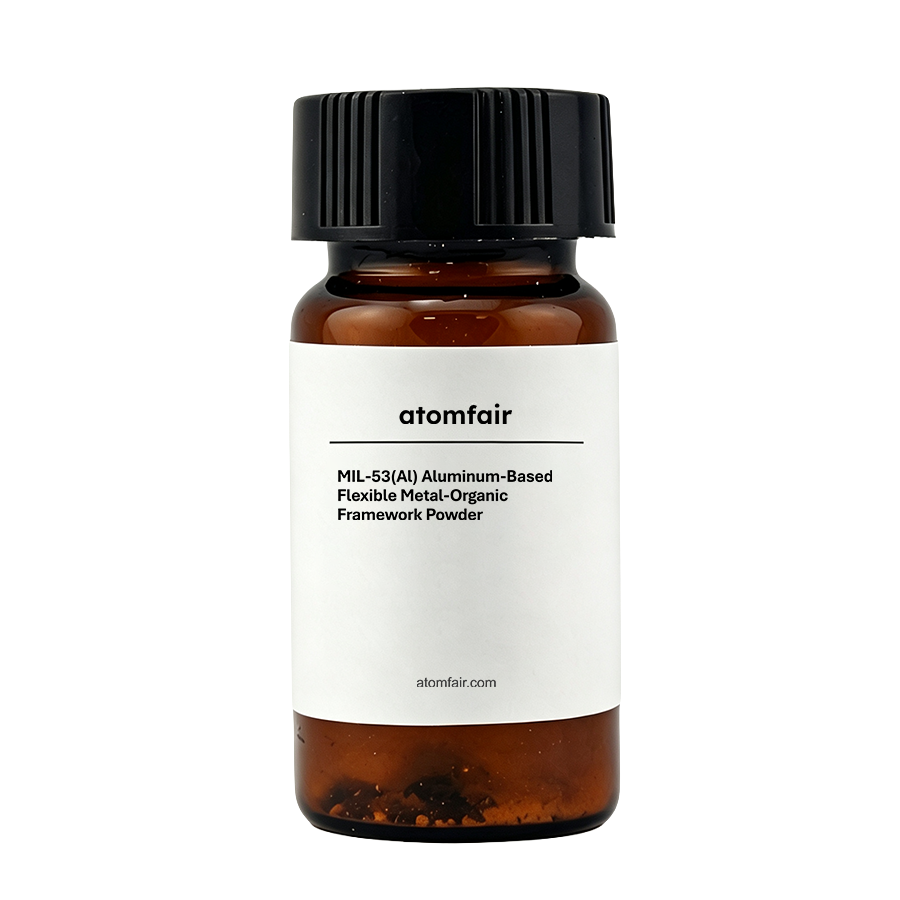
MIL-53(Al) Aluminum-Based Flexible Metal-Organic Framework PowderRESEARCH GRADE MATERIAL
|
||||||||||||||||||||
|
This material exhibits extreme sensitivity to temperature and external pressure stimuli, which can induce structural phase changes that alter pore conformation and adsorption properties. The material is also highly sensitive to ambient exposure, requiring storage in tightly sealed containers or exclusive handling within an anhydrous inert gas environment to prevent phase contamination or degradation before thermal validation.
- Breathing Framework Sensitivity: The flexible crystalline structure undergoes adaptive cell parameter adjustments under variable pressure or thermal gradients, which can unpredictably shift gas selectivity if environmental controls are not maintained.
- Ambient Exposure Degradation: Exposure to ambient atmosphere before thermal validation risks phase contamination and irreversible degradation of the porous framework architecture.
- Storage Atmosphere Requirement: Containers must be kept tightly sealed and material handled exclusively within an anhydrous inert gas environment to preserve structural integrity and adsorption performance.
This procedure details the steps to safely transfer, thermally activate, and store MIL-53(Al) aluminum-based MOF powder while preserving its flexible crystalline framework. Proper inert atmosphere handling and controlled thermal conditioning are critical to prevent ambient degradation and ensure reproducible adsorption performance.
Required Equipment: Anhydrous inert gas glovebox, Vacuum oven with temperature control, Weighing balance, Sealed transfer vessel
- Transfer material to glovebox
Transfer the sealed container into an anhydrous inert gas glovebox immediately upon receipt to prevent ambient exposure. - Weigh under inert atmosphere
Weigh the required amount of MIL-53(Al) powder using a balance placed inside the glovebox, ensuring all manipulations are performed under anhydrous conditions. - Load into vacuum oven
Load the weighed powder into a vacuum oven preheated to the activation temperature specified in your protocol, maintaining inert gas flow during transfer. - Perform thermal activation
Apply vacuum and controlled heating to remove residual solvent and activate the porous framework, ramping temperature gradually as required by the material specification. - Cool under vacuum
Allow the activated powder to cool to room temperature under dynamic vacuum to prevent readsorption of atmospheric moisture or gases. - Store in sealed inert container
Transfer the cooled, activated powder to a pre-dried, gas-tight storage vessel inside the glovebox and seal immediately for later use.
How does the breathing effect of MIL-53(Al) influence its gas adsorption selectivity under varying temperature and pressure conditions?
The breathing effect enables adaptive cell parameter adjustments, allowing tunable gas selectivity. The source states MIL-53(Al) exhibits extreme sensitivity to temperature and pressure stimuli, with dynamic pore conformation enabling custom-selective interception of target gases. Its pore size range of 0.4–0.8 nm and BET surface area exceeding 1000 m²/g support this stimuli-responsive behavior.
What are the critical handling and storage requirements for MIL-53(Al) to prevent phase contamination?
MIL-53(Al) is highly sensitive to ambient exposure. Containers must be kept tightly sealed or handled exclusively within an anhydrous inert gas environment to prevent phase contamination or degradation before thermal validation. This is explicitly stated in the logistics and operational notice.
Can MIL-53(Al) be integrated into existing carbon dioxide capture frameworks without significant infrastructure modification?
Yes, MIL-53(Al) is designed for carbon dioxide environmental capture frameworks and complex gas blend separation. Its nanoscale particle size (50–200 nm) promotes quick adsorption-desorption response. However, the material requires anhydrous inert gas handling, which may necessitate additional infrastructure for ambient-sensitive operations.
MIL-53(Al) is a research-grade flexible aluminum-based MOF powder with a BET surface area exceeding 1000 m²/g and 0.4–0.8 nm pores, combining a stimuli-responsive breathing framework with 50–200 nm particles for tunable gas adsorption and rapid sensor response. Its high sensitivity to ambient exposure requires anhydrous inert handling and sealed storage until thermal validation.
Positive
- High BET Surface Area Exceeding 1000 m²/g: The porous framework architecture exceeding 1000 m²/g provides an extensive active interaction interface, supporting high-capacity gas adsorption and environmental separation workflows.
- Stimuli-Responsive Breathing Framework: The flexible crystalline structure exhibits high sensitivity to temperature and external pressure, enabling adaptive cell parameter changes and tunable gas selectivity parameters for targeted separation applications.
Trade-offs
- Ambient Exposure Sensitivity: This material is highly sensitive to ambient exposure; containers must remain tightly sealed or handling must occur under anhydrous inert gas to prevent phase contamination or degradation before thermal validation.
- Thermal and Pressure Operating Constraints: Because the framework responds to thermal and pressure gradients, operating conditions must be controlled to maintain the intended adsorption selectivity and avoid unintended structural changes.
Every advanced material, component, equipment, and instrument in our catalog is backed by rigorous testing. We maintain strict internal quality management frameworks and align with CE conformity metrics to deliver transparent, reproducible performance data via our public open-science repository.
To request raw batch performance data, submit formal vendor registration paperwork, or execute a fast-turnaround R&D manufacturing loop, contact us at inquiry@atomfair.com.
Item is dispatched under the Atomfair Shipping & Delivery Framework (Free worldwide shipping on orders over $59 USD excl. heavy equipment). Return is governed by the Atomfair Return & Refund Policy (7-day technical return window).