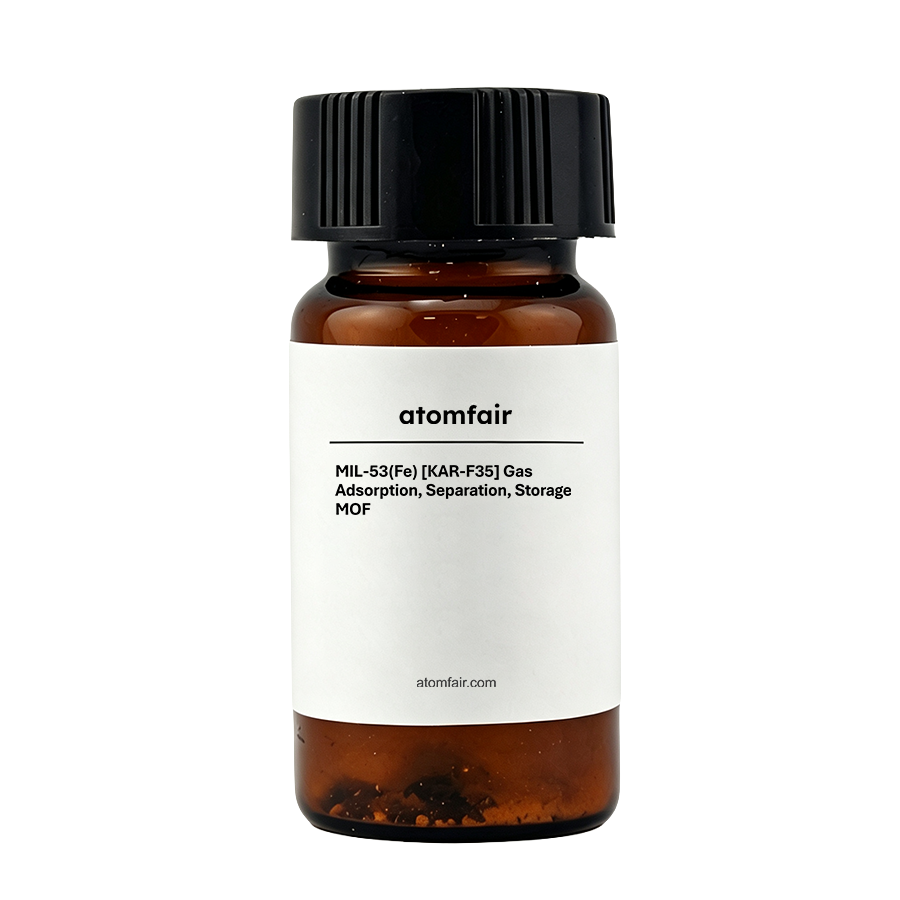
MIL-53(Fe) [KAR-F35] Gas Adsorption, Separation, Storage MOFRESEARCH GRADE MATERIAL
|
|||||||||||||||||||||||||||||||
|
|||||||||||||||||||||||||||||||
|
TAILORED SOLUTIONS FOR RESEARCH
Contact our engineering team for technical support or official institutional quotations.
EMAIL: inquiry@atomfair.com
|
|||||||||||||||||||||||||||||||
|
Manufacturer: Atomfair LLC
Brand: ATOMFAIR®
|
|||||||||||||||||||||||||||||||
MIL-53(Fe) is an air- and moisture-sensitive MOF that must be protected from ambient exposure to avoid phase contamination or degradation. Storage and handling require sealed containment or an anhydrous inert gas atmosphere until thermal validation is performed.
- Ambient Exposure Sensitivity: Exposure to ambient atmosphere can contaminate or degrade the MOF phase before thermal validation.
- Sealed Container Storage: Keep the container tightly sealed at all times when the material is not being actively transferred.
- Inert Gas Handling Requirement: Handle the material exclusively within an anhydrous inert gas environment to prevent phase contamination.
Use this procedure when transferring or storing MIL-53(Fe) outside its original sealed container. Work is limited to an anhydrous inert gas environment to maintain phase purity before thermal validation.
Required Equipment: Anhydrous inert gas environment
- Transfer to inert gas
Transfer the sealed container into an anhydrous inert gas environment before opening it. - Open under inert gas
Open the container only inside the inert gas atmosphere to prevent ambient exposure. - Reseal after transfer
Reseal the container tightly whenever material transfer is not actively occurring. - Store until thermal validation
Store the sealed container under the inert gas atmosphere until thermal validation is conducted.
What is the typical particle size of MIL-53(Fe) [KAR-F35] and how does it influence gas adsorption and catalytic performance?
MIL-53(Fe) [KAR-F35] has a particle size of less than 1000 nm, ensuring a high surface area-to-volume ratio that enhances adsorption kinetics and catalytic activity. The material's homogeneous purity and highly uniform elemental distribution further support consistent performance in selective gas capture and heterogeneous catalysis.
Can MIL-53(Fe) [KAR-F35] be used in a solvothermal sponge composite for photocatalytic applications?
Yes, the source describes an Advanced Solvothermal Sponge Composite (cs/mil-53(Fe)) formed by in-situ growth on charcoal sponge. This composite optimizes microstructure and enhances photogenerated charge carrier separation, addressing traditional limitations of low photocatalytic efficiency, poor stability, and recycling difficulties.
What storage and handling conditions are required to prevent degradation of MIL-53(Fe) [KAR-F35]?
MIL-53(Fe) [KAR-F35] is highly sensitive to ambient exposure. Containers must be kept tightly sealed, and the material should be handled exclusively in an anhydrous inert gas environment to prevent phase contamination or degradation before thermal validation.
MIL-53(Fe) [KAR-F35] is a research-grade MOF with homogeneous elemental distribution and flexible pore channels optimized for selective CO2/CH4 adsorption and catalytic hydrogen production, but requires strict inert atmosphere handling and lacks specified pore diameter and surface area parameters.
Positive
- Homogeneous material purity: Uncompromised structural configuration with highly uniform elemental distribution across the MOF matrix, ensuring consistent baseline performance in lab workflows.
- High-efficiency selective adsorption: Flexible, adjustable pore channel framework optimized for selective capture, separation, and storage of CO2 and CH4, enabling targeted gas separation applications.
Trade-offs
- Sensitive to ambient exposure: Product requires sealed storage or handling exclusively in anhydrous inert gas to prevent phase contamination or degradation before thermal validation.
- Undefined key structural parameters: Pore diameter and specific surface area are listed as 'To be determined (TBD)', meaning these critical performance metrics are not available from the source, requiring additional characterization by the user.
Every advanced material, component, equipment, and instrument in our catalog is backed by rigorous testing. We maintain strict internal quality management frameworks and align with CE conformity metrics to deliver transparent, reproducible performance data via our public open-science repository.
To request raw batch performance data, submit formal vendor registration paperwork, or execute a fast-turnaround R&D manufacturing loop, contact us at inquiry@atomfair.com.
Item is dispatched under the Atomfair Shipping & Delivery Framework (Free worldwide shipping on orders over $59 USD excl. heavy equipment). Return is governed by the Atomfair Return & Refund Policy (7-day technical return window).