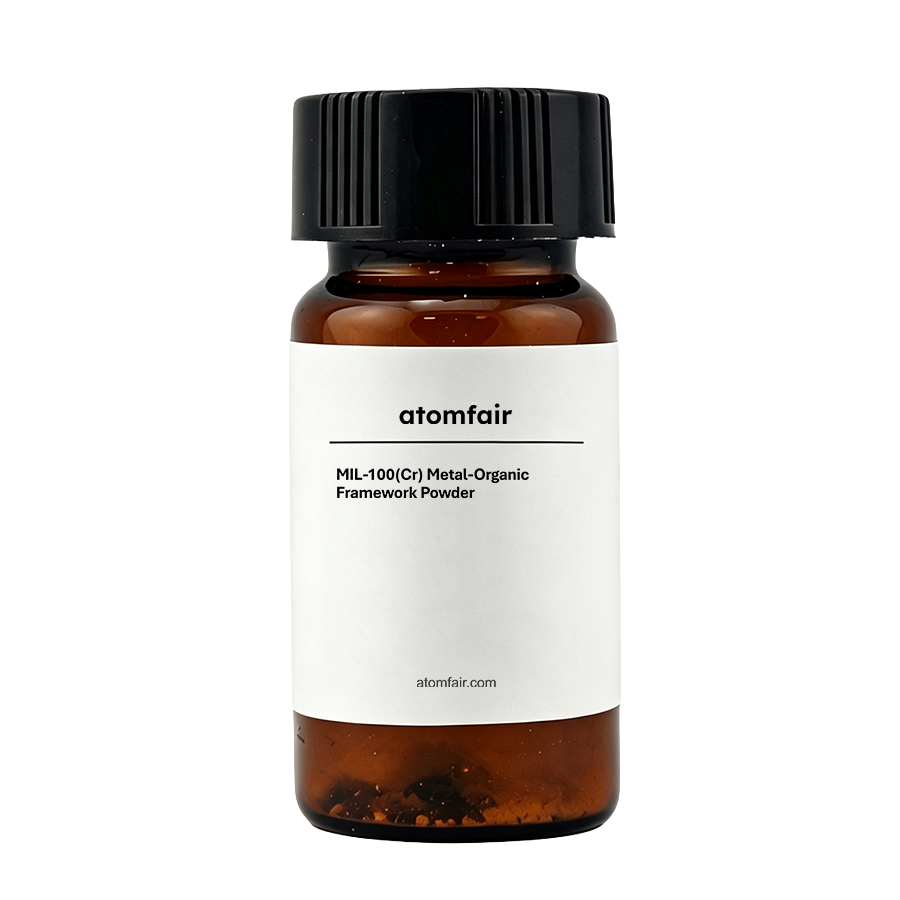
MIL-100(Cr) Metal-Organic Framework PowderRESEARCH GRADE MATERIAL
|
||||||||||||||||||||||
|
Handling constraints for MIL-100(Cr) metal-organic framework. The material must be protected from ambient exposure and kept under anhydrous inert gas until thermal validation.
- Atmosphere handling limit: Handle the material exclusively within an anhydrous inert gas environment to prevent phase contamination or degradation.
- Container sealing requirement: Keep containers tightly sealed at all times when the material is not being handled inside the inert gas environment.
- Pre-thermal-validation storage: Maintain anhydrous inert conditions during storage until thermal validation has been completed.
Procedure for handling MIL-100(Cr) under anhydrous inert atmosphere. All transfers should be performed inside an inert gas environment with the container sealed when not in use.
- Move container into inert atmosphere
Transfer the sealed container into an anhydrous inert gas environment before opening it. - Open under inert gas
Open the container only inside the anhydrous inert gas environment to prevent ambient exposure. - Transfer under inert gas
Transfer the material only while the container remains inside the anhydrous inert gas environment. - Reseal container
Reseal the container tightly immediately after transfer operations. - Store until thermal validation
Store the sealed container under anhydrous inert gas until thermal validation is complete.
What hydrogen adsorption capacity does MIL-100(Cr) achieve under cryogenic conditions?
MIL-100(Cr) delivers a maximum hydrogen uptake of 3.28 wt% at 77 K and 25 bar. This performance is supported by a BET surface area exceeding 1200 m²/g and a pore size range of 0.3–2.0 nm, enabling high-capacity solid-state storage.
Can MIL-100(Cr) be used for selective gas separation or biomolecule isolation without modification?
Yes, the framework's engineered porous coordination geometry provides strong affinity for adsorbing hydrogen sulfide, carbon dioxide, and methane, and supports selective biomolecule separation and identification. Its nanoscale grain size of 50–100 nm ensures uniform matrix blending and optimized mass transfer for chromatographic and sensor applications.
What handling precautions are required to prevent degradation of MIL-100(Cr) powder before use?
The product is highly sensitive to ambient moisture and air. It must be stored in tightly sealed containers and handled exclusively within an anhydrous inert gas environment to avoid phase contamination or structural degradation prior to thermal validation or experimental use.
MIL-100(Cr) is a chromium-based MOF powder with a BET surface area exceeding 1200 m²/g and a pore size range of 0.3–2.0 nm, optimized for solid-state hydrogen storage up to 3.28 wt% at 77 K and 25 bar. Its nanoscale particle size (50–100 nm) supports uniform phase blending, but the material requires anhydrous inert gas handling to prevent ambient degradation.
Positive
- High-capacity hydrogen adsorption: Delivers up to 3.28 wt% solid-state hydrogen storage at 77 K and 25 bar, making it suitable for cryogenic hydrogen storage research.
- Large surface area and porosity: BET surface area >1200 m²/g with pore sizes 0.3–2.0 nm enables efficient multi-component gas trapping of H₂S, CO₂, and CH₄.
Trade-offs
- Ambient exposure sensitivity: Highly sensitive to ambient moisture and air; requires storage in sealed containers and handling under anhydrous inert gas to prevent phase contamination or degradation.
- Cryogenic operating conditions required: Maximum hydrogen adsorption is achieved at 77 K, necessitating liquid nitrogen or equivalent cryogenic infrastructure for experimental validation.
Every advanced material, component, equipment, and instrument in our catalog is backed by rigorous testing. We maintain strict internal quality management frameworks and align with CE conformity metrics to deliver transparent, reproducible performance data via our public open-science repository.
To request raw batch performance data, submit formal vendor registration paperwork, or execute a fast-turnaround R&D manufacturing loop, contact us at inquiry@atomfair.com.
Item is dispatched under the Atomfair Shipping & Delivery Framework (Free worldwide shipping on orders over $59 USD excl. heavy equipment). Return is governed by the Atomfair Return & Refund Policy (7-day technical return window).