|
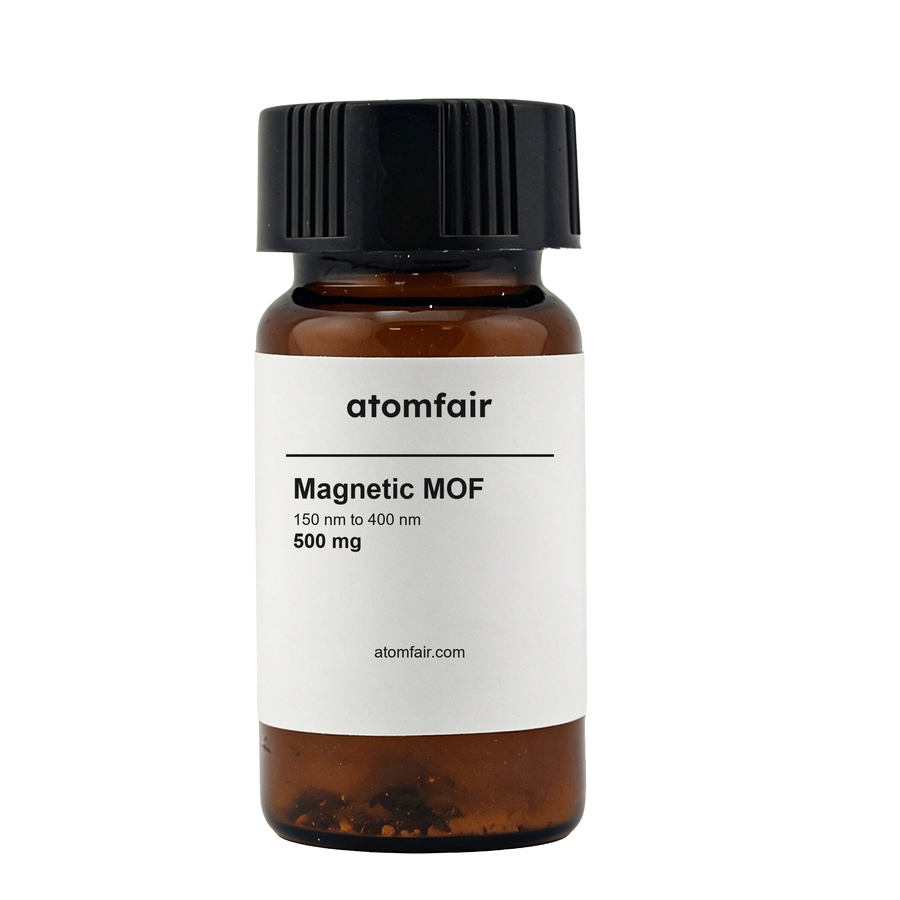
Magnetic MOF (Fe3O4@ZIF-8), 150 nm to 400 nm, 500 mg
Product Type: Metal-organic framework material
Research-grade laboratory product
|
|||||||||||||||||||||||
|
|||||||||||||||||||||||
|
LABORATORY PROCUREMENT SUPPORT
For MOF composition, particle size, pore data, package size or quotation confirmation, contact our technical sales team.
E-MAIL: inquiry@atomfair.com
|
|||||||||||||||||||||||
|
Manufacturer: Atomfair LLC
Brand: ATOMFAIR®
|
What is the specific surface area and pore diameter range of the Fe3O4@ZIF-8 magnetic MOF?
The Fe3O4@ZIF-8 magnetic MOF has a specific surface area of approximately 368 m²/g and a pore diameter range of 0.34 nm to 1.16 nm. These parameters are critical for evaluating adsorption capacity and molecular sieving performance in catalytic or separation applications.
What are the particle size and composition constraints for integrating this magnetic MOF into a microfluidic or packed-bed reactor?
The particle diameter ranges from 150 nm to 400 nm, which is suitable for suspension-based microfluidic systems but may require careful packing density optimization in fixed-bed reactors. The composition includes Fe3O4 and ZIF-8, so the magnetic response from Fe3O4 enables external field manipulation, but the ZIF-8 framework's pore structure (0.34–1.16 nm) limits guest molecule size to small molecules or gases.
What storage and handling precautions are required for this 500 mg Fe3O4@ZIF-8 magnetic MOF?
As a research-grade metal-organic framework, the material should be stored under inert atmosphere or vacuum to prevent moisture-induced degradation of the ZIF-8 structure and oxidation of Fe3O4 nanoparticles. The 500 mg package size is typical for small-scale synthesis or characterization studies; avoid exposure to strong magnetic fields during storage to prevent aggregation.
The Fe3O4@ZIF-8 composite offers a magnetic core with a ZIF-8 shell providing ~368 m2/g surface area and microporosity, but the broad particle size range (150–400 nm) and small pore diameters (0.34–1.16 nm) impose constraints on reproducibility and molecular accessibility.
Positive
- Magnetic core-shell architecture enables magnetic separation: Fe3O4 core provides magnetic responsiveness, while the ZIF-8 shell retains high surface area (~368 m2/g) and microporosity for sorption or catalysis applications.
- High surface area and tuneable microporosity: With ~368 m2/g specific surface area and pore diameters from 0.34 to 1.16 nm, this material offers significant accessible surface for molecular sieving or catalysis.
Trade-offs
- Broad particle size distribution (150–400 nm): The specified diameter range is wide, leading to potential batch-to-batch variability in magnetic response and pore accessibility for size-selective applications.
- Microporous structure limits accessibility to larger molecules: Pore diameters as low as 0.34 nm restrict diffusion of molecules larger than approximately 3.4 Å, requiring careful matching of substrate size to pore dimensions.
Every advanced material, component, equipment, and instrument in our catalog is backed by rigorous testing. We maintain strict internal quality management frameworks and align with CE conformity metrics to deliver transparent, reproducible performance data via our public open-science repository.
To request raw batch performance data, submit formal vendor registration paperwork, or execute a fast-turnaround R&D manufacturing loop, contact us at inquiry@atomfair.com.
Item is dispatched under the Atomfair Shipping & Delivery Framework (Free worldwide shipping on orders over $59 USD excl. heavy equipment). Return is governed by the Atomfair Return & Refund Policy (7-day technical return window).