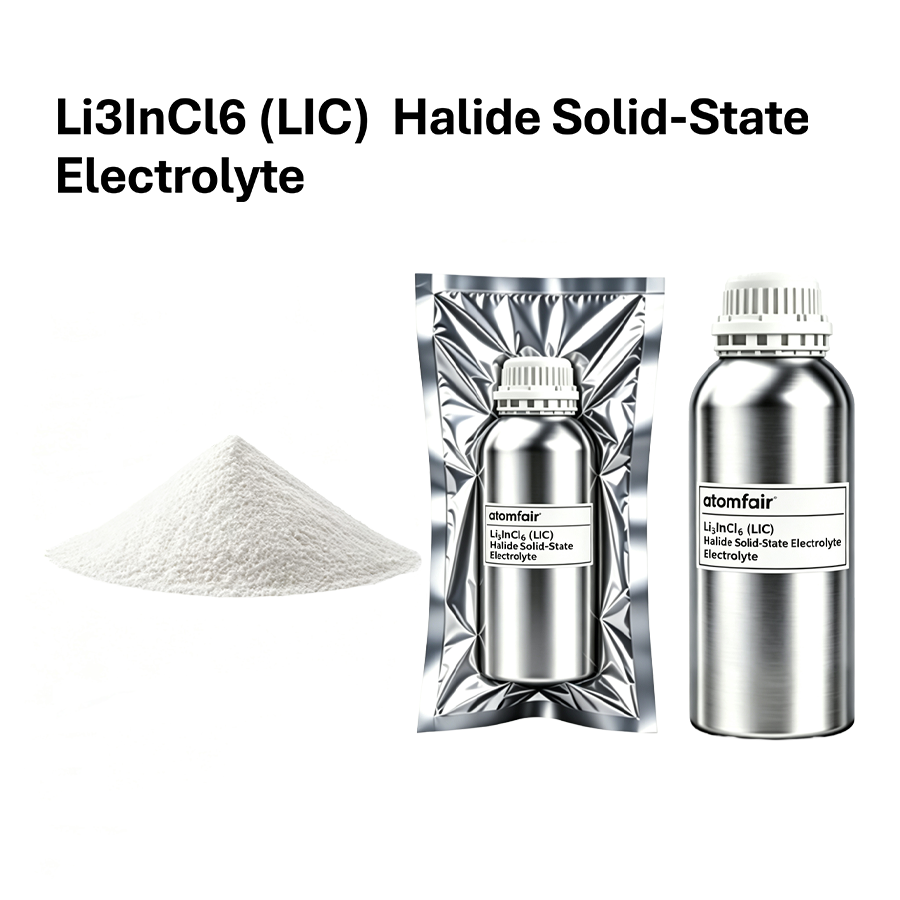
Li3InCl6 (LIC) Halide Solid‑State ElectrolyteHalide Solid-State Electrolytes
|
|||||||||||||||||||||
|
|||||||||||||||||||||
|
Li3InCl6 (LIC) halide solid-state electrolyte requires strict moisture-free storage in an argon or nitrogen glovebox to prevent degradation. The material's particle size directly influences its ionic conductivity, with larger particles (>5.0 μm) delivering higher conductivity than smaller particles (<1.0 μm).
- Storage Requirement: Store the material in an argon or nitrogen glovebox immediately after opening and reseal the container promptly to prevent moisture exposure.
- Handling Safety: Handle the powder only under inert atmosphere using appropriate personal protective equipment including gloves, mask, and safety goggles.
- Particle Size Selection: Select the particle size variant based on the required ionic conductivity, as larger particles (>5.0 μm) yield higher conductivity than smaller particles (<1.0 μm).
- Electrochemical Compatibility: Use the material exclusively with high-voltage oxide cathodes (e.g., NCM, LCO) to maintain electrochemical stability within the 4 V-class window.
- Composite Electrolyte Pairing: Pair the material with sulfide electrolytes such as LPSC as an anode-side separator when constructing composite electrolyte architectures.
How does particle size affect the ionic conductivity of Li3InCl6 halide solid-state electrolyte?
Larger particle sizes ( > 5.0 μm) deliver higher ionic conductivity ( > 1.4 mS/cm at 27 °C), while smaller particles ( < 1.0 μm) yield > 1.0 mS/cm at 27 °C. This trade-off allows researchers to balance conductivity against particle packing or slurry processing requirements in ASSB fabrication.
Is Li3InCl6 electrochemically compatible with high-voltage oxide cathodes like NCM or LCO?
Yes, Li3InCl6 is stable against 4 V-class oxide cathodes, making it suitable for use with NCM, LCO, and high-nickel systems. Its electrochemical window supports direct integration as a catholyte without significant decomposition, unlike sulfide electrolytes that require protective coatings.
What storage conditions are required to preserve the performance of Li3InCl6 after opening?
Li3InCl6 must be stored sealed in an argon or nitrogen glovebox, protected from moisture, and resealed promptly after each use. The material ships vacuum-sealed under inert atmosphere, and failure to maintain dry conditions can degrade its ionic conductivity due to moisture sensitivity, though it is significantly more moisture-tolerant than sulfide electrolytes.
Li3InCl6 is an indium-based chloride solid electrolyte delivering 1.0-1.4 mS/cm ionic conductivity at 27 °C, electronic conductivity below 1 x 10^-8 S/cm, and stability against 4 V-class oxide cathodes. It offers better moisture tolerance than sulfide electrolytes while still requiring inert-atmosphere glovebox storage and handling.
Positive
- High ionic conductivity, electronically insulating: The material provides 1.0-1.4 mS/cm ionic conductivity at 27 °C depending on particle size while maintaining electronic conductivity below 1 x 10^-8 S/cm, making it suitable as an ion-conducting catholyte in all-solid-state battery research.
- Moisture-tolerant and cold-pressable halide: Li3InCl6 shows significantly better moisture tolerance than sulfide electrolytes such as LGPS and LPSC, and it is cold-pressable, simplifying ASSB cell assembly and compatibility with high-voltage oxide cathodes.
Trade-offs
- Inert-atmosphere storage still required: Despite improved moisture tolerance relative to sulfides, the material ships vacuum-sealed under inert atmosphere and must be stored sealed in an Ar or N2 glovebox, protected from moisture, with prompt resealing after opening.
- Particle-size conductivity trade-off: The finer < 1.0 μm grade is specified at > 1.0 mS/cm while the coarser > 5.0 μm grade reaches > 1.4 mS/cm, so choosing a smaller particle size for processing carries a measurable ionic conductivity penalty.
Every advanced material, component, equipment, and instrument in our catalog is backed by rigorous testing. We maintain strict internal quality management frameworks and align with CE conformity metrics to deliver transparent, reproducible performance data via our public open-science repository.
To request raw batch performance data, submit formal vendor registration paperwork, or execute a fast-turnaround R&D manufacturing loop, contact us at inquiry@atomfair.com.
Item is dispatched under the Atomfair Shipping & Delivery Framework (Free worldwide shipping on orders over $59 USD excl. heavy equipment). Return is governed by the Atomfair Return & Refund Policy (7-day technical return window).