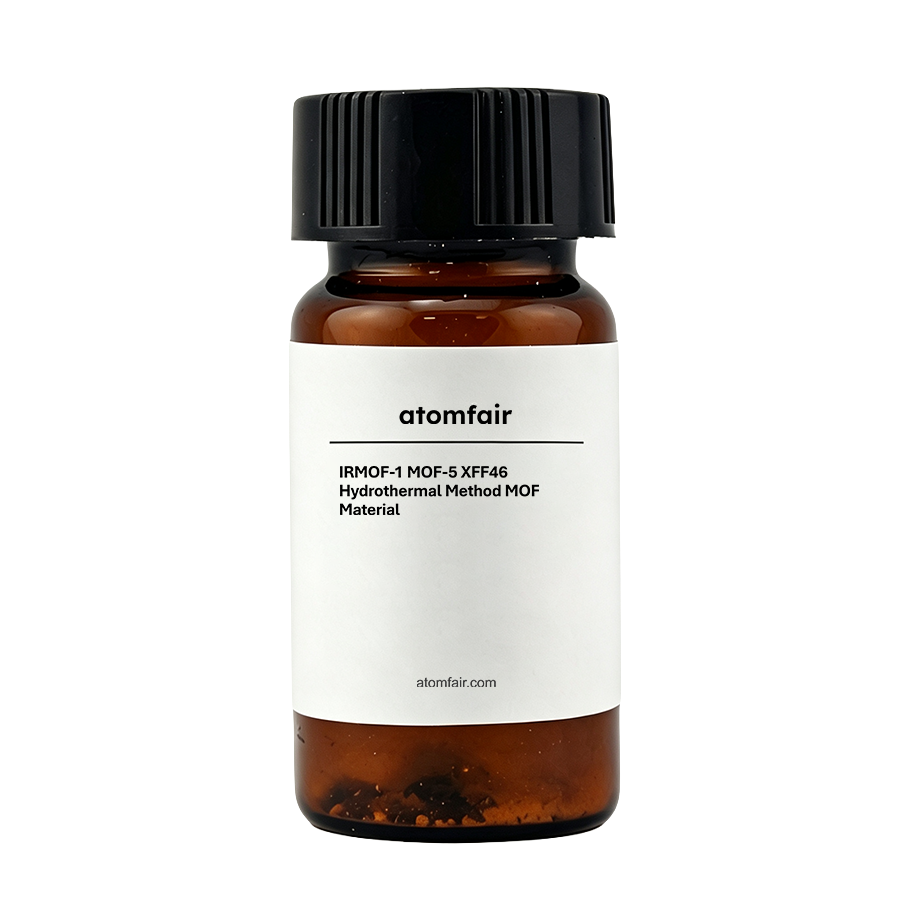
IRMOF-1 MOF-5 XFF46 MOF ORGANIC FRAMEWORK MATERIALRESEARCH GRADE MATERIAL
|
|||||||||||||||||||||||||||
|
|||||||||||||||||||||||||||
|
TAILORED SOLUTIONS FOR RESEARCH
Contact our engineering team for technical support or official institutional quotations.
EMAIL: inquiry@atomfair.com
|
|||||||||||||||||||||||||||
|
Product Classification: MOF Organic Framework Material
|
|||||||||||||||||||||||||||
This material is highly sensitive to ambient exposure and must be handled exclusively under anhydrous inert gas conditions. Phase contamination or degradation can occur if containers are not tightly sealed or if exposed to moisture or oxygen before thermal validation.
- Ambient Exposure Sensitivity: IRMOF-1 rapidly degrades upon exposure to moisture or oxygen, requiring strict inert atmosphere handling.
- Container Sealing: The sealed container must remain tightly closed except when transferring material inside an inert gas environment.
- Inert Gas Environment: All handling steps must be performed within a glovebox or similar enclosure purged with anhydrous inert gas.
- Pre-Thermal Validation Handling: Material must be protected from ambient exposure until thermal validation is performed to avoid phase contamination.
This procedure describes the safe handling of IRMOF-1 to prevent degradation from ambient moisture and oxygen. All steps must be performed in an anhydrous inert gas environment.
Required Equipment: Inert gas glovebox, Anhydrous inert gas supply (argon or nitrogen), Sealed container of IRMOF-1
- Transfer to glovebox
Transfer the sealed container of IRMOF-1 into an inert gas glovebox before opening. - Open under inert atmosphere
Open the container only inside the glovebox under a continuous flow of anhydrous inert gas. - Reseal after use
Reseal the container tightly immediately after removing the desired amount of material. - Store until thermal validation
Store the container under inert atmosphere until thermal validation is performed to prevent degradation.
What is the specific surface area of IRMOF-1 (MOF-5) and how does it affect gas adsorption performance?
The specific surface area of IRMOF-1 (MOF-5) is approximately 955 m²/g. This high surface area, combined with the 0.8 nm pore diameter, facilitates uniform molecular interaction and efficient gas adsorption, particularly for hydrogen and carbon dioxide. The material's ordered microstructure and crystalline integrity ensure data reproducibility in adsorption studies.
What activation conditions are required for IRMOF-1 before use in gas adsorption experiments?
IRMOF-1 is highly sensitive to ambient exposure. Before thermal validation, the material must be kept in a sealed container or handled exclusively in an anhydrous inert gas environment to prevent phase contamination or degradation. The hydrothermal synthesis ensures high phase purity, but improper activation can compromise the framework morphology and performance.
How should IRMOF-1 be stored to prevent degradation?
IRMOF-1 must be stored in a sealed analytical-grade protective container. Due to its high sensitivity to moisture and air, containers should be kept tightly sealed or handled only within an anhydrous inert gas environment to avoid phase contamination. Failure to maintain these conditions can lead to loss of the ordered microstructure and reduced adsorption capacity.
IRMOF-1 (MOF-5) with ~955 m²/g specific surface area, 0.8 nm pores, and 80–400 μm particle size is engineered for gas adsorption, separation, and catalysis, but requires strict anhydrous inert gas handling to prevent ambient degradation.
Positive
- High surface area and porosity: Specific surface area of ~955 m²/g with 0.8 nm pore diameter provides an optimized porous matrix for molecular sieving and uniform active site accessibility.
- Ordered crystalline microstructure: Hydrothermal synthesis yields well-defined pore channels and high phase purity, ensuring structural regularity and reproducibility in experimental workflows.
Trade-offs
- Ambient sensitivity: Material is highly sensitive to ambient exposure; containers must be sealed and handling performed exclusively under anhydrous inert gas to prevent phase contamination or degradation prior to thermal validation.
Every advanced material, component, equipment, and instrument in our catalog is backed by rigorous testing. We maintain strict internal quality management frameworks and align with CE conformity metrics to deliver transparent, reproducible performance data via our public open-science repository.
To request raw batch performance data, submit formal vendor registration paperwork, or execute a fast-turnaround R&D manufacturing loop, contact us at inquiry@atomfair.com.
Item is dispatched under the Atomfair Shipping & Delivery Framework (Free worldwide shipping on orders over $59 USD excl. heavy equipment). Return is governed by the Atomfair Return & Refund Policy (7-day technical return window).