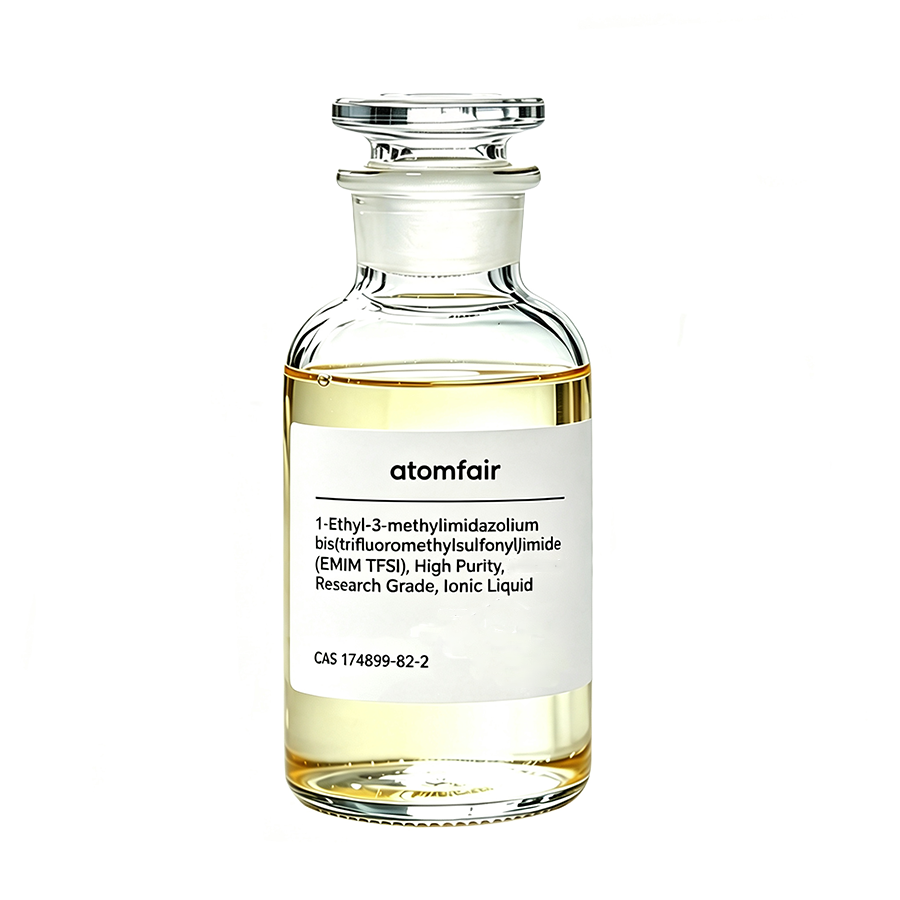
1-Ethyl-3-methylimidazolium bis(trifluoromethylsulfonyl)imide (EMIM TFSI), High Purity, Research Grade, 99%, Ionic Liquid
Product Introduction
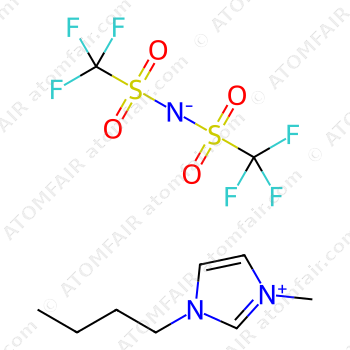
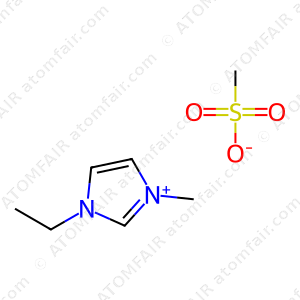
1-Ethyl-3-methylimidazolium bis(trifluoromethylsulfonyl)imide (EMIM TFSI), High Purity, Research Grade, 99%, Ionic Liquid is a research grade ionic liquid identified in the supplied product record as 1-Ethyl-3-methylimidazolium with Bis(trifluoromethylsulfonyl)imide (TFSI/NTf2). The record lists CAS number 174899-82-2, molecular formula C8H11F6N3O4S2, purity 99%, package 100g.
The material is used in laboratory research in electrochemistry, electrolyte development, catalysis, separation science, and energy-storage research. Use as a solvent or electrolyte component; verify compatibility with the intended electrodes, salts, solvents, and operating conditions before use.
Key Features
- Defined ionic composition: The listed cation and anion provide a clear basis for electrolyte, solvent, and reaction-medium comparison.
- Declared purity: The supplied record lists 99% purity, supporting controlled material selection for research trials.
- Research package: Supplied in 100g for laboratory-scale evaluation and procurement planning.
- Compatibility and handling reference: The product record notes insoluble in water, which helps screen aqueous handling and solvent compatibility. The supplied thermal references include melting point -16.45 °C.
Technical Specifications
| Parameter | Specification |
|---|---|
| Product Name | 1-Ethyl-3-methylimidazolium bis(trifluoromethylsulfonyl)imide (EMIM TFSI), High Purity, Research Grade, 99%, Ionic Liquid |
| CAS No. | 174899-82-2 |
| Cation | 1-Ethyl-3-methylimidazolium |
| Anion | Bis(trifluoromethylsulfonyl)imide (TFSI/NTf2) |
| Molecular Formula | C8H11F6N3O4S2 |
| Purity | 99% |
| Grade | Research Grade |
| Melting Point | -16.45 °C |
| Density | 1.53 g/cm3 at 25 °C |
| Water Solubility | Insoluble in water |
| Package | 100g |
Application Areas
- Electrolyte composition and ion-coordination studies
- Electrochemical reaction-media development
- Organic synthesis and catalysis research
- Solvent compatibility and separation-process screening
- Battery and energy-storage formulation research where the listed ionic composition is appropriate
Handling and Procurement
Keep the container tightly closed in a cool, dry, well ventilated area. Protect the material from moisture, water contamination, heat, and direct sunlight, and keep the container closed when not in use. Before handling, review the SDS and use appropriate protective equipment.
Related Products
| Research Need | Related Product | Best For |
|---|---|---|
| Compare the same cation with a different counterion | 1-Ethyl-3-methylimidazolium dicyanamide (EMIM DCA), 98%, Ionic Liquid | Counterion screening and formulation comparison. |
| Compare the same cation with a different counterion | 1-Ethyl-3-methylimidazolium dimethyl phosphate (EMIM DMP), 99%, Ionic Liquid | Counterion screening and formulation comparison. |
| Compare the same cation with a different counterion | 1-Ethyl-3-methylimidazolium methylsulfate (EMIM MeSO4), Research Grade, 98%, Ionic Liquid | Counterion screening and formulation comparison. |
| Compare the same cation with a different counterion | 1-Ethyl-3-methylimidazolium diethyl phosphate (EMIM DEP), Research Grade, 98%, Ionic Liquid | Counterion screening and formulation comparison. |
1-Ethyl-3-methylimidazolium bis(trifluoromethylsulfonyl)imide (EMIM TFSI) is an ionic liquid with a melting point of -16.45°C and a decomposition temperature of 436°C, defining its operational liquid-phase range. The material is insoluble in water, ensuring clean phase separations in aqueous systems.
- Melting Point Constraint: Below -16.45°C, this ionic liquid solidifies and requires controlled temperature for liquid-phase operations.
- Decomposition Constraint: Above 436°C, the material undergoes thermal degradation and should not be exposed to such temperatures.
- Solubility Constraint: The material's water insolubility prevents dissolution in aqueous media but may require organic solvents for mixing.
How does the low melting point of [C2MIm] NTf2 affect its use in low-temperature electrochemical studies?
At -16.45°C, [C2MIm] NTf2 solidifies, which limits its fluidity and electrochemical performance below this temperature. However, above this threshold it remains a liquid, offering a wide operational range up to its decomposition temperature of 436°C.
Is [C2MIm] NTf2 compatible with aqueous reaction systems?
No, [C2MIm] NTf2 is fully insoluble in water, rendering it incompatible with aqueous environments. It is designed for non-aqueous applications where its hydrophobic profile facilitates clean phase separations.
What are the usage restrictions for [C2MIm] NTf2 in research laboratories?
[C2MIm] NTf2 is sold exclusively for laboratory research and is prohibited for commercial use, diagnostics, or human/animal applications. The buyer assumes all compliance liability as stated in the product disclaimer.
1-Ethyl-3-methylimidazolium bis(trifluoromethylsulfonyl)imide (EMIM TFSI) is a research-grade ionic liquid with high thermal stability (decomposition at 436°C) and hydrophobic nature, suitable for non-aqueous electrochemical and catalytic studies. However, its water insolubility and research-only designation impose application constraints.
Positive
- High thermal stability: Maintains structural integrity up to a verified decomposition threshold of 436°C, enabling high-temperature electrochemical and catalytic investigations without premature degradation.
- Hydrophobic phase separation: Fully insoluble in aqueous environments, facilitating clean, efficient phase separations in biphasic reactions and water-sensitive systems.
Trade-offs
- Limited aqueous compatibility: Complete insolubility in water precludes direct use in aqueous electrolyte systems or biological buffers, restricting application to non-aqueous or hydrophobic media.
- Research-only usage restriction: Sold exclusively for laboratory research; prohibited for commercial, diagnostic, or human/animal applications, placing full compliance liability on the buyer.
Every advanced material, component, equipment, and instrument in our catalog is backed by rigorous testing. We maintain strict internal quality management frameworks and align with CE conformity metrics to deliver transparent, reproducible performance data via our public open-science repository.
To request raw batch performance data, submit formal vendor registration paperwork, or execute a fast-turnaround R&D manufacturing loop, contact us at inquiry@atomfair.com.
Item is dispatched under the Atomfair Shipping & Delivery Framework (Free worldwide shipping on orders over $59 USD excl. heavy equipment). Return is governed by the Atomfair Return & Refund Policy (7-day technical return window).