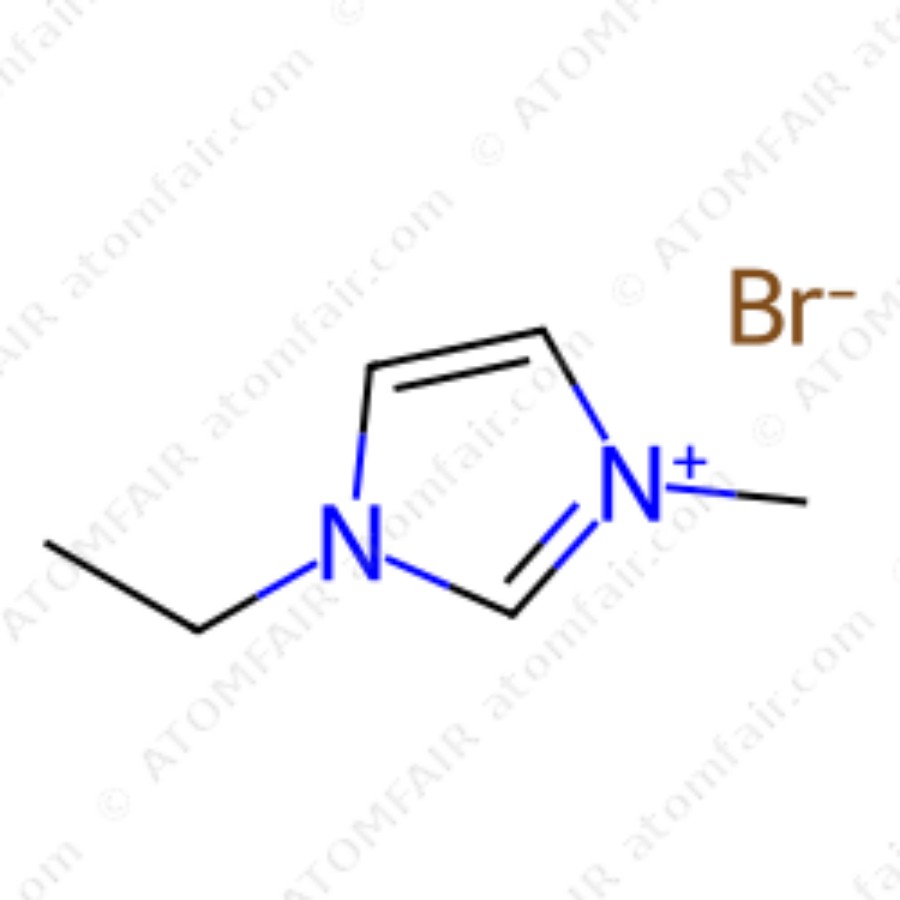
1-Ethyl-3-Methylimidazolium Bromide CAS 65039-08-9 ATOMFAIR

Price range: $250.00 through $300.00

Institutional Procurement & Supply Compliance: As a verified US supplier, Atomfair accepts formal institutional Purchase Orders (POs), contract billing schedules, and custom procurement loops for university and national laboratories, and corporate R&D departments globally.

Research Grade 1-Ethyl-3-Methylimidazolium Bromide (CAS 65039-08-9). Melting point 76.75°C, decomposition 301°C. Electrochemistry grade. In stock.

Description

ATOMFAIR® 1-ETHYL-3-METHYLIMIDAZOLIUM BROMIDE

RESEARCH GRADE MATERIAL

Product Overview

1-Ethyl-3-MethylImidazolium Bromide, designated as Atomfair Ionic Liquid [C2MIm]X series, is an essential halogenated ionic material tailored for precision laboratory analysis. Synthesized under controlled specifications, this high-purity chemical reagent exhibits a distinct crystalline phase transition profile and targeted solvation traits critical for baseline electrochemical, catalytic, and chemical synthesis research frameworks, while remaining fully compliant with baseline tracking metrics for competitive [C2MIm]Br ionic liquid price structures.

Technical Specifications

PARAMETER DETAILS
1. Basic Identification
English Name 1-Ethyl-3-MethylImidazolium Bromide
Product Abbreviation [C2MIm]Br
Product Code LDIM-202
CAS No. 65039-08-9
2. Core Physical Properties
Chemical Formula C6H11N2Br
Molecular Weight 191.07 g/mol
Melting Point 76.75 °C
Decomposition Temperature 301 °C
3. Solubility & Phase Profiles
Solubility Soluble in water
Manufacturing Rules Refined and verified under a precise crystalline phase transition profile threshold
Alternative Options Explore our related imidazolium homologue catalog or customized molar allocations. For bulk requests or institutional bidding, please contact our support team.


Key Features & Advantages

  • Thermal Boundaries: Exhibits clean stability thresholds with structural breakdown occurring strictly at 301 °C.
  • Solid-Liquid Phase Profile: Features a sharp, well-defined melting point boundary at 76.75 °C for specialized molten salt applications.
  • Aqueous Hydrophilic Nature: Formulated for full solubility in water, enabling homogenous liquid phase preparations.

APPLICATION SCOPE: Core component for Atomfair Ionic Liquid [C2MIm]X structural series, laboratory-scale organic synthesis, and electrochemistry investigations.
CUSTOMIZATION REQUIREMENTS: If you’re interested, have any questions, or have specific customization requirements, please feel free to contact us for integrated product coordination at inquiry@atomfair.com.
IMPORTANT NOTICE & DISCLAIMER: Sold exclusively for laboratory research. Prohibited for commercial use, diagnostics, or human/animal applications. Buyers assume all compliance liability. This material is highly sensitive to atmospheric moisture; open and handle containers exclusively within an anhydrous inert gas environment to prevent phase transformation or moisture degradation.

Frequently Asked Technical Questions

Why is ATOMFAIR 1-ETHYL-3-METHYLIMIDAZOLIUM BROMIDE preferred as a halogenated ionic material?

ATOMFAIR 1-ETHYL-3-METHYLIMIDAZOLIUM BROMIDE functions as a premier **halogenated ionic material** inside specialized setups. It delivers accelerated mass transport kinetics across active phases, significantly boosting chemical reaction metrics and phase purity during laboratory testing workflows.

How to prevent ambient phase contamination in halogenated ionic material?

To successfully solve how to prevent ambient phase contamination in halogenated ionic material without secondary phase contamination, this material must be handled strictly according to inert gas glovebox storage protocols before thermal processing.

How does ATOMFAIR 1-ETHYL-3-METHYLIMIDAZOLIUM BROMIDE compare to traditional solvent alternatives regarding thermal stability?

Compared to standard organic alternatives, the optimized matrix of ATOMFAIR 1-ETHYL-3-METHYLIMIDAZOLIUM BROMIDE incorporates a stable aromatic ring system. This unique architecture dramatically enhances structural resistance against high-temperature breakdown up to 301 °C, preserving long-term validation integrity.

What material processing benefits does the crystalline phase transition profile of this grade offer?

Boasting a sharply defined crystalline phase transition profile, this product offers superior molten salt stability and predictable liquidity. The controlled form factor facilitates lower chemical processing barriers and promotes ideal phase boundaries during multi-component blending.

How is the phase purity and quality control of this research-grade batch validated?

Every competitive batch undergoes rigid analytical quality validation testing. Total elemental and volatile halide impurities are strictly regulated below narrow industry thresholds to eliminate parasitic electronic leakage and maintain uncompromised data reproducibility.
TAILORED SOLUTIONS FOR RESEARCH
Contact our engineering team for technical support or official commercial quotes.
EMAIL: inquiry@atomfair.com
Manufacturer: Atomfair LLC
Brand: ATOMFAIR®

A halogenated ionic liquid with a well-defined solid-liquid phase transition at 76.75 °C and thermal decomposition initiating at 301 °C. This material requires storage and handling at temperatures below its decomposition threshold to maintain chemical integrity.

  • Thermal Decomposition Limit: Maintain environmental temperatures below 301 °C to prevent thermal degradation of the halide salt.
  • Solid-Liquid Phase Transition: Avoid prolonged exposure above 76.75 °C to prevent melting and potential change in physical form due to the sharp melting point.

How does the 76.75°C melting point of [C2MIm]Br affect its applicability in low-temperature electrochemical studies compared to room-temperature ionic liquids?

[C2MIm]Br melts sharply at 76.75°C, making it a solid at ambient temperature and unsuitable for low-temperature electrochemical studies without heating. However, its high thermal stability up to 301°C enables reliable molten salt electrochemistry in elevated-temperature systems where room-temperature ionic liquids would degrade or volatilize.

What are the key considerations for using [C2MIm]Br as a solvent or catalyst in transition-metal-mediated organic synthesis?

[C2MIm]Br is a halogenated ionic liquid whose bromide anion can coordinate with or serve as a halide source for transition metals, influencing catalytic cycles. Its full water solubility enables homogeneous aqueous-phase workups, but water content must be strictly controlled to avoid hydrolysis or ligand displacement in moisture-sensitive reactions.

What specific storage and handling precautions are required for [C2MIm]Br to maintain its purity and prevent decomposition?

Store [C2MIm]Br in a dry, sealed container away from heat sources, as decomposition initiates at 301°C. Being water-soluble, it is hygroscopic; for moisture-sensitive applications, handle under inert atmosphere and dry thoroughly before use. Avoid contact with strong oxidizing agents to prevent exothermic reactions.

1-Ethyl-3-methylimidazolium bromide (EMIM Br) presents a well-defined crystalline phase with a melting point of 76.75°C and thermal stability up to 301°C, suitable for molten salt electrochemistry and synthesis. Its solid state at room temperature and confirmed solubility only in water impose specific handling and solvent selection requirements for laboratory deployment.

Positive

  • Sharp melting point for molten salt studies: Features a sharp, well-defined melting point boundary at 76.75 °C for specialized molten salt applications, enabling precise phase control in electrochemical or synthetic setups.
  • High thermal stability up to 301 °C: Exhibits clean stability thresholds with structural breakdown occurring strictly at 301 °C, allowing operation over a wide temperature window without premature decomposition.

Trade-offs

  • Solid at ambient laboratory temperatures: With a melting point of 76.75 °C, this material is a crystalline solid at standard room temperature and requires heating for use in liquid-phase applications such as electrochemistry or synthesis.
  • Only aqueous solubility is explicitly confirmed: The technical specification lists solubility only in water; performance or miscibility in organic solvents is not characterized, necessitating empirical validation for non-aqueous workflows.

Every advanced material, component, equipment, and instrument in our catalog is backed by rigorous testing. We maintain strict internal quality management frameworks and align with CE conformity metrics to deliver transparent, reproducible performance data via our public open-science repository.

To request raw batch performance data, submit formal vendor registration paperwork, or execute a fast-turnaround R&D manufacturing loop, contact us at inquiry@atomfair.com.

Item is dispatched under the Atomfair Shipping & Delivery Framework (Free worldwide shipping on orders over $59 USD). Return is governed by the Atomfair Return & Refund Policy (7-day technical return window).
Additional information

weight

250g, 400g