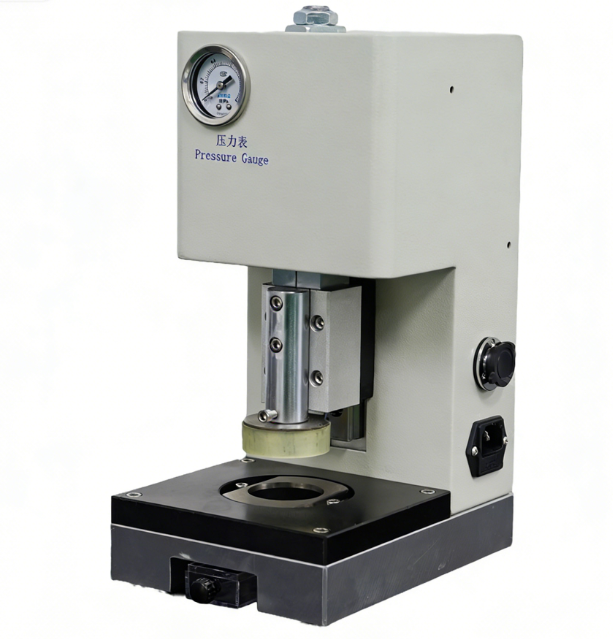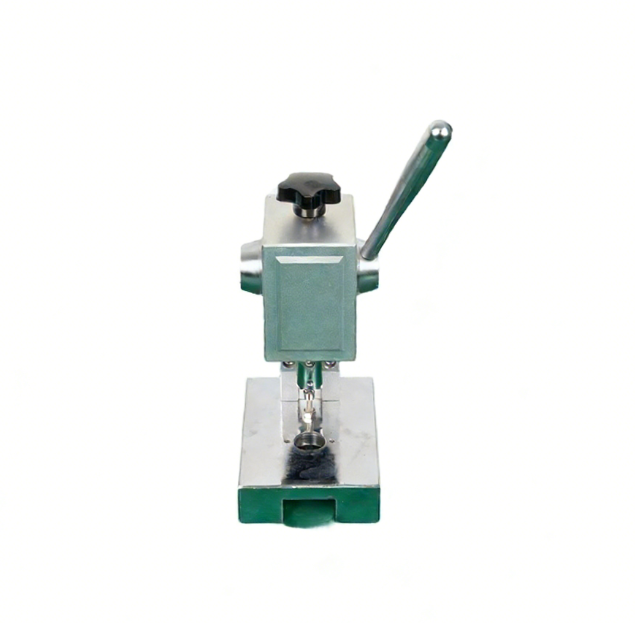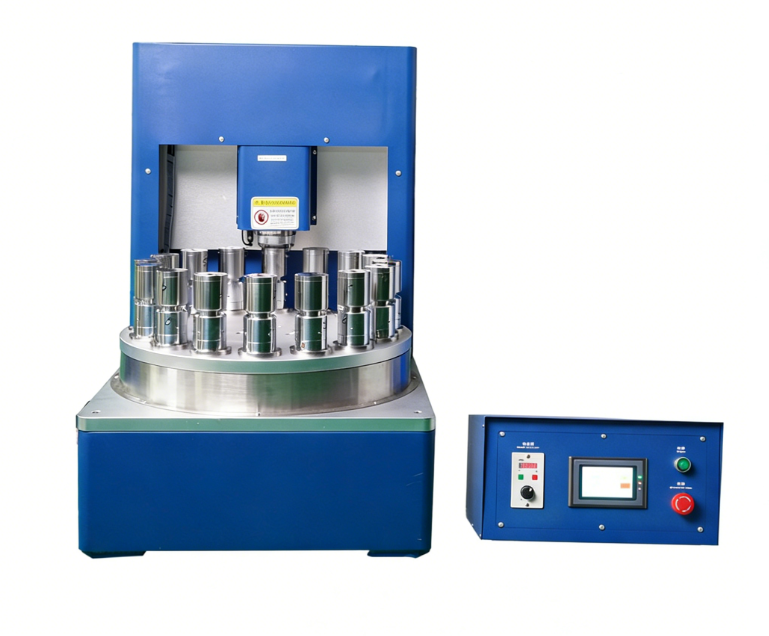
High-Throughput Button Cell Encapsulation Machine
Basic Information
Model
Atomfair‑CEM186
Release Date
2025‑01‑07
Application
Battery material screening and R&D stage
Overview
This is a compact 16-station button cell encapsulation machine. It uses a cam divider rotating lower die and cylinder-driven upper die for encapsulation, compatible with CR2016, CR2025, CR2032 button cells. It can be placed inside a glove box for operation in an argon atmosphere, with adjustable and displayable encapsulation pressure to ensure experimental consistency.
Key Features
- 16-station rotary design enables batch encapsulation, greatly improving efficiency
- Automatic cycle encapsulation via HMI and button programming
- Encapsulation dies made of die steel for durability and stability
- Encapsulation pressure adjustable and real‑time display
- Support automatic and manual operation modes
- Easy to clean and quick to change dies
- Compact structure, suitable for glove box operation in argon atmosphere
Technical Parameters
- Compatible Sizes: CR2032 (standard); CR2016, CR2025, CR2325, CR2450 (optional)
- Encapsulation Pressure: 0–1.5T adjustable, digital pressure gauge (≤0.8T recommended for CR20XX series)
- Power Supply: AC220V/50Hz
- Power: 1KW
- Main Unit Dimensions: L550 × W600 × H840 mm
- Control Box Dimensions: L460 × W380 × H260 mm
- Net Weight: 260 kg
If you’re interested, have any questions, or have specific customization requirements, please feel free to contact us at inquiry@atomfair.com.
This machine is designed for operation within an argon-filled glovebox to maintain an inert atmosphere during battery assembly. The encapsulation pressure must be limited to 0.8T for CR20XX series cells to prevent damage to the dies or cell components.
- Atmosphere Constraint: Operate the machine inside an argon-filled glovebox to prevent oxidation of cell components during the encapsulation process.
- Pressure Constraint: Do not exceed 0.8T encapsulation pressure when processing CR20XX series cells to avoid die damage or cell deformation.
- Die Compatibility Constraint: Use only the designated die sets for the specific button cell size being processed to ensure proper sealing and dimensional accuracy.
This procedure outlines the safe and correct operation of the Atomfair-CEM186 for encapsulating button cells. It covers setup, operation, and shutdown within a glovebox environment.
Required Equipment: Atomfair-CEM186 Button Cell Encapsulation Machine, Argon-filled glovebox, Appropriate die set for the target cell size
- Install the correct die set
Install the die set matching the target button cell size (e.g., CR2032) onto the machine's upper and lower platens. - Set the encapsulation pressure
Set the encapsulation pressure on the HMI to the recommended value (e.g., 0.8T for CR20XX series) using the digital pressure gauge. - Load the cell components
Place the pre-assembled cell components (case, electrode, separator, electrolyte, spacer, spring, and cap) into the bottom die cavity. - Initiate the encapsulation cycle
Initiate the encapsulation cycle by pressing the start button on the HMI, which will automatically rotate the carousel and lower the upper die to crimp the cell. - Remove the encapsulated cell
Remove the encapsulated cell from the die cavity after the cycle is complete and the upper die retracts. - Inspect the crimped cell
Inspect the crimped cell for proper sealing, uniform crimp, and any signs of damage or deformation.
What is the maximum encapsulation pressure for the Atomfair-CEM186 and what is the recommended pressure for CR20XX series cells?
The Atomfair-CEM186 offers an adjustable encapsulation pressure range of 0–1.5T, with a digital pressure gauge for real-time monitoring. For CR20XX series cells, a pressure of ≤0.8T is recommended to ensure optimal sealing without damaging the cell components.
The Atomfair-CEM186 is a 16-station rotary button cell encapsulation machine designed for high-throughput battery material screening, offering adjustable encapsulation pressure (0–1.5T) and compatibility with CR2016, CR2025, CR2032, CR2325, and CR2450 cells. Its compact footprint and glove-box compatibility enable argon-atmosphere operation, but the 260 kg weight and 1 kW power requirement demand dedicated lab infrastructure.
Positive
- 16-station rotary design: Batch encapsulation via cam divider and cylinder-driven dies significantly increases throughput for R&D screening compared to single-cell manual presses.
- Adjustable pressure with digital display: Encapsulation pressure is adjustable from 0 to 1.5T with real-time digital readout, enabling reproducible sealing conditions across experiments.
Trade-offs
- Heavy and bulky unit: At 260 kg net weight and 840 mm height, the main unit requires a reinforced bench or floor support and may complicate glove box installation due to weight and size.
- Pressure limit for CR20XX series: For CR2016, CR2025, and CR2032 cells, the recommended encapsulation pressure is ≤0.8T, which may restrict process windows for certain electrode or electrolyte systems.
Every advanced material, component, equipment, and instrument in our catalog is backed by rigorous testing. We maintain strict internal quality management frameworks and align with CE conformity metrics to deliver transparent, reproducible performance data via our public open-science repository.
To request raw batch performance data, submit formal vendor registration paperwork, or execute a fast-turnaround R&D manufacturing loop, contact us at inquiry@atomfair.com.
Item is dispatched under the Atomfair Shipping & Delivery Framework (Free worldwide shipping on orders over $59 USD excl. heavy equipment). Return is governed by the Atomfair Return & Refund Policy (7-day technical return window).