ATOMFAIR® ATOMFAIR-SCT-706 BATTERY TESTERRESEARCH GRADE MATERIAL
|
|||||||||||||||||||||||||||||||||||||||||||
|
|||||||||||||||||||||||||||||||||||||||||||
This high-voltage short-circuit tester requires careful handling due to lethal electrical potentials up to 1000V. The device incorporates a 20kΩ auto-discharge module to ensure safe operation with capacitive loads.
- Electrical Hazard: The output voltage range of 25V to 1000V presents an electrical shock hazard requiring proper insulation and grounding.
- Auto-Discharge Module: The built-in 20kΩ discharge module automatically dissipates capacitive energy after each test to prevent residual charge.
- Insulation Resistance Measurement: The insulation resistance measurement range from 2MΩ to 4000MΩ requires clean test leads and stable contact to avoid false readings.
- Delay Judgment Function: The delay judgment function, settable from 0.1s to 999.9s, must be used for capacitive loads to allow transient currents to settle.
- Remote Interface Grounding: The RS232 and PLC interfaces enable remote control but require proper shielding to prevent noise interference.
This procedure describes the safe initialization and operation of the Atomfair-SCT-706 Battery Short-Circuit Tester for capacitive loads. Follow each step sequentially to ensure accurate measurement and prevention of electrical shock.
Required Equipment: Atomfair-SCT-706 Battery Short-Circuit Tester
- Set Output Voltage
Set the desired output voltage between 25V and 1000V using the front panel controls. - Configure Test Parameters
Configure the insulation resistance threshold and test timing parameters via the user interface. - Connect Device Under Test
Connect the battery cell to the test terminals on the front or rear panel using appropriate test leads. - Initiate Test
Initiate the short-circuit test by pressing the start button for manual testing or via remote RS232/PLC command. - Monitor Alarms
Monitor the audible and visual alarm to detect any insulation resistance failure or leakage current exceedance. - Allow Auto-Discharge
Allow the built-in 20kΩ discharge module to dissipate stored energy automatically after the test completes. - Record and Disconnect
Record the test results displayed on the panel and disconnect the battery cell after confirming zero residual voltage.
How does the output voltage accuracy of ±(2%×setting+2V) affect low-voltage insulation resistance measurements on the Atomfair-SCT-706?
The ±(2%×setting+2V) accuracy specification means the fixed +2V offset dominates at low output voltages, introducing a larger relative error. For a 25V setting the error is ±2.5V (10%), while at 1000V the error is ±22V (2.2%). This is acceptable for Go/No-Go insulation resistance testing (2.000MΩ–4000MΩ) as the comparator uses upper/lower thresholds, but precise absolute measurements near 25V may be less accurate. The wide adjustable voltage range by 1V steps still supports fine control for diverse test scenarios.
What specific capacitive load characteristics does the delay judgment function accommodate, and can the tester integrate with automated production lines?
The delay judgment function is designed for capacitive products such as battery cells to avoid false failures from inrush current, with an adjustable delay time of 0.1s–999.9s to suit various capacitance values. The tester integrates with automated systems via standard RS232 and PLC remote interfaces, supports 100 groups of parameter storage, and provides front/rear panel test terminals for flexible fixture connections.
What infrastructure and safety precautions are required when operating the Atomfair-SCT-706 with its built-in 20kΩ discharge module?
The tester requires a stable AC 220V, 50Hz power supply and proper grounding for safe operation. The built-in 20kΩ discharge module automatically drains capacitive loads after each test to mitigate shock risk. However, because output voltage can reach 1000V, users must follow high-voltage laboratory safety protocols including insulated tools, clear signage, and operator training. The unit weighs 7.2 kg and fits a compact 300×88×380 mm footprint suitable for bench-top use.
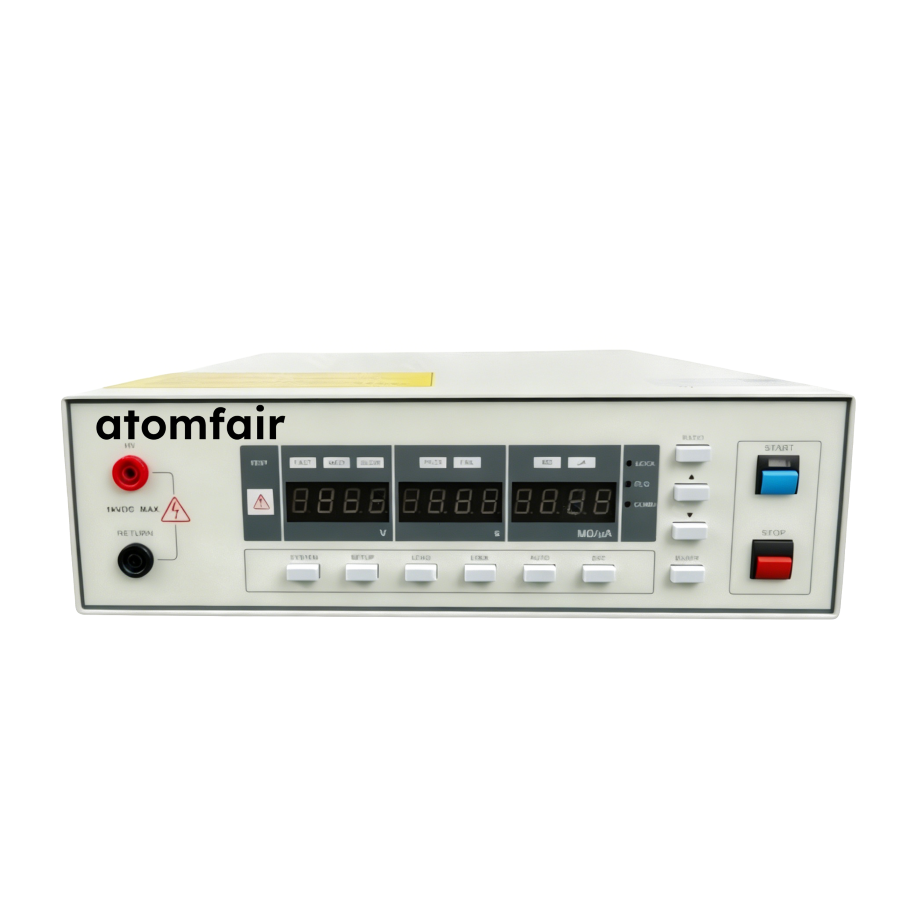
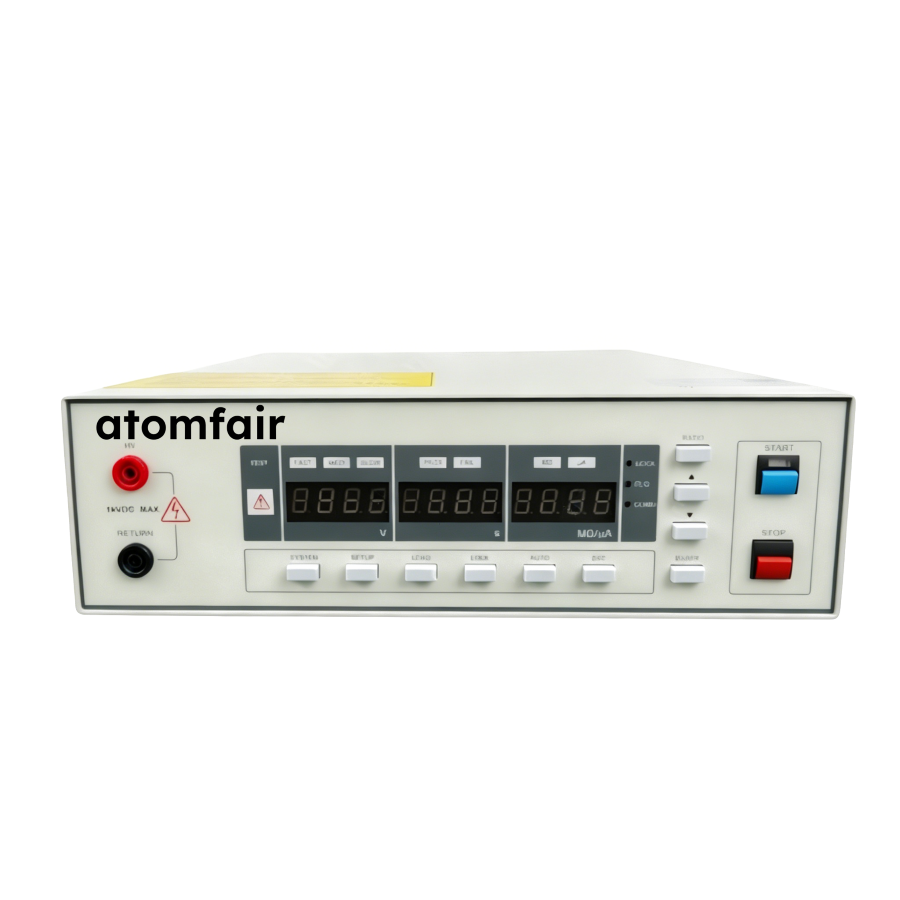
The Atomfair-SCT-706 is a precision short-circuit tester designed for battery cells and capacitive loads, offering adjustable 25V–1000V output in 1V steps and a built-in 20kΩ discharge module for safe operation. Its delay judgment function and wide insulation resistance range make it suitable for automated quality control in battery manufacturing, though the 1mA current limit and 220V/50Hz power requirement present operational constraints.
Positive
- Wide adjustable output voltage: Output voltage from 25V to 1000V in 1V steps enables precise testing across various battery chemistries and cell types, including high-voltage systems.
- Built-in discharge and delay judgment: A 20kΩ auto-discharge module and configurable delay time (0.1s–999.9s) ensure safe capacitor discharge and accurate measurement for capacitive loads.
Trade-offs
- Low maximum output current: Maximum output current is limited to 1mA, which may be insufficient for short-circuit testing of large-capacity or high-rate battery cells where higher fault currents are required.
- Fixed AC power requirement: Operates solely on AC 220V, 50Hz input, necessitating a step-down transformer or frequency converter for use in regions with 110V–120V or 60Hz mains supply.
Every advanced material, component, equipment, and instrument in our catalog is backed by rigorous testing. We maintain strict internal quality management frameworks and align with CE conformity metrics to deliver transparent, reproducible performance data via our public open-science repository.
To request raw batch performance data, submit formal vendor registration paperwork, or execute a fast-turnaround R&D manufacturing loop, contact us at inquiry@atomfair.com.
Item is dispatched under the Atomfair Shipping & Delivery Framework (Free worldwide shipping on orders over $59 USD excl. heavy equipment). Return is governed by the Atomfair Return & Refund Policy (7-day technical return window).