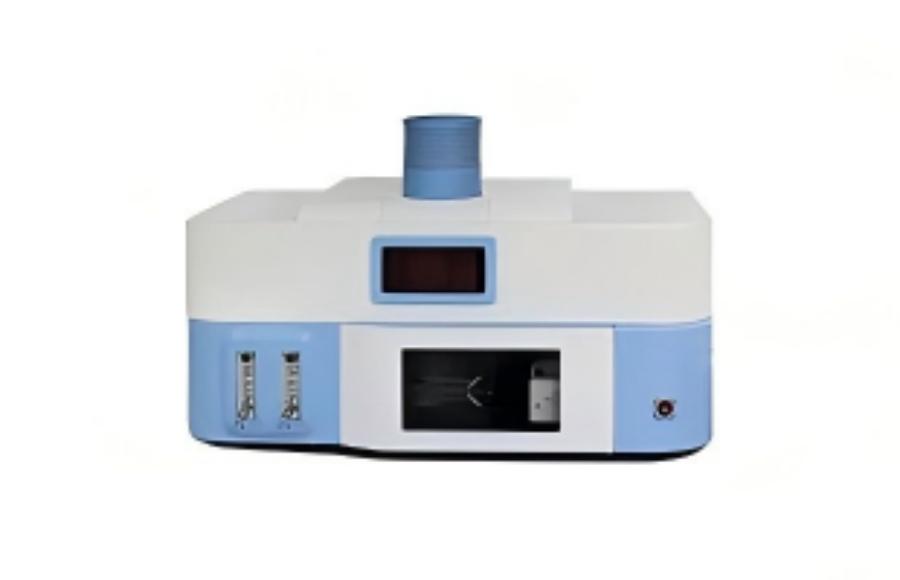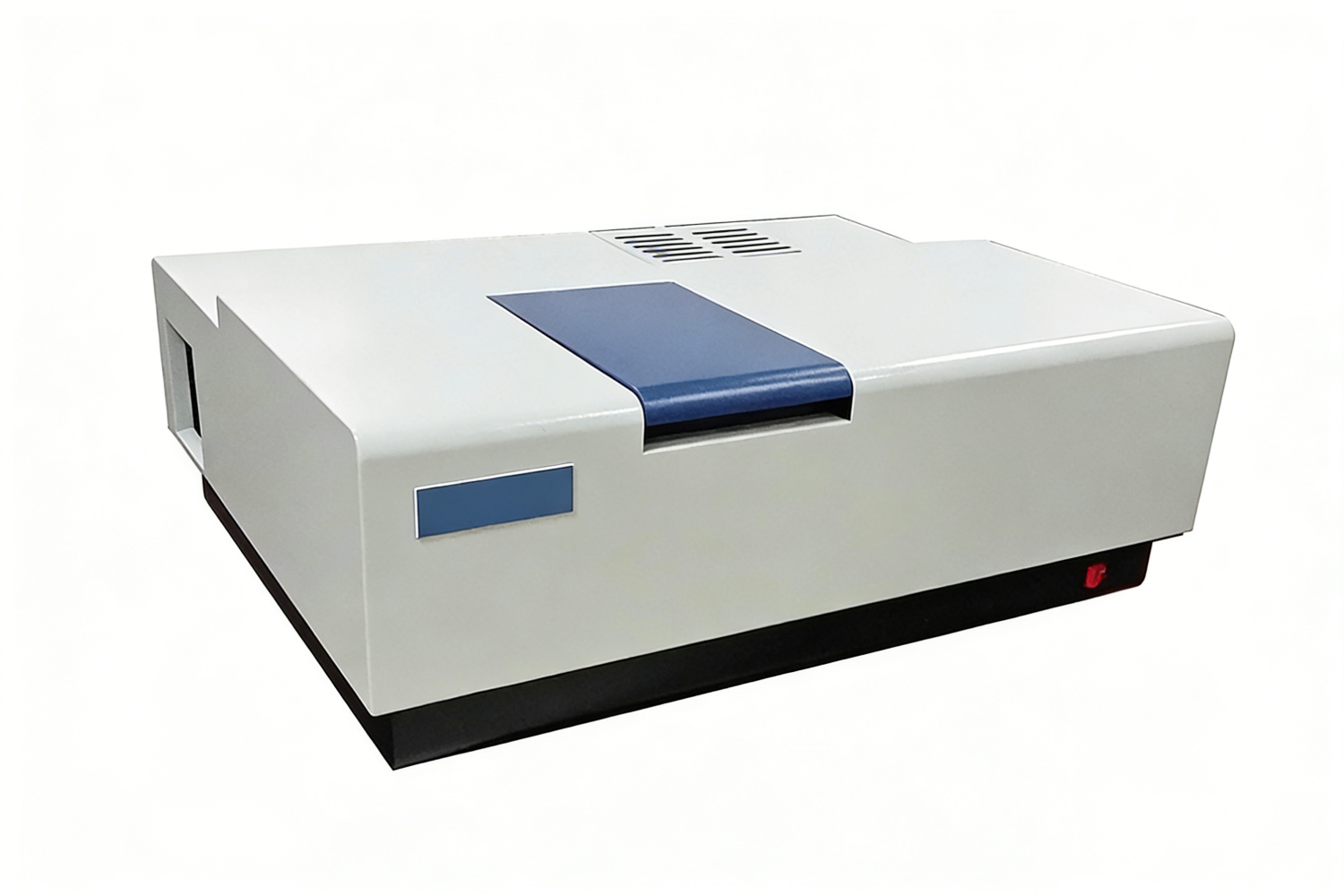
Atomfair-UVN-745 UV-VIS-NIR Spectrophotometer
1. Product Overview
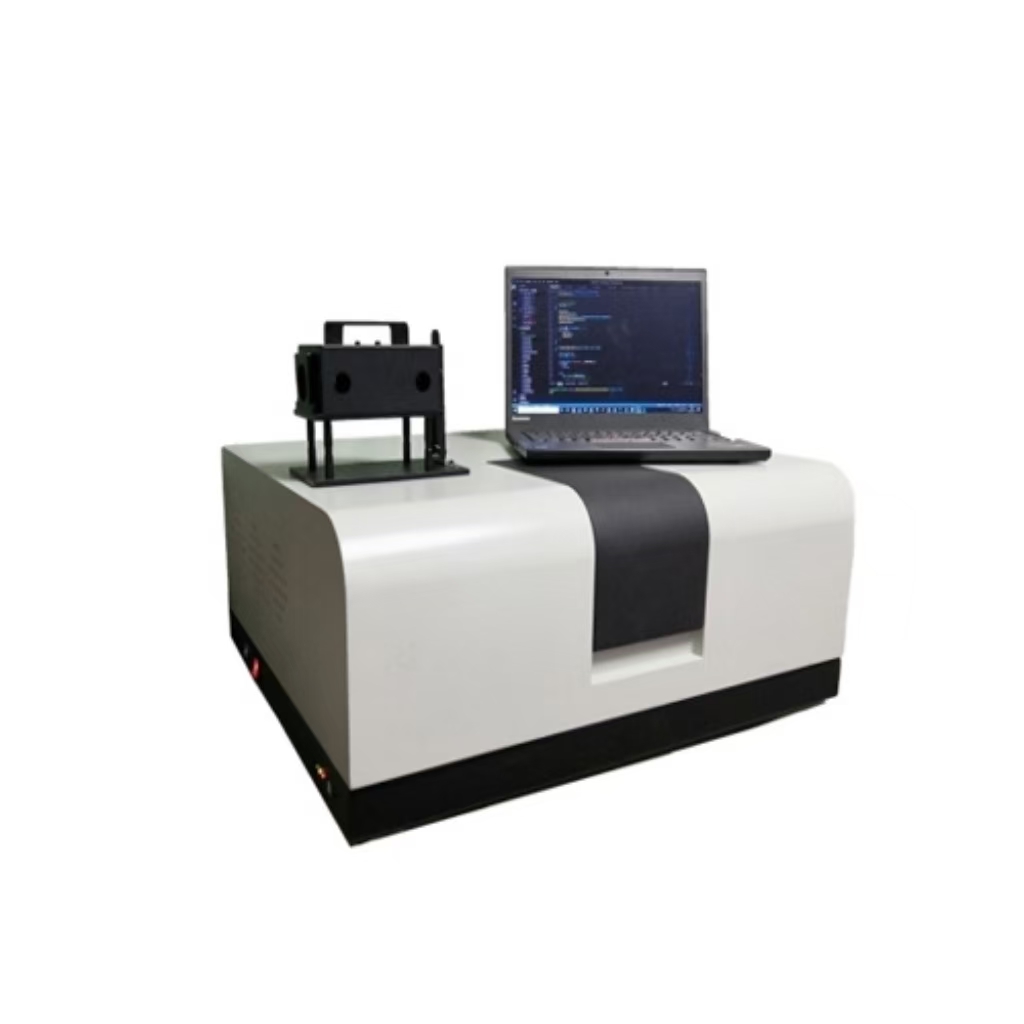
Atomfair-UVN-745 UV-VIS-NIR Spectrophotometer adopts an integrated design of main unit and integrating sphere unit, a high-performance analytical instrument covering the full ultraviolet, visible and near-infrared bands. All core performance indicators meet international standards, which can directly and accurately measure transmission spectrum, specular reflection spectrum and diffuse reflection spectrum. It has the ability to measure optical and thermal parameters of architectural glass, special fabrics and organic liquids (fructose, glucose, sucrose, etc.). Compatible with solid, liquid and other sample forms, easy to operate with stable and reliable data, it is widely used in architectural glass testing, material science, chemical analysis, textile industry, food testing and other fields, providing high-precision analysis support for scientific research experiments and industrial production.
2. Core Features
- Integrated design: Seamless integration of main unit and φ60mm integrating sphere unit without additional assembly, directly measuring transmission, specular reflection and diffuse reflection spectra, adapting to the testing needs of optical characteristics of various samples with efficient and convenient operation.
- Precise full-band coverage: Wavelength range 280-2500nm, covering ultraviolet, visible and near-infrared regions, equipped with dual imported detectors (dedicated for UV/VIS/NIR bands), sensitive to weak signals with low noise and higher detection accuracy.
- High-end optical configuration: Adopting dual-beam and dual-grating optical system design, effectively reducing background interference and improving test accuracy; supported by imported light source with longer service life and stronger luminous stability to ensure the consistency of long-term test data.
- Excellent detection performance: Wavelength accuracy ±0.5nm (UV/VIS), ±2.0nm (NIR); wavelength repeatability ≤0.3nm (UV/VIS), ≤1.0nm (NIR); transmittance accuracy ±0.3%T; stray light ≤0.2%T (220nm). All core indicators reach the international advanced level.
- Intelligent control system: Support automatic computer control and automatic calibration on startup, automatically complete data collection and processing, dedicated for special equipment and easy for laboratory management; matched with professional data software, support data export (text/EXCEL format) and test report printing to simplify the operation process.
- Wide sample adaptation range: Measurable sample specification is 20-100mm with thickness ≤20mm, compatible with various architectural glass such as ordinary transparent glass, vacuum magnetron sputtering glass, coated glass, as well as special fabrics and organic liquids with wide application scenarios.
- Flexible spectral bandwidth adjustment: UV-VIS band provides 6 gears of spectral bandwidth including 0.2nm, 0.5nm, 1nm; NIR band provides 6 options including 0.8nm, 2nm, 4nm, which can be flexibly switched according to the testing needs of different samples with stronger adaptability.
- Stable operation environment adaptation: Adapt to ambient temperature of 15-28℃ and humidity <65% without condensation, power supply supports AC220V & DC12V switching with power consumption of only 40W, taking into account fixed laboratory use and flexible mobile scenarios with stable and reliable operation.
3. Specification Parameters
| Item | Detailed Parameters |
|---|---|
| Model No. | Atomfair-UVN-745 |
| Wavelength Range | 280-2500nm |
| Working Mode | Integrated design of main unit and integrating sphere unit, support transmission spectrum, specular reflection spectrum, diffuse reflection spectrum measurement |
| Wavelength Accuracy | UV/VIS: ±0.5nm; NIR: ±2.0nm |
| Wavelength Repeatability | UV/VIS: ≤0.3nm; NIR: ≤1.0nm |
| Transmittance Accuracy | ±0.3%T |
| Transmittance Repeatability | ≤0.2%T |
| Stray Light | ≤0.2%T (220nm) |
| Baseline Flatness | ±0.008A (280-2500nm, after 30 mins warm-up) |
| Spectral Bandwidth | UV-VIS: 0.2nm, 0.5nm, 1nm, 2nm, 3nm, 5nm; NIR: 0.8nm, 2nm, 4nm, 8nm, 12nm, 20nm |
| Light Source | Imported light source with long service life and high stability |
| Detector | Dual imported detectors (dedicated for UV/VIS/NIR bands) |
| Integrating sphere specification | Diameter φ60mm, equipped with dual detectors |
| Measurable sample specification | 20-100mm, thickness ≤20mm |
| Overall Dimension (L×H×W) | 750×600×260mm |
| Sample Chamber Dimension (L×H×W) | 300×240×190mm |
| Weight | 65kg |
| Power Supply | AC220V / DC12V, 40W |
| Operating System | Windows 11 64-bit and above |
| Environmental Adaptability | Temperature 15-28℃, Humidity <65% (no condensation) |
| Working Mode | Transmittance, Absorbance, Reflectivity, Energy |
| Software Function | Real-time measurement, data import and export (text/EXCEL), report printing, special measurement function for architectural glass & coatings |
4. Typical Applications
- Architectural glass industry: Detection of shading coefficient of ordinary transparent glass, vacuum magnetron sputtering glass, coated glass, measurement of optical and thermal parameters to meet the quality control needs of the industry.
- Material science field: Optical characteristic analysis of special fabrics and film materials, detection and evaluation of spectral performance in the research and development of new materials.
- Chemical analysis field: Qualitative and quantitative analysis of organic liquid (fructose, glucose, sucrose, etc.) components, determination of optical parameters to assist the research and development and quality testing of chemical products.
- Textile industry: Detection of light transmittance and reflectivity of special fabrics, evaluation of optical performance and functionality of fabrics to guide product optimization and upgrading.
- Food testing field: Component analysis of organic liquids such as sugars, judgment of product purity and quality through optical parameters to ensure food quality and safety.
- Scientific research experiments: Research on optical characteristics of materials in universities and research institutes, multi-band spectral analysis experiments to provide accurate data support for scientific research projects.
- Industrial quality inspection: Random quality inspection and factory inspection in the production process of related materials to ensure that the optical performance of products meets international standards and customer requirements.
If you’re interested, have any questions, or have specific customization requirements, please feel free to contact us at inquiry@atomfair.com.
The instrument requires a controlled environment with temperature between 15°C and 28°C and humidity below 65% without condensation. A 30-minute warm-up period is necessary before achieving specified baseline flatness and measurement accuracy.
- Environmental conditions: Maintain ambient temperature of 15–28°C and relative humidity <65% with no condensation.
- Sample size limits: Use samples with dimensions from 20 mm to 100 mm and thickness ≤20 mm.
- Warm-up requirement: Allow a 30-minute warm-up after power-on for baseline stabilization.
- Power supply specification: Connect to AC220V or DC12V power supply with 40W power consumption.
- Operating system compatibility: Operate the instrument with Windows 11 64-bit or later.
The following steps guide the user through preparing and performing a spectral measurement. Ensure the instrument is properly set up and the sample meets size requirements.
Required Equipment: Computer with proprietary spectrophotometer software running Windows 11 64-bit
- Verify environmental conditions
Confirm that the ambient temperature is between 15°C and 28°C and relative humidity remains below 65% without condensation. - Warm up the instrument
Power on the instrument and allow it to warm up for at least 30 minutes to stabilize the baseline. - Load the sample
Place the sample with dimensions between 20 mm and 100 mm and thickness not exceeding 20 mm into the sample chamber. - Set spectral bandwidth
Select the appropriate spectral bandwidth for the UV-VIS or NIR region using the connected computer software. - Perform measurement
Initiate the measurement via the software to automatically collect transmission, reflection, or absorption data.
How do the wavelength accuracy and repeatability specifications differ between the UV/VIS and NIR bands on the Atomfair-UVN-745, and what impact does this have on spectral measurements?
The UV/VIS band achieves a wavelength accuracy of ±0.5 nm and repeatability ≤0.3 nm, while the NIR band has accuracy ±2.0 nm and repeatability ≤1.0 nm. This difference arises from the dedicated dual detectors (UV/VIS and NIR) and dual-grating optical system, ensuring high precision across the full 280–2500 nm range. For applications requiring high resolution in the UV/VIS region, such as chemical analysis of organic liquids, the tighter tolerance is critical for reliable component identification.
What are the sample size and thickness constraints for the Atomfair-UVN-745, and which types of samples are compatible with its integrating sphere design?
The instrument accepts samples with dimensions of 20–100 mm and thickness up to 20 mm. It is designed for solid samples like architectural glass (ordinary transparent, vacuum magnetron sputtering, coated), special fabrics, and liquid samples (e.g., fructose, glucose, sucrose) within the φ60 mm integrating sphere unit. The integrated design supports transmission, specular reflection, and diffuse reflection measurements without additional assembly.
What are the power supply and environmental operating requirements for the Atomfair-UVN-745 to ensure stable performance?
The spectrophotometer operates on AC220V or DC12V power with a consumption of only 40 W, allowing flexible laboratory or mobile use. It requires an ambient temperature of 15–28 °C and relative humidity below 65 % without condensation. These conditions are necessary to maintain baseline flatness of ±0.008 A and overall measurement stability after a 30-minute warm-up.
The Atomfair-UVN-745 integrates a φ60mm integrating sphere with dual-beam, dual-grating optics and dual detectors to deliver transmission, specular reflection, and diffuse reflection measurements across 280-2500nm, with wavelength accuracy of ±0.5nm (UV/VIS) and transmittance accuracy of ±0.3%T. Its 20-100mm sample size and ≤20mm thickness compatibility, combined with six selectable spectral bandwidths per band, make it a versatile tool for architectural glass, textile, and organic liquid analysis, though its 65kg weight and 15-28°C humidity-controlled operating environment require dedicated lab space.
Positive
- Integrated dual-detector integrating sphere: The φ60mm integrating sphere with dedicated UV/VIS and NIR detectors enables direct measurement of transmission, specular reflection, and diffuse reflection spectra without additional assembly, supporting solid and liquid samples in a single instrument.
- High spectral accuracy and low stray light: Wavelength accuracy of ±0.5nm (UV/VIS) and ±2.0nm (NIR), transmittance repeatability ≤0.2%T, and stray light ≤0.2%T at 220nm ensure reliable quantitative analysis for demanding optical characterization.
Trade-offs
- Environmental sensitivity to temperature and humidity: The instrument requires ambient temperatures of 15-28°C and humidity <65% without condensation; baseline flatness of ±0.008A is only guaranteed after a 30-minute warm-up, so uncontrolled lab conditions can compromise measurement stability.
- Sample size and thickness constraints: The sample chamber (300×240×190mm) limits measurable samples to 20-100mm in size with thickness ≤20mm, which may exclude larger or thicker specimens common in some material testing workflows.
Every advanced material, component, equipment, and instrument in our catalog is backed by rigorous testing. We maintain strict internal quality management frameworks and align with CE conformity metrics to deliver transparent, reproducible performance data via our public open-science repository.
To request raw batch performance data, submit formal vendor registration paperwork, or execute a fast-turnaround R&D manufacturing loop, contact us at inquiry@atomfair.com.
Item is dispatched under the Atomfair Shipping & Delivery Framework (Free worldwide shipping on orders over $59 USD excl. heavy equipment). Return is governed by the Atomfair Return & Refund Policy (7-day technical return window).