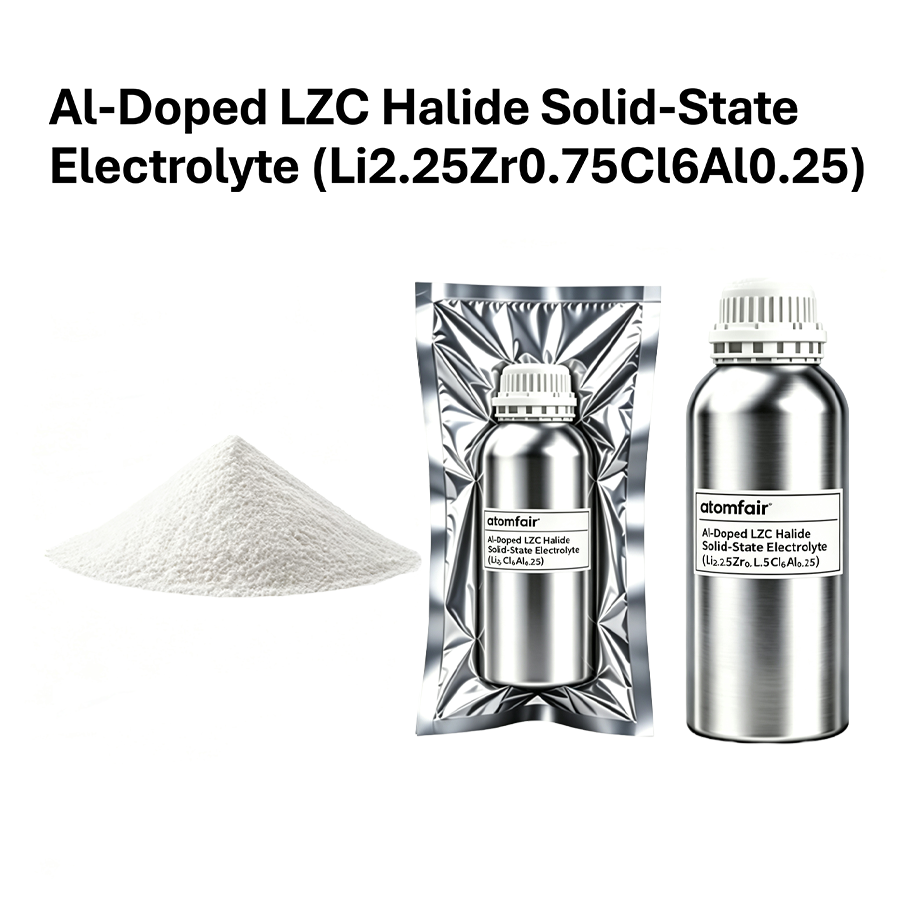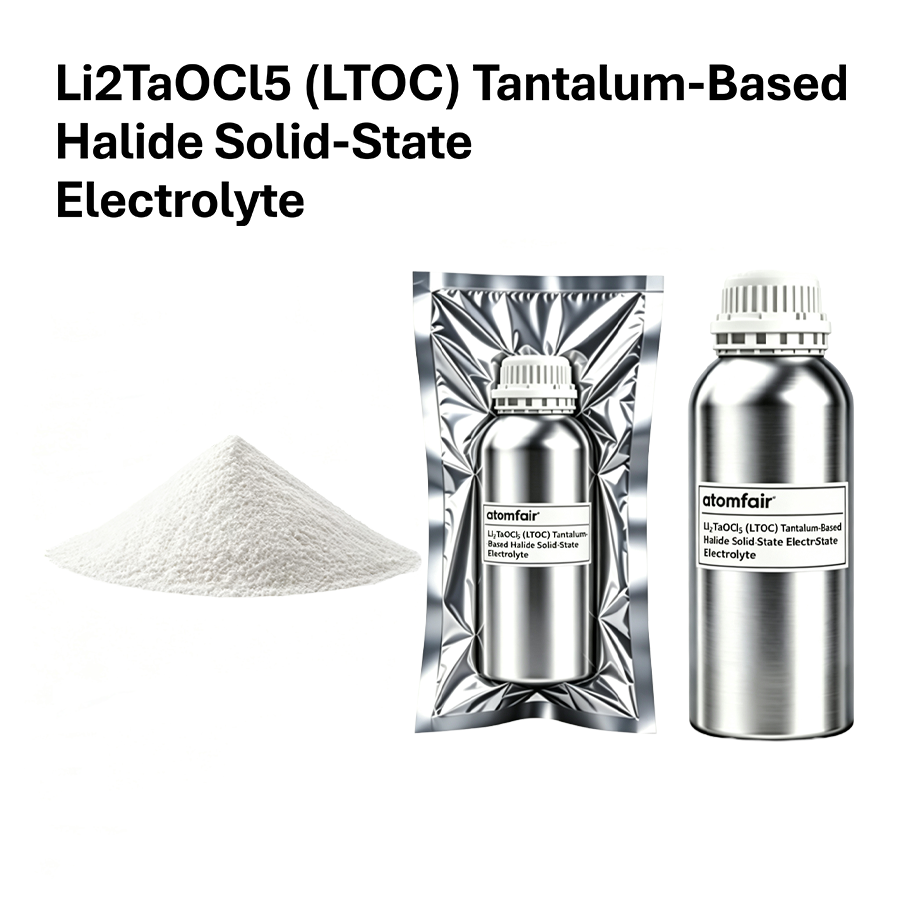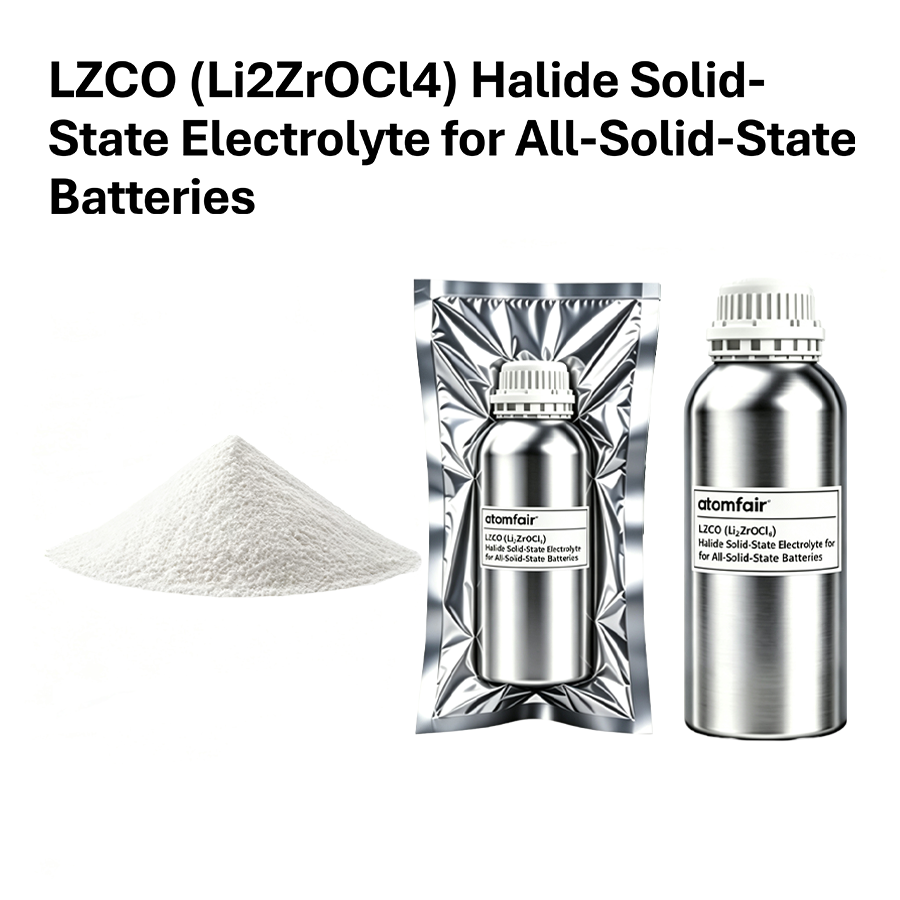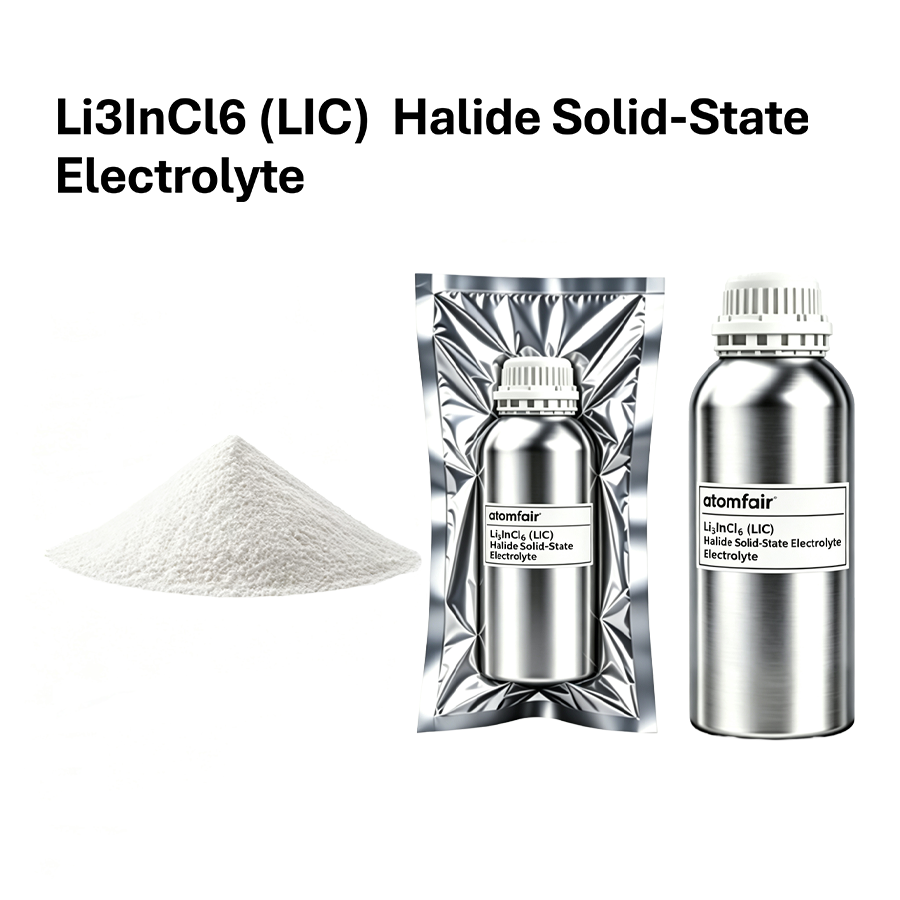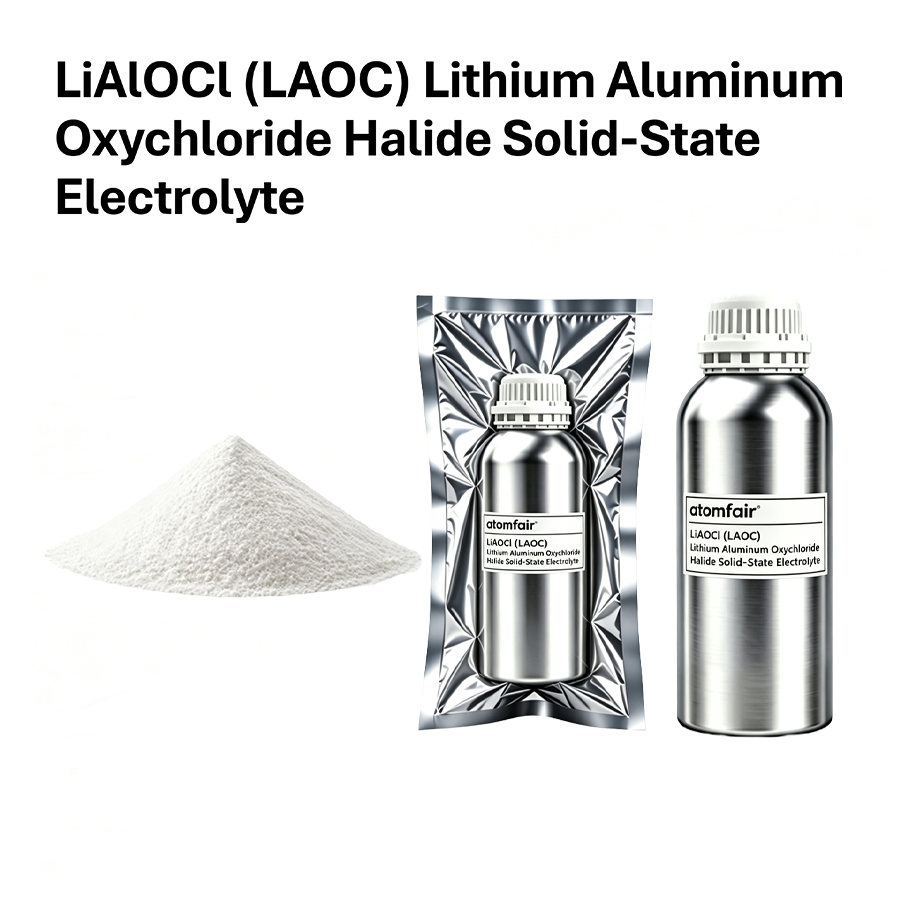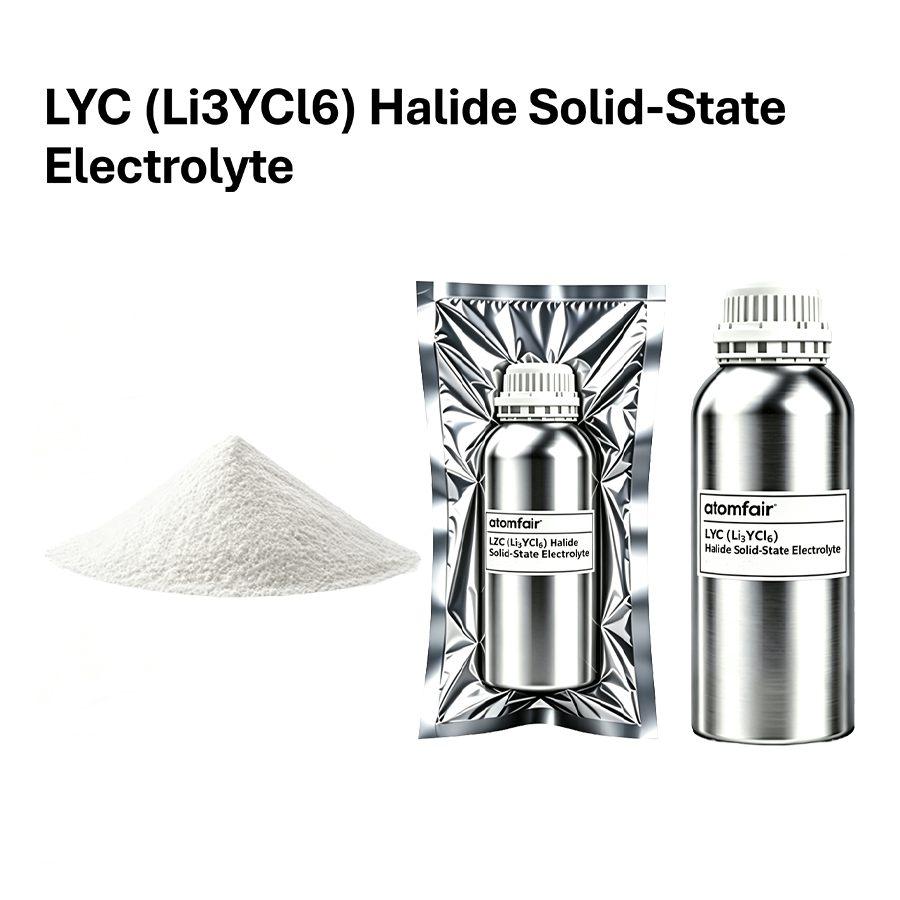
LYC (Li3YCl6) Halide Solid-State ElectrolyteHalide Solid-State Electrolytes
|
|||||||||||||||||||||
|
|||||||||||||||||||||
|
This material degrades rapidly upon exposure to ambient moisture. Storage and handling must occur under strictly dry inert atmosphere conditions.
- Moisture Sensitivity: The electrolyte is moisture-sensitive and must be handled in an environment with dew point below –40 °C.
- Inert Atmosphere Storage: Store the sealed bag in an argon or nitrogen glovebox to prevent moisture ingress.
- Dew Point Requirement: The handling environment must maintain a dew point below –40 °C to avoid degradation.
- Resealing Requirement: Reseal the moisture-barrier aluminum-laminated bag immediately after each opening.
Proper handling prevents moisture-induced degradation and ensures material performance. Follow these steps in a controlled dry environment.
Required Equipment: Argon or nitrogen glovebox, Personal protective equipment (gloves, mask, safety goggles)
- Store in Glovebox
Store the sealed moisture-barrier bag in an argon or nitrogen glovebox immediately upon receipt. - Verify Environment
Confirm the handling environment has a dew point below –40 °C before opening the bag. - Don PPE
Wear appropriate personal protective equipment including gloves, mask, and safety goggles. - Reseal Bag
Reseal the moisture-barrier bag promptly after removing the required amount of material.
How does the ionic conductivity of LYC (Li3YCl6) halide solid-state electrolyte compare to sulfide electrolytes and what are the practical implications for cell-level performance?
LYC delivers 0.3–0.4 mS/cm ionic conductivity at 28 °C, which is lower than the best sulfide electrolytes (e.g., LPSC or LGPS at ~1–10 mS/cm). However, LYC offers intrinsic stability against 4 V-class cathodes, eliminating the need for cathode interface coatings required by sulfide systems. In practice, this trade-off means LYC is best suited as a catholyte in sulfide-halide composite architectures, where the sulfide layer handles high conductivity on the anode side and LYC provides the cathode interface stability.
What cathode materials and electrolyte architectures are compatible with LYC in all-solid-state lithium batteries?
LYC is stable against 4 V-class cathodes such as LCO and NCM (Ni83), making it suitable as a catholyte without additional coating layers. It can be paired with sulfide separators like LPSC or LGPS in composite electrolyte architectures, enabling high-voltage pouch cell prototyping. The product description explicitly confirms compatibility with sulfide-halide composite designs and high-voltage cathode materials.
What are the required storage and handling conditions for LYC to prevent moisture degradation?
LYC is moisture-sensitive and must be stored sealed in an inert argon or nitrogen glovebox with dew point < –40 °C. The product is vacuum-sealed under inert atmosphere in moisture-barrier aluminum-laminated bags. After opening, the container must be resealed promptly, and all handling requires PPE (gloves, masks, safety goggles) to avoid exposure. These conditions are critical to maintain the halide electrolyte's ionic conductivity and structural integrity.
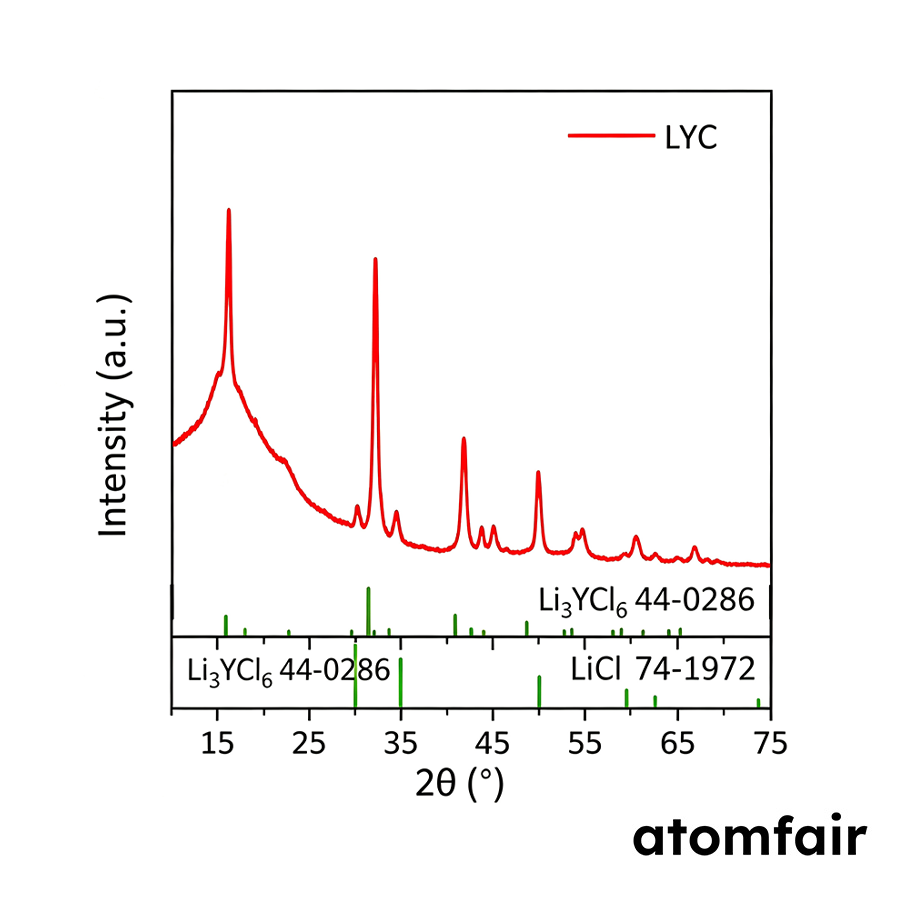
LYC (Li3YCl6) is a chloride-based halide solid-state electrolyte offering 0.3–0.4 mS/cm ionic conductivity and intrinsic stability against 4V-class cathodes, eliminating the need for cathode coatings. It is moisture-sensitive and requires glovebox handling.
Positive
- Intrinsic high-voltage stability: LYC is stable against 4V-class cathodes without requiring cathode interface coatings, a key advantage over sulfide electrolytes that need additional interfacial engineering.
- Well-characterized benchmark material: As the most extensively studied halide electrolyte in academic literature, LYC provides a reliable and reproducible benchmark for all-solid-state battery research.
Trade-offs
- Moisture-sensitive handling required: LYC must be handled in a dry environment with dew point below –40 °C and stored under inert atmosphere, necessitating glovebox use and careful resealing after opening.
- Moderate room-temperature conductivity: With ionic conductivity of 0.3–0.4 mS/cm at 28 °C, LYC may limit rate performance compared to higher-conductivity sulfide or oxide electrolytes in high-power applications.
Every advanced material, component, equipment, and instrument in our catalog is backed by rigorous testing. We maintain strict internal quality management frameworks and align with CE conformity metrics to deliver transparent, reproducible performance data via our public open-science repository.
To request raw batch performance data, submit formal vendor registration paperwork, or execute a fast-turnaround R&D manufacturing loop, contact us at inquiry@atomfair.com.
Item is dispatched under the Atomfair Shipping & Delivery Framework (Free worldwide shipping on orders over $59 USD excl. heavy equipment). Return is governed by the Atomfair Return & Refund Policy (7-day technical return window).