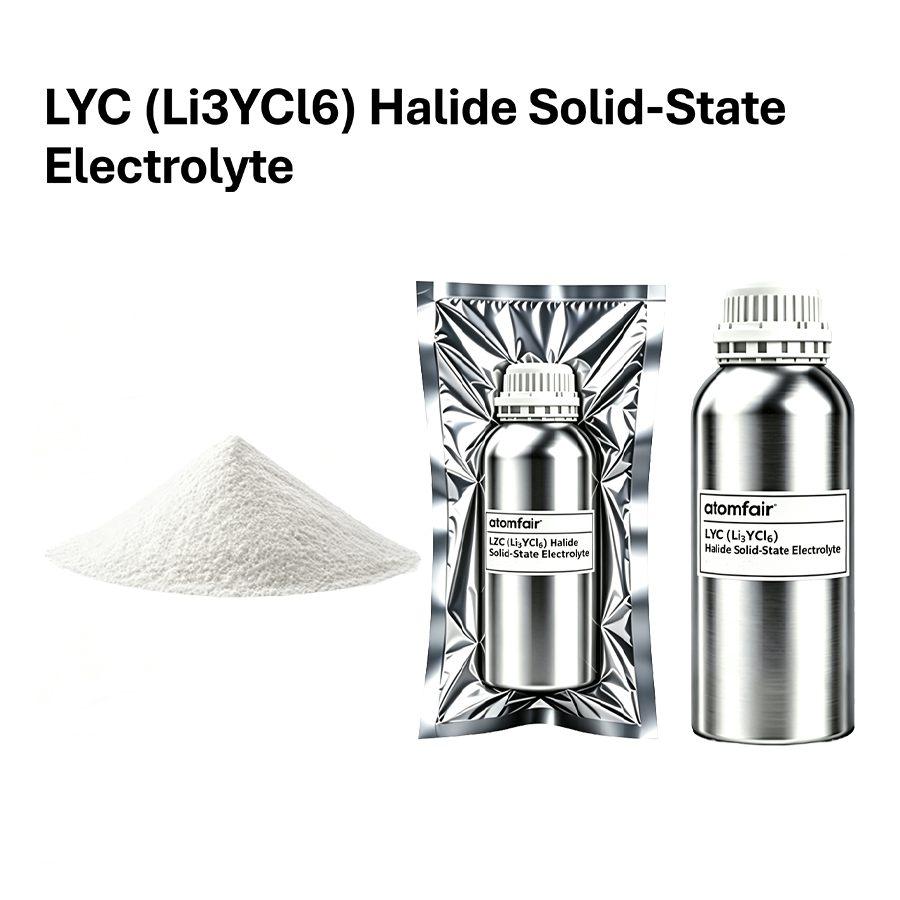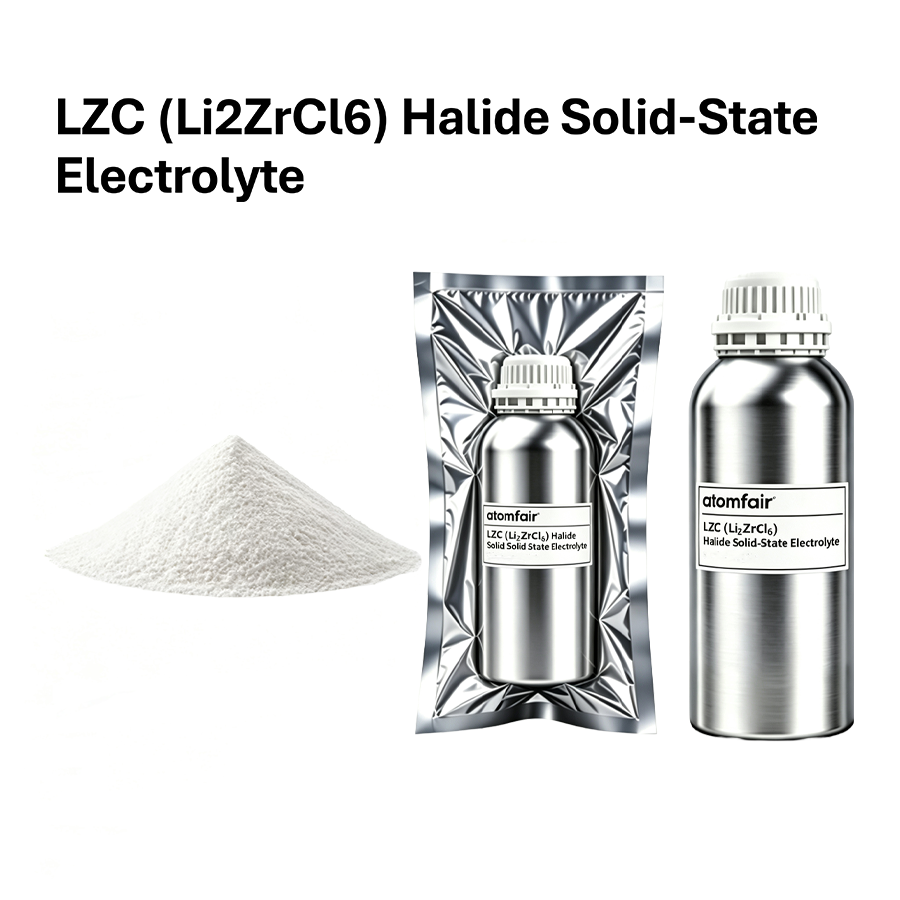
LZC (Li2ZrCl6) Halide Solid‑State ElectrolyteHalide Solid-State Electrolytes
|
|||||||||||||||||||||||
|
|||||||||||||||||||||||
|
LZC is moisture-sensitive and must be handled exclusively in a dry environment with dew point below -40°C. Store sealed in an inert atmosphere glovebox to prevent degradation from atmospheric moisture.
- Moisture Sensitivity: LZC degrades upon exposure to moisture, requiring handling in a dry environment with dew point below -40°C.
- Storage Conditions: Store the material sealed in an argon or nitrogen glovebox at all times.
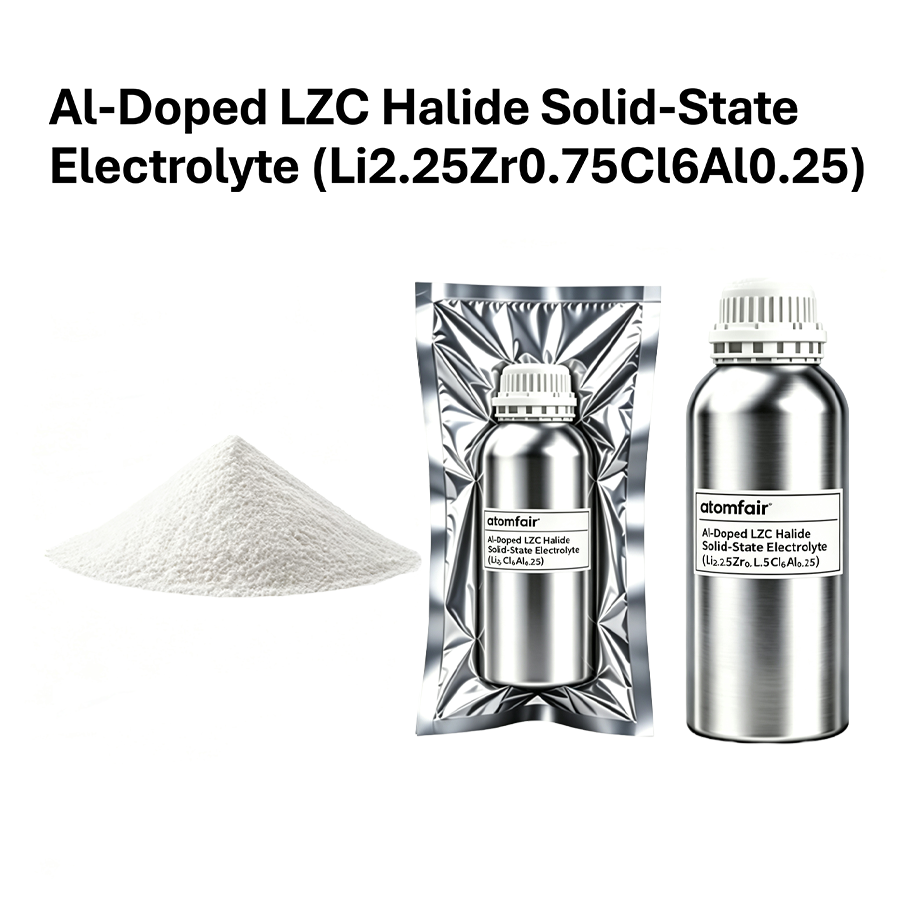
- Packaging Integrity: The product is vacuum-sealed in a moisture-barrier aluminum-laminated bag; do not open outside a dry atmosphere.
- Post-Opening Procedure: Reseal the bag promptly after removing the required amount of electrolyte to minimize moisture exposure.
Follow these steps to safely handle LZC without exposing it to moisture. All operations must be performed inside an inert atmosphere glovebox.
Required Equipment: Argon or nitrogen glovebox
- Verify glovebox atmosphere
Verify that the glovebox dew point is below -40°C before handling the electrolyte. - Transfer sealed bag into glovebox
Transfer the sealed moisture-barrier bag into the glovebox through the antechamber. - Open bag inside glovebox
Open the bag only inside the glovebox to prevent moisture exposure. - Reseal bag after use
Reseal the bag promptly after removing the desired amount of material.
What is the ionic conductivity of LZC (Li2ZrCl6) halide solid-state electrolyte at room temperature?
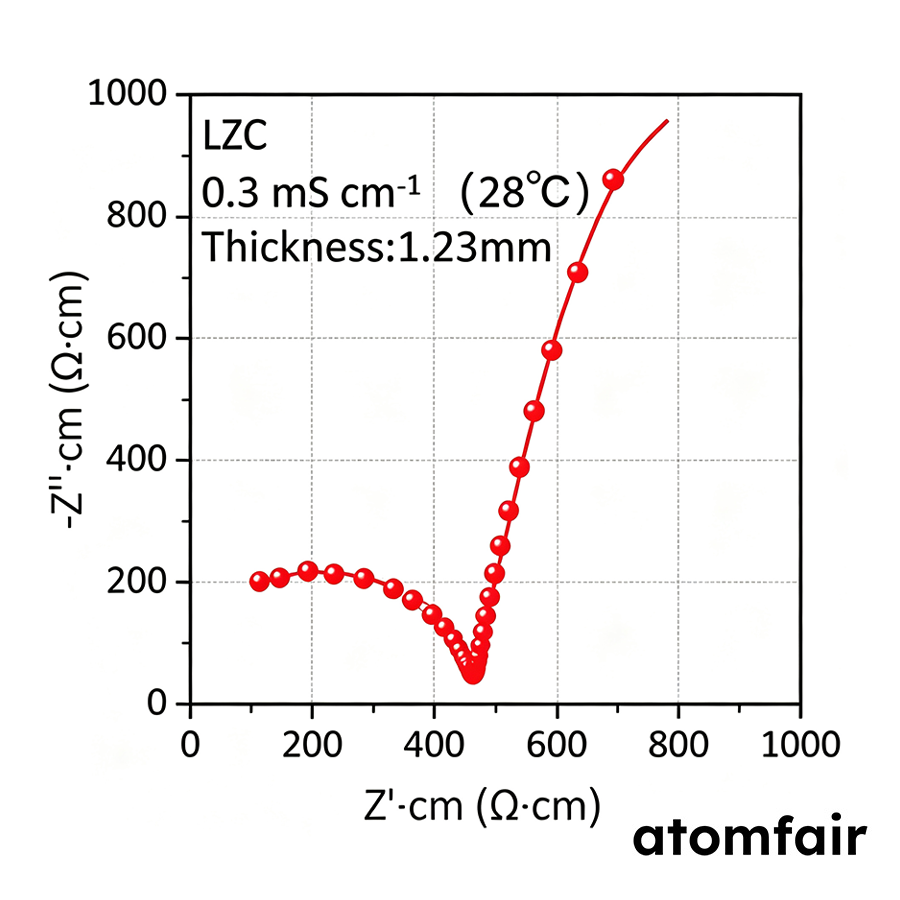
LZC exhibits an ionic conductivity of approximately 0.3 mS/cm at 28 °C, measured by EIS on a 1.23 mm pellet. This performance positions it as a low-cost alternative to yttrium-based halide electrolytes while maintaining competitive conductivity for all-solid-state battery applications.
Can LZC be used directly with high-voltage cathodes like NCM without a coating?
Yes, LZC offers intrinsic stability against 4 V-class cathodes such as LCO and NCM/Ni83, eliminating the need for cathode interface coatings required by sulfide electrolyte systems. This compatibility makes it suitable as a catholyte in all-solid-state lithium batteries and in sulfide-halide composite architectures.
What storage conditions are required for LZC halide electrolyte to prevent degradation?
LZC is moisture-sensitive and must be stored sealed in an inert atmosphere (Ar or N2 glovebox) with a dew point below –40 °C. The product is vacuum-sealed in moisture-barrier aluminum-laminated bags; after opening, reseal promptly to avoid exposure to ambient humidity.
The LZC (Li2ZrCl6) halide solid-state electrolyte offers intrinsic electrochemical stability against 4 V-class cathodes with a room-temperature ionic conductivity of 0.3 mS/cm, eliminating the need for cathode coatings required by sulfide systems, but demands strict moisture-free handling in inert atmosphere.
Positive
- Intrinsic cathode stability: LZC exhibits inherent electrochemical stability against 4 V-class cathodes such as LCO and NCM, eliminating the need for protective coating layers required by sulfide electrolytes.
- Zirconium-based cost-effective alternative: The Li2ZrCl6 composition replaces yttrium with more abundant zirconium, offering a lower-cost halide electrolyte system without sacrificing key performance metrics.
Trade-offs
- Strict moisture-free handling required: LZC is moisture-sensitive; storage and processing must be performed under inert atmosphere (Ar or N2 glovebox) with dew point below –40 °C to prevent degradation.
- Research use only safety protocols: The product is intended for research and industrial use only; proper PPE (gloves, mask, goggles) and SDS-referenced safety measures must be followed during handling.
Every advanced material, component, equipment, and instrument in our catalog is backed by rigorous testing. We maintain strict internal quality management frameworks and align with CE conformity metrics to deliver transparent, reproducible performance data via our public open-science repository.
To request raw batch performance data, submit formal vendor registration paperwork, or execute a fast-turnaround R&D manufacturing loop, contact us at inquiry@atomfair.com.
Item is dispatched under the Atomfair Shipping & Delivery Framework (Free worldwide shipping on orders over $59 USD excl. heavy equipment). Return is governed by the Atomfair Return & Refund Policy (7-day technical return window).