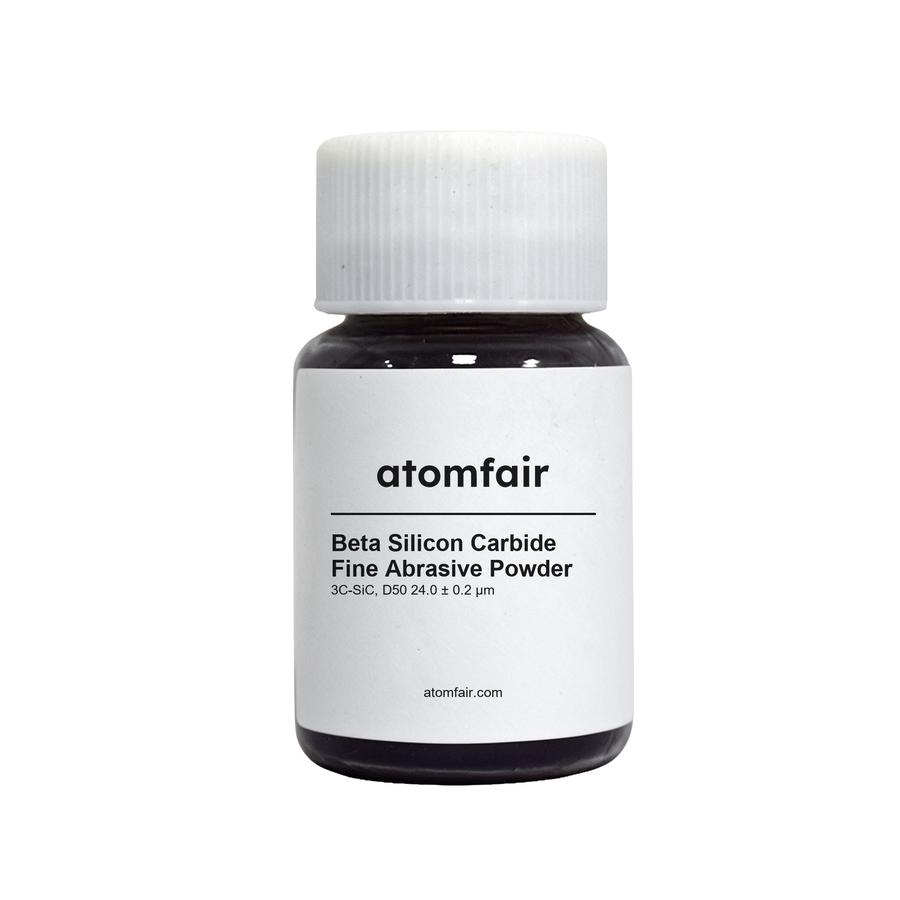
Atomfair Beta Silicon Carbide Fine Abrasive Powder (3C-SiC), D50 24.0 ± 0.2 μm
Product Description
Atomfair Beta Silicon Carbide Fine Abrasive Powder (3C-SiC) is supplied with a D50 24.0 ± 0.2 μm particle-size specification and high natural bulk density. It is intended for precision grinding, lapping, polishing, and abrasive-processing research.
|
Technical Specifications
|
||||||||||||||||||||||
|
Customization & Ordering
Custom particle-size and purity requirements may be evaluated for selected
grades upon request. Alternative package sizes may also be available.
Minimum order quantities, pricing, and lead times vary by specification and
will be confirmed during technical review and quotation.
Key Features and Advantages
- Defined D50 24.0 ± 0.2 μm particle-size grade.
- High natural bulk density and efficient abrasive-cutting behavior.
- Lower processed-surface roughness and improved surface-finish performance.
- Suitable for controlled grinding, lapping, and polishing evaluation.
APPLICATION SCOPE: precision grinding, lapping, polishing, and abrasive-processing research
DOCUMENTATION: COA and SDS can be provided upon request for batch-specific confirmation. Additional documentation requirements may be discussed before order confirmation.
LABORATORY PROCUREMENT SUPPORT
For grade selection, particle-size confirmation, documentation support or custom specification review, contact our technical sales team.
Store in a dry, sealed container to prevent moisture absorption and agglomeration. Avoid exposure to airborne contaminants that may alter particle-size distribution.
- Moisture Sensitivity: Moisture uptake can cause particle bridging and reduced abrasive performance.
- Contamination Risk: Cross-contamination with other grit sizes or materials degrades surface-finish consistency.
Prepare a slurry by dispersing the powder in a compatible carrier fluid for controlled material removal. Apply the slurry to a lapping plate and maintain consistent particle distribution throughout the process.
Required Equipment: Lapping plate or polishing pad, Carrier fluid (e.g., water, oil, or glycol), Mixing container and stirrer
- Prepare the slurry
Mix the powder with the carrier fluid at a recommended concentration of 5–15% by weight until a uniform suspension is achieved. - Apply slurry to lapping plate
Pour or spread the slurry evenly onto the lapping plate surface to ensure full coverage. - Load workpiece
Place the workpiece onto the lapping plate with controlled pressure to initiate material removal. - Monitor particle distribution
Replenish slurry periodically to maintain consistent abrasive concentration and prevent drying. - Clean workpiece after processing
Rinse the workpiece thoroughly with a compatible solvent to remove residual abrasive particles.
How do the tight particle size tolerances (D50 ±0.2 μm) of this beta silicon carbide powder affect its suitability for precision lapping research?
The D50 of 24.0±0.2 μm, combined with D10 15.0±0.2 μm, D90 35.0±0.25 μm, and D97 ≤49 μm, ensures a narrow particle size distribution. This reduces surface roughness variability and enables reproducible results in controlled lapping and polishing experiments, as supported by the product's specification for precision grinding and polishing research.
What is the role of the cubic beta-SiC crystal phase in the abrasive performance of this powder?
The product is supplied as cubic beta-SiC (3C-SiC), which is the crystal phase specified. The source indicates that this phase, combined with the defined particle size and high bulk density, delivers lower processed-surface roughness and improved surface-finish performance, making it suitable for precision grinding, lapping, and polishing evaluation.
What documentation is available to verify the quality and safety of this beta silicon carbide powder?
A Certificate of Analysis (COA) and Safety Data Sheet (SDS) can be provided upon request for batch-specific confirmation, as stated in the product description. This allows researchers to verify particle size distribution, chemical composition, and handling precautions before use.
This 3C-SiC beta-phase abrasive powder, with a tightly controlled D50 of 24.0 ± 0.2 μm and high tap density of 1.76 ± 0.05 g/cm³, is engineered for precision grinding, lapping, and polishing research where consistent particle size distribution and efficient cutting behavior are critical.
Positive
- Tight particle size distribution: The D50 is specified at 24.0 ± 0.2 μm with D10 at 15.0 ± 0.2 μm and D90 at 35.0 ± 0.25 μm, ensuring reproducible abrasive behavior for controlled material removal and surface finishing.
- High tap density for efficient cutting: A tap density of 1.76 ± 0.05 g/cm³ indicates high natural bulk density, which supports efficient abrasive-cutting action and contributes to lower processed-surface roughness in lapping and polishing applications.
Trade-offs
- Beta-phase content variability: The basic grain content is specified as 60%-80%, meaning the proportion of beta-SiC (3C) can vary within this range, which may affect consistency in abrasive performance across batches.
- Customization requires technical review: Custom particle-size or purity requirements are only evaluated upon request and are subject to minimum order quantities, pricing, and lead times that are confirmed during technical review, limiting immediate off-the-shelf availability.
Every advanced material, component, equipment, and instrument in our catalog is backed by rigorous testing. We maintain strict internal quality management frameworks and align with CE conformity metrics to deliver transparent, reproducible performance data via our public open-science repository.
To request raw batch performance data, submit formal vendor registration paperwork, or execute a fast-turnaround R&D manufacturing loop, contact us at inquiry@atomfair.com.
Item is dispatched under the Atomfair Shipping & Delivery Framework (Free worldwide shipping on orders over $59 USD excl. heavy equipment). Return is governed by the Atomfair Return & Refund Policy (7-day technical return window).