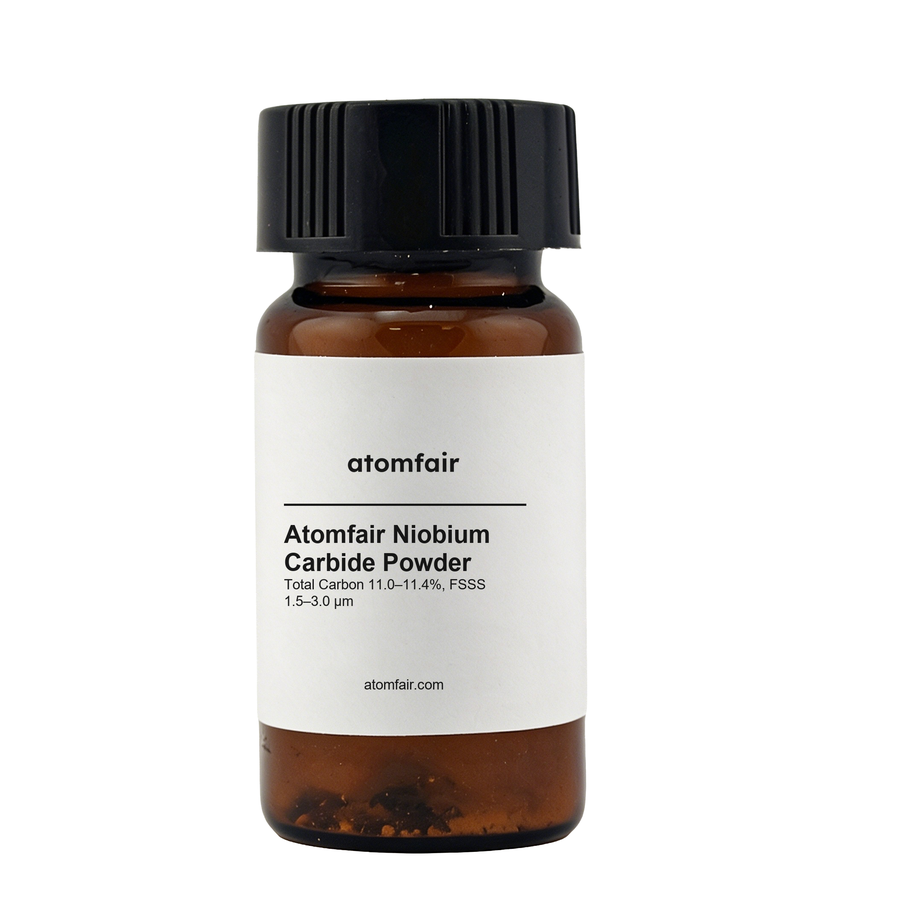
Atomfair Niobium Carbide (NbC) Powder, Total Carbon 11.0–11.4%, FSSS 1.5–3.0 μm
Product Description
Atomfair niobium carbide (NbC) powder is supplied as dark grey powder with total carbon 11.0–11.4%, free carbon ≤0.15%, nitrogen ≤0.20%, tantalum ≤0.30%, and FSSS 1.5–3.0 μm. It is intended for hard alloy additive research.
|
Technical Specifications
|
||||||||||||||||||||||||||
|
Customization & Ordering
Custom composition and particle-size requirements may be evaluated for selected grades upon request. Alternative package sizes may also be available. Minimum order quantities, pricing, and lead times vary by specification and will be confirmed during technical review and quotation.
Key Features and Advantages
- Defined composition and particle-size specification for hard alloy materials research.
- Source-defined chemical composition and impurity limits are listed for technical review.
- Powder format suitable for cermet or hard alloy additive research.
APPLICATION SCOPE: hard alloy additive research
DOCUMENTATION: COA and SDS can be provided upon request for batch-specific confirmation.
LABORATORY PROCUREMENT SUPPORT
For grade selection, particle-size confirmation, documentation support or custom specification review, contact our technical sales team.
Niobium carbide powder is a fine particulate material that may generate airborne dust during handling, requiring engineering controls to minimize inhalation exposure. The powder's specified impurity limits for oxygen, free carbon, and nitrogen indicate sensitivity to atmospheric contamination during storage and processing.
- Atmospheric Sensitivity: Store in a sealed container under inert atmosphere to prevent oxygen and moisture uptake that could alter the specified oxygen content.
- Dust Control: Use local exhaust ventilation or a glovebox when transferring powder to avoid inhalation of fine particles.
This procedure describes safe transfer and storage of niobium carbide powder for hard alloy additive research. The steps assume use of standard laboratory protective equipment and a controlled atmosphere environment.
Required Equipment: Inert-atmosphere glovebox or fume hood, Sealed container with inert gas purge, Powder weighing spatula
- Prepare workspace
Set up the inert-atmosphere glovebox or fume hood and verify that all surfaces are clean and dry. - Don personal protective equipment
Wear lab coat, safety glasses, and nitrile gloves before opening the powder container. - Open container under inert atmosphere
Transfer the sealed container into the glovebox or fume hood and open it only after the atmosphere is established. - Weigh required amount
Use a clean spatula to transfer the powder into a pre-weighed vessel, minimizing dust generation. - Reseal the original container
Close the original container immediately after use and purge with inert gas before storage. - Clean workspace
Wipe down all surfaces with a damp cloth to remove any residual powder and dispose of waste according to local regulations.
What is the significance of the total carbon content range (11.0–11.4%) and the low free carbon (≤0.15%) in NbC powder for hard alloy applications?
The total carbon content of 11.0–11.4% is specified to maintain stoichiometric NbC, which is essential for optimal hardness and wear resistance in hard alloys. The free carbon is limited to ≤0.15% to avoid unreacted carbon that can weaken the carbide matrix or affect sintering behavior. These tightly controlled carbon parameters directly influence the mechanical performance of the final cermet or hard alloy composite.
What are the typical application constraints for this NbC powder in hard alloy additive research?
This NbC powder is intended for hard alloy additive research, including cermet formulations. The specified impurity limits—tantalum ≤0.30%, tungsten ≤0.10%, oxygen ≤0.30%, and titanium ≤0.02%—are designed to minimize adverse interactions with binder metals and sintering atmospheres. Custom composition and particle-size options may be evaluated upon request, allowing adaptation to specific binder systems or processing conditions.
What safety and handling precautions are recommended for this fine NbC powder to maintain its specified purity?
The powder is a dark grey, fine material with an oxygen content ≤0.30%, indicating that exposure to air should be minimized to prevent surface oxidation. The manufacturer provides a Safety Data Sheet (SDS) upon request, and standard laboratory practices for fine metal carbide powders—such as inert atmosphere storage and dust control—are recommended to preserve the specified chemical composition and particle size distribution.
Atomfair NbC powder with total carbon 11.0–11.4% and FSSS 1.5–3.0 μm provides a defined composition for hard alloy additive research, with controlled impurities and particle size distribution suited for cermet and hard alloy applications.
Positive
- Controlled carbon stoichiometry and low free carbon: Total carbon 11.0–11.4% with free carbon ≤0.15% ensures phase consistency for hard alloy formulations.
- Defined particle size for additive research: FSSS 1.5–3.0 μm particle size distribution is suitable for cermet and hard alloy additive manufacturing studies.
Trade-offs
- Trace impurity constraints: Tantalum ≤0.30% and other trace elements set a baseline purity that may limit use in ultra-high-purity alloy research.
- Oxidation sensitivity of fine powder: Oxygen content ≤0.30% and fine 1.5–3.0 μm particles require inert atmosphere storage and handling to prevent further oxidation.
Every advanced material, component, equipment, and instrument in our catalog is backed by rigorous testing. We maintain strict internal quality management frameworks and align with CE conformity metrics to deliver transparent, reproducible performance data via our public open-science repository.
To request raw batch performance data, submit formal vendor registration paperwork, or execute a fast-turnaround R&D manufacturing loop, contact us at inquiry@atomfair.com.
Item is dispatched under the Atomfair Shipping & Delivery Framework (Free worldwide shipping on orders over $59 USD excl. heavy equipment). Return is governed by the Atomfair Return & Refund Policy (7-day technical return window).